

Likely, Possible, Unclear: The Language a Careful Reader Uses
Are psychic readings accurate? Not in the sense of reliably predicting events: controlled tests have not shown that readers know hidden facts or the future. A careful reader says so, using words like likely, possible and unclear, and treats each impression as something for you to weigh against facts, not an answer to obey.
Key takeaways
- Psychic readings are not accurate in the sense most people mean: no reader has been shown, under controlled conditions, to know hidden facts or future events reliably.
- Because the alternative is guessing, and guessing in a reading is easy to dress up.
- The post on whether tarot can predict the future looks at this from the cards' side, and five cold-reading tactics shows what careless certainty can sound like.
- Love psychics are no more accurate than any other reader, and love questions are where false certainty does the most harm.
- The arithmetic is exact; the meaning is traditional.
Halfway through a session, a careful reader may pause and say, "This part is unclear. I'm not going to guess." Some clients find that disappointing. They expected certainty. But that sentence is one of the most honest things a reader can say, and the vocabulary around it, likely, possible, unclear, is worth understanding before you book anyone.
Are psychic readings accurate?
Psychic readings are not accurate in the sense most people mean: no reader has been shown, under controlled conditions, to know hidden facts or future events reliably. Astrology has been tested too. In a well-known double-blind study published in Nature in 1985, astrologers tried to match birth charts to personality profiles and did no better than chance.
Why, then, do so many readings feel accurate? Two well-studied effects explain much of it. The Barnum effect makes general statements feel personal. Confirmation bias makes us remember the hits and forget the misses. A reading can feel uncannily right without containing any special knowledge.
None of this means readings are useless. It means their value lies somewhere other than prediction: in reflection, in a structured conversation, in a traditional lens that helps you see a question differently. That is how this practice presents them.
The words a careful reader uses
| When you hear | It means | What to do with it |
|---|---|---|
| "Likely" | The cards or chart point fairly clearly in one direction, by the rules of the tradition | Treat it as a theme worth testing against facts |
| "Possible" | One of several readings; the reader leans slightly one way | Keep it in mind, but do not plan around it |
| "Unclear" | The reader cannot honestly say | Rely on your own judgment and practical information |
| "A tendency, not an event" | A pattern in temperament or timing, not something booked to happen | Notice it in your behavior; you can work with it |
| "I don't see that" | Nothing in the reading supports what you asked about | Not a no, just no information |
Why say "unclear" out loud?
Because the alternative is guessing, and guessing in a reading is easy to dress up. A reader who never says "unclear" is either extraordinarily gifted or filling silence. Given what testing shows, the second is far more likely. Saying it out loud protects you from building a decision on a guess, and it keeps the reader honest with themselves.
It also changes the conversation. When a reader says a part is unclear, the session can turn to what you already know, what you could find out, and who could help. That is often more useful than a confident answer.
What this means for your decisions
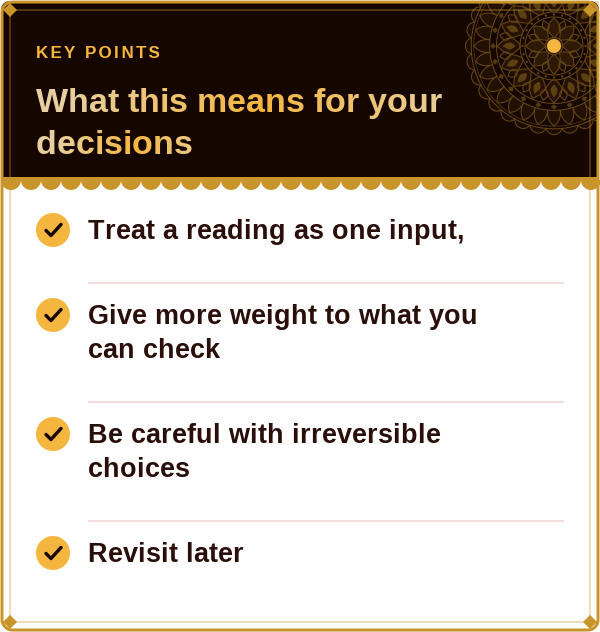
- Treat a reading as one input, next to facts, advice from people who know you and professional guidance.
- Give more weight to what you can check. If a reading suggests friction at work, look at what is actually happening there.
- Be careful with irreversible choices. Quitting, moving, ending a relationship or spending savings deserve more than a reading.
- Revisit later. Notes reread a month on show which parts were useful and which were not.
The post on whether tarot can predict the future looks at this from the cards' side, and five cold-reading tactics shows what careless certainty can sound like.
Are love psychics accurate?
Love psychics are no more accurate than any other reader, and love questions are where false certainty does the most harm. No reader can see into another person's heart or tell you whether someone will return. A careful love reading focuses on you: your patterns, your hopes, what you want to do next. Any reader who says "he will come back in three months" is guessing.
How accurate is a numerology reading?
The arithmetic is exact; the meaning is traditional. Your root and destiny numbers are calculated precisely from your date of birth, and a name number from the letters of your name. What those numbers mean comes from a symbolic system, not from measurement. A numerology reading is best treated the same way as any other reading: a prompt for reflection, offered with the same likely, possible and unclear.
The same language across every method
This vocabulary applies to every tool the practice uses. In a face reading, a feature suggests a tendency, never a fixed trait or a verdict about character. In chart work, a period favors certain themes without guaranteeing any of them. The post on checking intuitive impressions against the chart explains how two methods can keep each other honest. Sessions with Astrologer and Psychic Vijayram are held by phone, WhatsApp or video.
What no reader can promise
No reading can offer certainty about the future, another person's feelings or the outcome of a decision. It can offer careful language, honest uncertainty and a space to think, and that is what a responsible reader aims to give.
Common questions
What is a numerology reading?
A numerology reading works out numbers from your date of birth and name and interprets them through a traditional system linking each number with qualities and, in Indian numerology, with a planet. It is a symbolic way to reflect on temperament and timing, not a measurement.
How do I do a numerology reading myself?
Add the digits of your day of birth and reduce them to one digit for your root number, then do the same with your full date of birth for your destiny number. Then read what tradition links with each. A reader adds context, such as how the numbers sit with your name and chart.
Why did my reading feel so accurate?
Often because of how minds work. We rate general statements as personal, and we remember hits and forget misses. That does not mean the reading was worthless; it may still have helped you think. It does mean accuracy is hard to judge from feeling alone.
Should I make a big decision based on a reading?
Not on a reading alone. Use it as one input beside facts, advice from people who know your situation and, where needed, professionals. Be especially wary of anything irreversible.
Related service

Keep reading

Breaks, Islands and Forks: Reading Changes Along the Major Palm Lines
Palm lines meaning for the markings palmists notice: breaks, islands, forks, crosses and squares on the heart, head, life and fate lines, read in context.
Read article →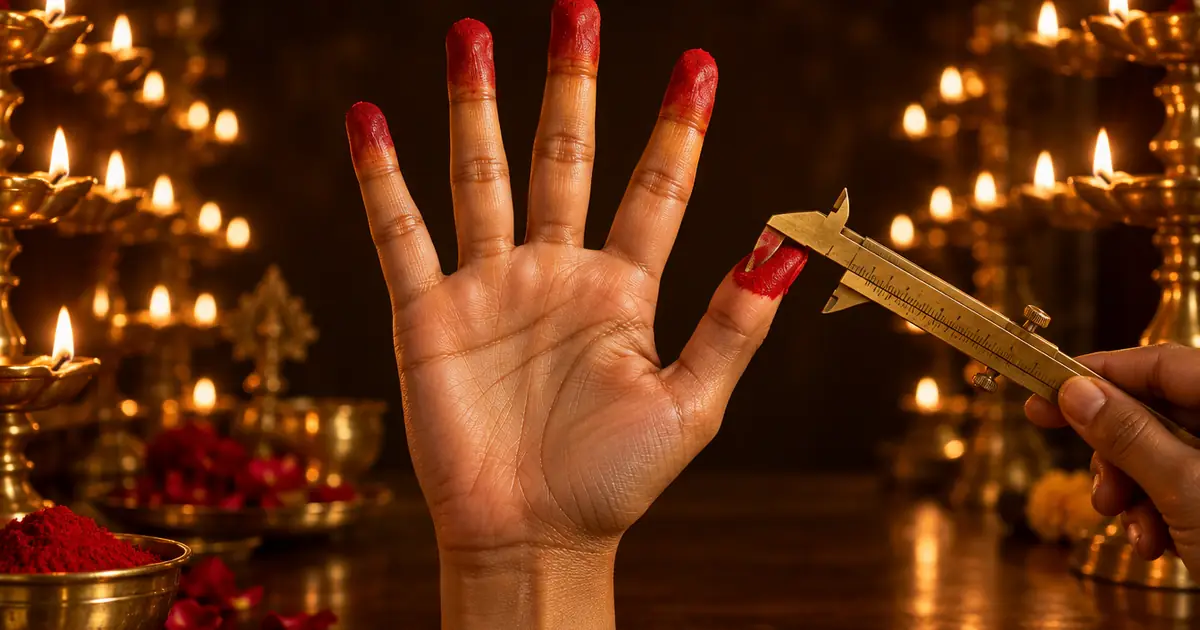
Thumbs and Fingers in Indian Palmistry: Length and Phalanges
Fingers in palmistry, the Indian way: how hasta samudrika reads the thumb, finger lengths, the three phalanges and flexibility, and how they fit with the lines.
Read article →
Mount of Venus, Mount of Saturn: Palm Mounts Beside the Vedic Chart
Mounts of the palm meaning in Indian palmistry: Venus, Jupiter, Saturn and more, compared with the same planets in your kundli, and what to do if they differ.
Read article →Quick answers
Is the price agreed before a reading begins?
Yes. For a psychic reading in Fort Worth, the fee and session length are agreed in writing before the reading begins, with nothing added during the call.
Read answer →Can I bring a friend to my first psychic reading?
Yes, a friend can join your first psychic reading in Fort Worth, sitting beside you at home or on the video call, with your consent and a few privacy points.
Read answer →Talk to Astrologer and Psychic Vijayram
Tell us what you are facing. If a reading is unlikely to help, you will be told that plainly.