
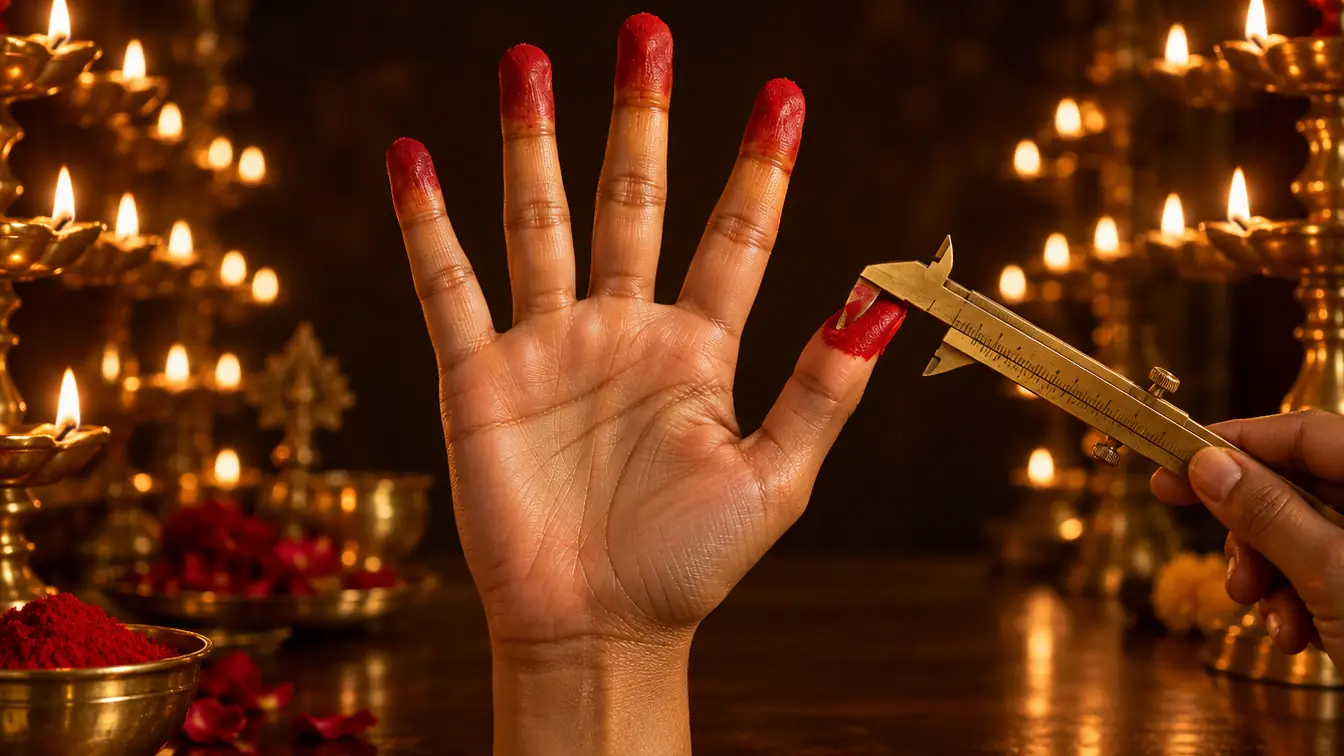
Thumbs and Fingers in Indian Palmistry: Length and Phalanges
In Indian palmistry, fingers are read for temperament before any line is touched. The thumb shows will and reasoning, each finger is linked with a planet, relative lengths suggest where confidence lies, and the three sections of each finger, the phalanges, show whether thought, practical sense or comfort leads. Flexibility adds a note on adaptability.
Key takeaways
- Indian palmistry gives the thumb (angushtha) a special place.
- The same planets name the mounts beneath each finger, which the post on palm mounts beside the Vedic chart explains.
- Finger length meaning in the palm is about proportion, not absolute size.
- Every finger has three sections, called phalanges.
- A sloping head line on a hand with long, smooth, pointed fingers reads as imagination; the same line on a square hand with knotty fingers reads as imagination kept in check by analysis.
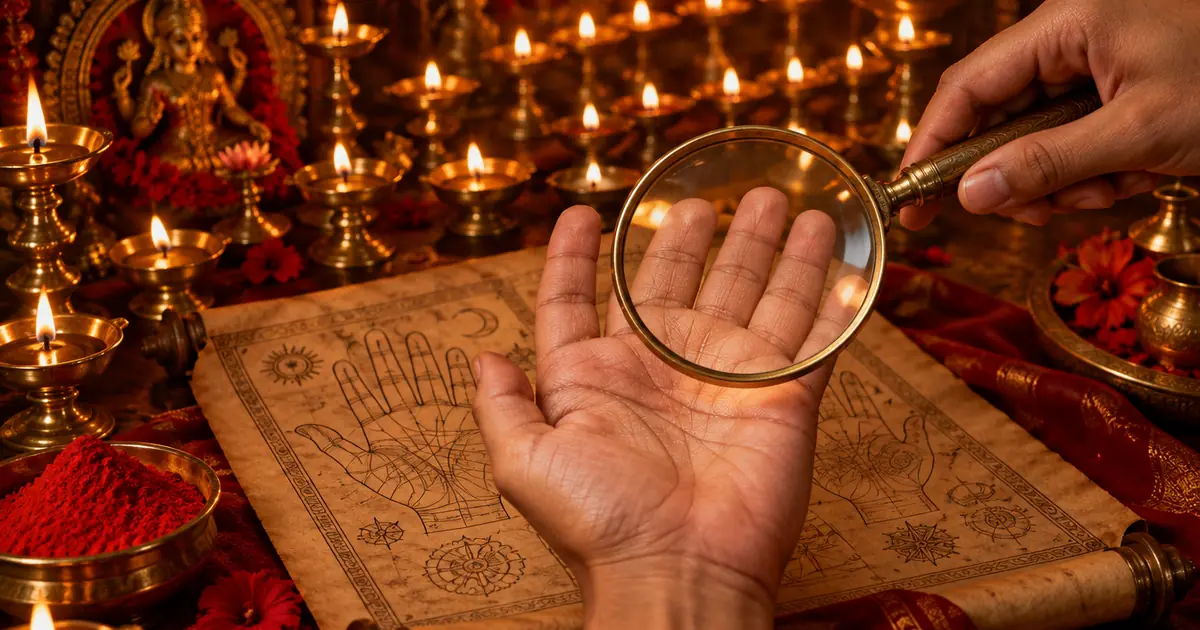
Ask someone to show you their palm and they hold it flat and point at the lines. An Indian palmist will often start somewhere else: with the thumb, then the length and shape of the fingers, before looking at a single crease. In hasta samudrika, the hand-reading branch of samudrika shastra, the fingers set the frame that every line is read within. This post explains how fingers in palmistry are read, from the thumb outward.
The thumb comes first
Indian palmistry gives the thumb (angushtha) a special place. Indian methods reached English readers through books such as Mrs. J. B. Dale's 1895 Indian Palmistry, and many Indian readers today still begin a session with the thumb. In thumb palmistry, three features matter most.
The thumb's sections
- The top section, with the nail, is read for willpower and determination.
- The middle section is read for reasoning and judgment.
- The base, which merges into the fleshy Mount of Venus, is read for warmth, energy and attachment.
When the top and middle sections are roughly equal, tradition reads a balance between deciding and thinking. A long top section suggests someone who acts on will; a long middle section suggests someone who weighs things carefully first. Indian tradition also notices a barley-grain-shaped mark (yava) at the middle joint of the thumb, which is traditionally considered auspicious.
The thumb's angle and set
Hold your hand out naturally. A thumb that opens wide from the hand is read as openness and generosity; one held close as reserve and caution. A thumb set low on the hand is often linked with independence, a high-set thumb with a more careful temperament.
Flexibility
Press the tip gently backward. A thumb that bends back easily is read as adaptability and an easygoing nature; a firm, stiff thumb as determination and steadiness. Neither is better. Two firm thumbs in a marriage, readers like to say, make for interesting conversations.
Each finger and its planet
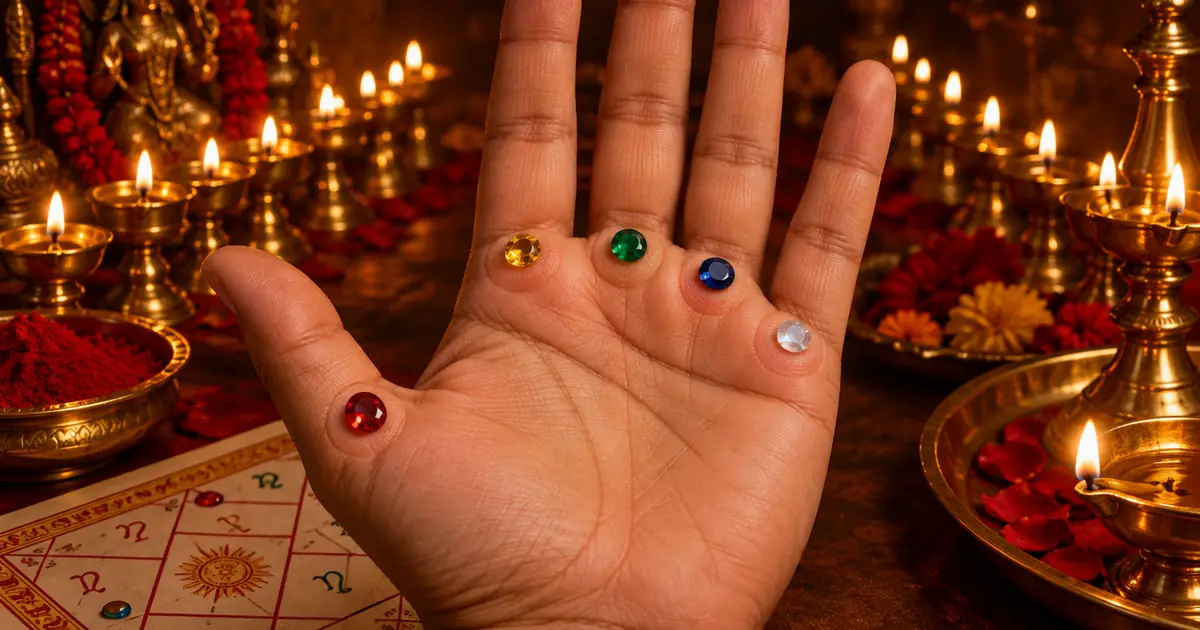
| Finger | Planet in Indian tradition | Qualities linked with it |
|---|---|---|
| Index | Jupiter (Guru) | Ambition, confidence, leadership, teaching |
| Middle | Saturn (Shani) | Responsibility, seriousness, discipline |
| Ring | Sun (Surya) | Creativity, self-expression, recognition |
| Little | Mercury (Budha) | Communication, trade, quick thinking |
The same planets name the mounts beneath each finger, which the post on palm mounts beside the Vedic chart explains.
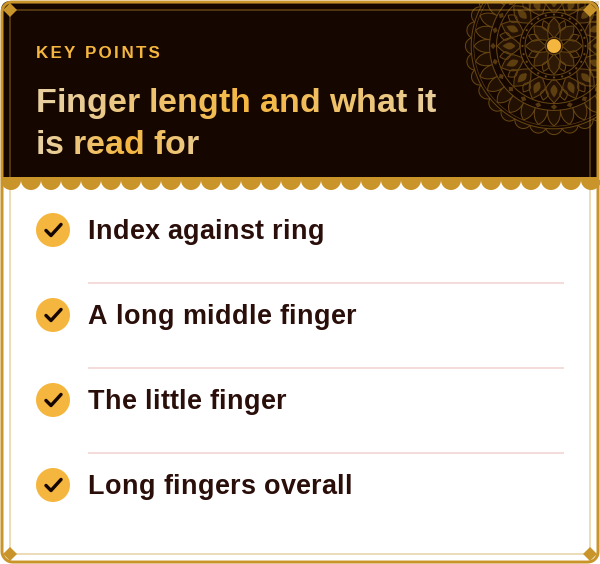
Finger length and what it is read for
Finger length meaning in the palm is about proportion, not absolute size. Readers compare fingers with each other and with the palm.
- Index against ring. A longer index is read as confidence and a wish to lead; a longer ring finger as creativity and appetite for risk; equal lengths as balance.
- A long middle finger, standing well above its neighbors, is read as a serious, responsible nature. A short one may suggest someone who dislikes rules.
- The little finger reaching past the top joint of the ring finger is read as a gift for words and persuasion.
- Long fingers overall on a shorter palm suggest patience with detail; short fingers suggest quick, big-picture thinking.
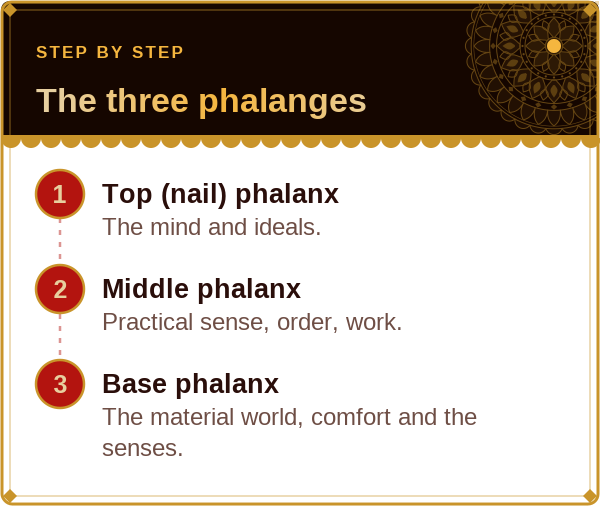
The three phalanges
Every finger has three sections, called phalanges. Tradition reads them as three worlds:
- Top (nail) phalanx: the mind and ideals.
- Middle phalanx: practical sense, order, work.
- Base phalanx: the material world, comfort and the senses.
A reader looks at which section is longest or fullest on each finger. A long top phalanx on the index finger might suggest ambition driven by ideals; a full base phalanx on the same finger, ambition tied to comfort and status. Across the whole hand, the pattern shows where a person's attention naturally rests.
Knots, tips and gaps
- Knotty joints are read as an analytical, questioning mind; smooth fingers as intuition and speed.
- Fingertips may be square (practical), rounded (adaptable), spatulate (active, inventive) or pointed (sensitive, idealistic).
- Gaps between relaxed fingers matter too. A wide gap between thumb and index finger is read as independence of thought.
How fingers sit beside the lines
Fingers give context. A sloping head line on a hand with long, smooth, pointed fingers reads as imagination; the same line on a square hand with knotty fingers reads as imagination kept in check by analysis. The post on breaks, islands and forks along the major palm lines covers the lines in detail. Readers trained in samudrika often add a short look at the face too; the post on face reading in the Indian tradition and the face reading service explain that companion practice.
Having your fingers read
A palm reading with Astrologer and Psychic Vijayram begins with the thumb and fingers, from photos and a short live video call held by phone, WhatsApp or video. You will be asked to flex your thumb and spread your fingers on camera, which shows things a still photo cannot.
What fingers cannot tell you
Finger shape and length cannot predict events, wealth or health, and they say nothing fixed about who you are. Changes such as swollen joints, color changes or rounded, clubbed fingertips are reasons to see a doctor, not a palmist. Palmistry offers a traditional portrait of temperament for reflection, and no more than that.
Common questions
Which finger is most important in Indian palmistry?
The thumb. Many Indian palmists consider it the key to the whole hand, and some say a careful reading of the thumb alone tells a great deal about will and reasoning. The four fingers are then read in relation to it.
My ring finger is longer than my index finger. What does that mean?
Palmists traditionally read a longer ring finger as a creative, risk-taking streak and a longer index finger as confidence and a wish to lead. It is one trait among many, read as a tendency, not a verdict.
My fingers have become stiff. Does that change my reading?
Stiffness from arthritis, injury or age is a physical matter, not a change in character, and a careful reader will not read it as one. If joints are painful or swollen, see a doctor.
Can fingers be read from photos?
Yes, with a few extra shots: the hand held up naturally with fingers relaxed, a side view, and the thumb bent back gently. A short video call lets the reader see flexibility in motion.
Related service
Keep reading
Mount of Venus, Mount of Saturn: Palm Mounts Beside the Vedic Chart
Mounts of the palm meaning in Indian palmistry: Venus, Jupiter, Saturn and more, compared with the same planets in your kundli, and what to do if they differ.
Read article →
Moolank and Bhagyank: Indian Numerology's Two Core Numbers
Your numerology birth number in the Indian system: how moolank and bhagyank are worked out, what each is read for, and how both relate to the name number.
Read article →
Gut Feeling or Worry Loop? A Journal Test Before You Book
Intuition vs anxiety: a two-week journal test to tell a calm gut feeling from a worry loop, and the signs that a doctor or counselor is the better next step.
Read article →Quick answers
Do you read children's palms?
Yes, children's palms are read in Fort Worth, gently and with a parent present on video, looking at temperament and strengths, never at predictions.
Read answer →Is the price agreed before a reading begins?
Yes. For a psychic reading in Fort Worth, the fee and session length are agreed in writing before the reading begins, with nothing added during the call.
Read answer →Talk to Astrologer and Psychic Vijayram
Tell us what you are facing. If a reading is unlikely to help, you will be told that plainly.