
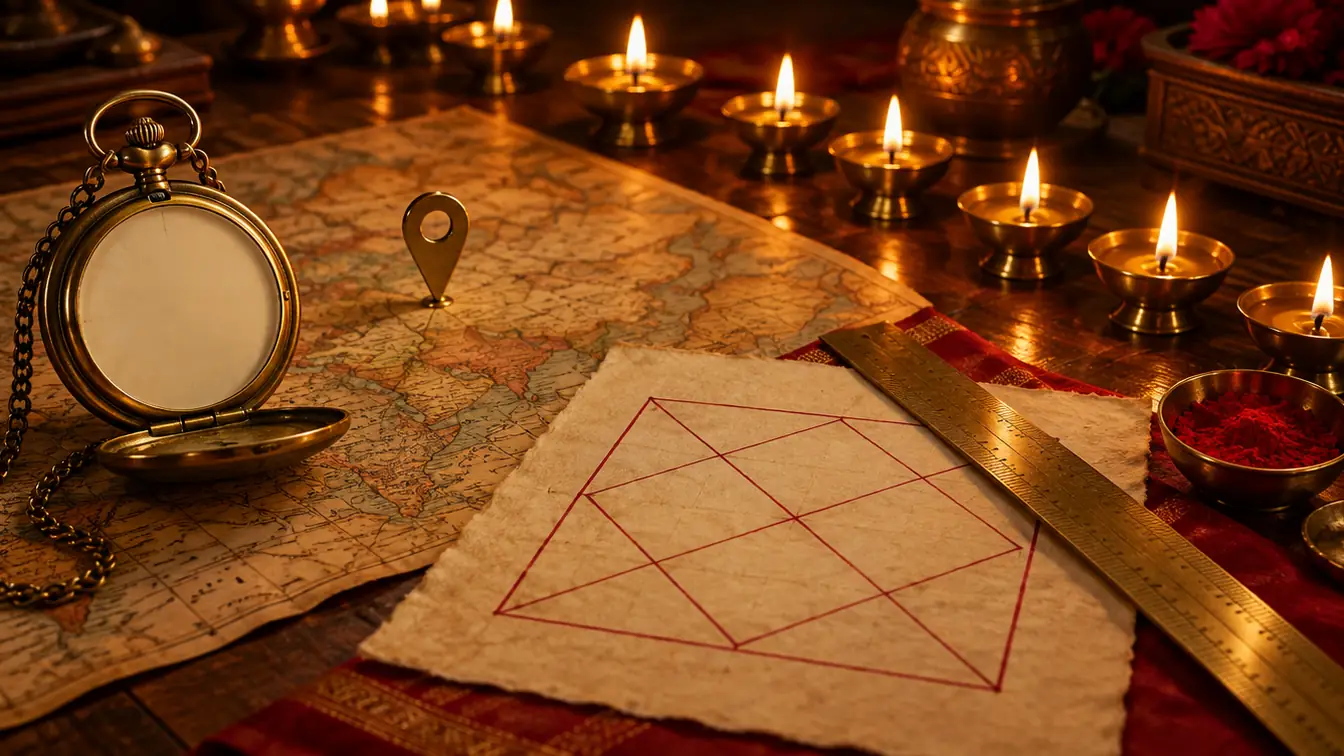
Why the Clock and Place of Your Call Matter in a Prashna Reading
A prashna reading is cast for the moment a question is understood and the place where the person asking is. Because the rising sign changes roughly every two hours and depends on location, the same question asked at the same moment from Keller and from Mumbai produces two different charts, and so two different readings.
Key takeaways
- A birth chart is fixed at the moment you were born.
- The rising sign, or lagna, is the anchor of a prashna chart: it stands for the person asking.
- At 8 p.m. on a Tuesday in Keller, during daylight time, it is 6:30 a.m. on Wednesday in Mumbai.
- Traditions differ when the person asking and the astrologer are apart.
- The time is converted to Universal Time before any chart is cast.
Two sisters are on the same video call. One sits at her kitchen table in Keller; the other is in Mumbai, where it is already the next morning. Both want to ask about their mother's planned move. If each asked a prashna reading the same question at the same second, the astrologer would cast two different charts. That surprises people, but it is the heart of the method. This post explains why the clock and the place of your call matter in prashna, how time zones and daylight saving are handled, and which questions suit a chart of the moment.
A chart that belongs to the moment
A birth chart is fixed at the moment you were born. A prashna chart is fixed at the moment a sincere question is understood. The tradition holds that the sky at that moment reflects the matter being asked about. Its classic Indian text is the seventeenth-century Prasna Marga from Kerala, described in the overview of the Prasna Marga. The full method, from framing the question to reading the houses, is set out on the prashna reading service page; this post looks only at the two inputs people underestimate: time and place.
What the clock changes
The rising sign, or lagna, is the anchor of a prashna chart: it stands for the person asking. Because the Earth turns, all twelve signs rise over the eastern horizon in about a day, so each holds the ascendant for roughly two hours, some longer and some shorter depending on the sign and the latitude. Ask at 7:55 p.m. and you may get one rising sign; ask at 8:05 p.m. and you may get the next. Every house moves with it, so the house that stands for your question may change sign and lord.
The Moon matters too. It moves about half a degree an hour and shows the flow of events in a prashna. A few hours can carry it into a different nakshatra.
What the place changes
Take that video call. At 8 p.m. on a Tuesday in Keller, during daylight time, it is 6:30 a.m. on Wednesday in Mumbai. In Keller the Sun is near the western horizon, setting or just set depending on the season, so in a chart cast there it sits close to the seventh house. In Mumbai it is around sunrise, so the Sun sits on or near the ascendant. The same planets, at the same moment, land in completely different houses. Latitude adds a further difference: Fort Worth and Mumbai are nearly fourteen degrees of latitude apart, so the signs rise at different speeds and the house sizes differ.
This is why a careful reader asks where you are at the start of the call, and why a remote session needs that answer to be honest. A question from a hotel room in Houston gets a Houston chart.
Whose location counts?
Traditions differ when the person asking and the astrologer are apart. Classical horary often used the place where the astrologer received the question. Many readers working by phone today use the place where the person asking is, since the question arises in their life and their sky. A good reader tells you which convention is being used and applies it consistently. For a client in Tarrant County, the two locations are often the same anyway.
Time zones and daylight saving
The time is converted to Universal Time before any chart is cast. Fort Worth is six hours behind UTC in standard time and five in daylight time; Indian Standard Time is five and a half hours ahead of UTC all year, with no daylight saving, as the overview of Indian Standard Time notes. So the gap between Keller and Mumbai is eleven and a half hours in winter and ten and a half in summer. Software handles this with the IANA time zone database, the standard record of every region's offsets and clock changes. Errors usually come from people, not software: a time noted from a phone set to the wrong zone, or a question sent by text and read hours later. For the same issue in birth charts, see daylight saving time and Texas birth charts.
Questions that suit a chart of the moment
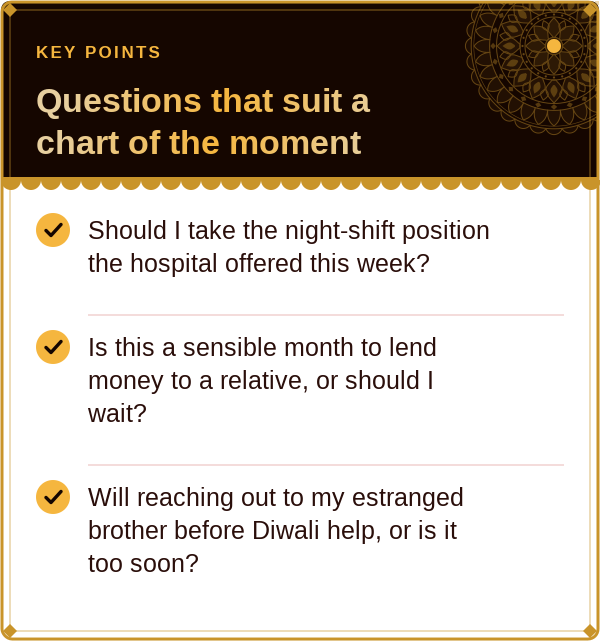
Prashna works best for one focused, time-bound question about your own situation, asked sincerely and not already decided. For example:
- Should I take the night-shift position the hospital offered this week?
- Is this a sensible month to lend money to a relative, or should I wait?
- Will reaching out to my estranged brother before Diwali help, or is it too soon?
Questions about death, the outcome of a court case, a medical diagnosis, or another person's private intentions are declined. So are questions asked as a test.
Asking by phone, video or WhatsApp
All three work. On a call, the reader notes the time your question becomes clear. By WhatsApp text, the chart is usually cast for when the reader reads and understands your message, so say where you are when you send it. The short answer on messaging an astrologer on WhatsApp before booking covers what to send first.
What prashna cannot do
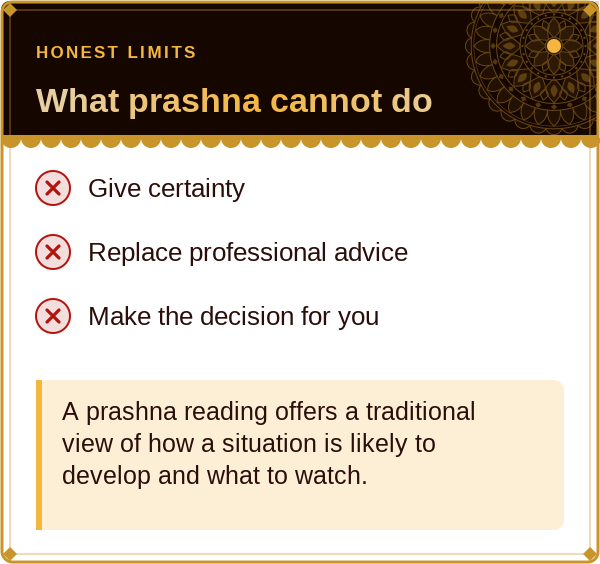
A prashna reading offers a traditional view of how a situation is likely to develop and what to watch. It cannot give certainty, replace professional advice or make the decision for you. If you have a reliable birth time and want the wider picture, a kundli and birth chart reading is often the better start, and the post on Vedic or Western astrology explains how prashna differs from Western horary. Astrologer and Psychic Vijayram offers prashna by phone, WhatsApp or video for clients in Fort Worth and beyond.
Common questions
Does it matter if I call from my car or my office?
Only if you are in a different town. Within Fort Worth, a few miles make almost no difference to the chart. A call from Houston or from India would, which is why the reader asks where you are.
Can I send my prashna question by WhatsApp text?
Yes. The chart is usually cast for when the reader reads and understands your message, at your stated location. Write the question in one clear sentence and say where you are when you send it.
Why can't I ask the same question twice?
Tradition holds that only the first sincere asking is read. A second asking at a different time gives a different chart, and comparing charts until one gives the answer you want turns a reading into a lottery.
Is prashna the same as Western horary astrology?
They share the same idea, a chart for the moment of a question, but use different zodiacs and rules. Prashna uses the sidereal zodiac and Indian techniques; Western horary uses the tropical zodiac and the rules of authors such as William Lilly.
Related service
Keep reading
Hindu Festival Dates for 2027, Worked Out for Tarrant County
Hindu festivals 2027 for Texas families, worked out for Fort Worth in Central Time, month by month, with the nine dates that fall a day before India's.
Read article →
Chhath Puja in Tarrant County: Sunset and Sunrise Arghya Timing
Chhath Puja time in Texas for 2027, worked out for Fort Worth: sunset and sunrise arghya in Central Time, water safety, and gentle limits on the fast.
Read article →
Lab-Grown or Natural? Gemstone Certificates for Fort Worth Buyers
How to read an astrology gemstone certificate: natural or lab-grown, treatments, what US rules require sellers to disclose, and why the chart comes first.
Read article →Quick answers
Must I stop reading Western horoscopes to see a Vedic astrologer?
No, you do not need to stop reading your Western horoscope to see a Vedic astrologer in Fort Worth. How the two zodiacs differ and why your sign may shift.
Read answer →Do I need my birth certificate for a Vedic reading?
You do not need your birth certificate for a Vedic reading in Fort Worth: date, time and place of birth matter, and a certificate simply confirms the time.
Read answer →Talk to Astrologer and Psychic Vijayram
Tell us what you are facing. If a reading is unlikely to help, you will be told that plainly.