
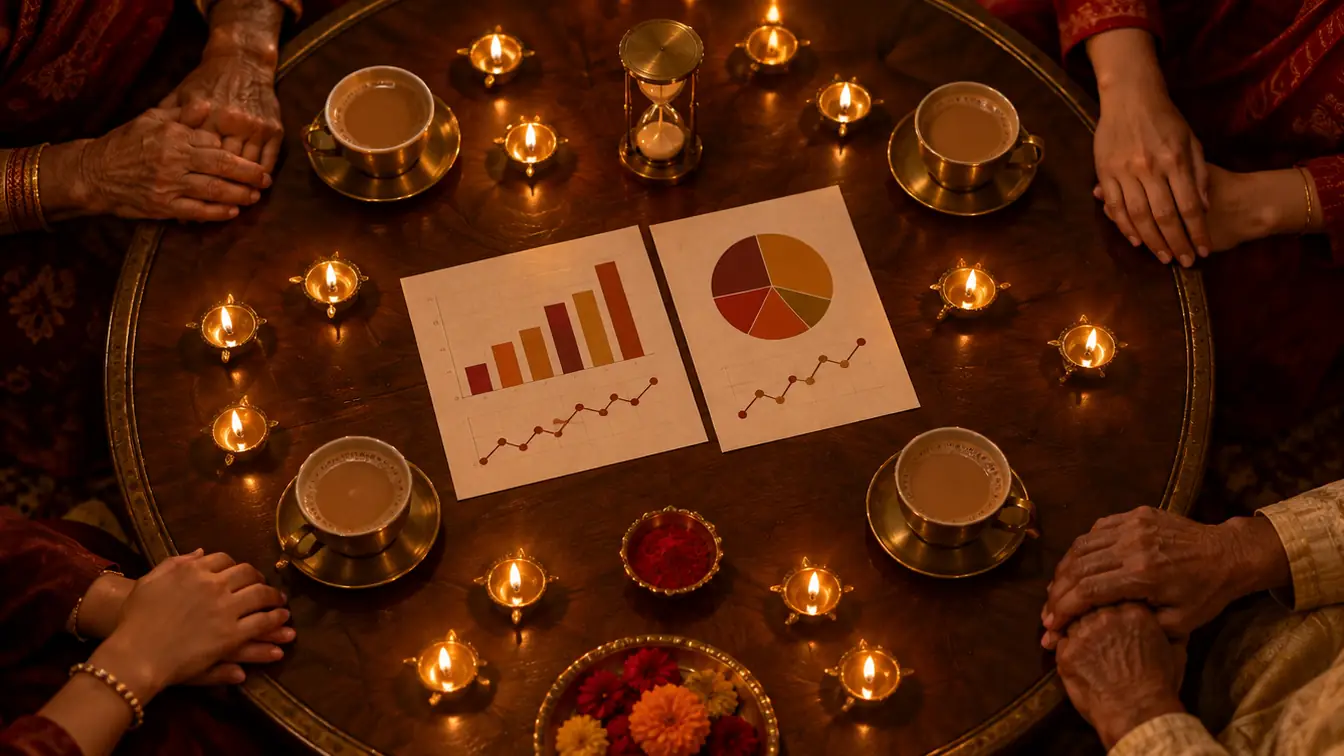
One Table, Two Generations: Running a Family Matching Meeting
When parents are not agreeing to a marriage, astrology works best as a structured joint session: questions agreed in advance, charts used to discuss temperament and timing but never as a veto, and every family member heard. It cannot convince or overrule anyone. The final decision stays with the two adults who will marry.
Key takeaways
- Often the most useful moment is step five.
- The delayed marriage astrology session often begins exactly here, because a long family standoff is one of the commonest reasons a marriage stalls.
- Some disagreements are about values that no chart touches, and a family therapist is the right next step.
- Astrologer and Psychic Vijayram runs these meetings by video so everyone can join from wherever they are.
Sometimes a family's disagreement about a match has been running for months. The couple is sure. One set of parents is not, or both are not, and every conversation at the dinner table in Arlington or Fort Worth ends the same way. When parents are not agreeing to a marriage, families sometimes turn to astrology, hoping the charts will settle it. They will not settle it. What a well-run joint session can do is give everyone one structured, fair conversation, which is more than many families have managed on their own.
What a family matching meeting is, and is not
It is a session with both partners and their parents, with both charts on the table, in which agreed questions are answered calmly and everyone is heard. It is not a trial of the couple, a way for one side to win, or a tool to convince parents to accept a love marriage. If you are hoping an astrologer will tell your parents they are wrong, or tell your son he is, this is not that session.
Before the meeting: agree the questions
- Each side writes down two or three questions. Parents might ask about temperament, Mars, or timing. The couple might ask what the charts suggest they should work on together.
- The couple approves the final list. It is their charts and their future, so nothing goes on the list without them.
- Both partners consent to sharing birth details. Adults' charts are only compared with their knowledge.
- Decide who attends. Both partners, always. Parents, and grandparents if they carry weight in the decision. Relatives in India can join by video; a morning in Fort Worth is evening in India.
- Agree the language. If a grandparent is more comfortable in another language, arrange for a family member to help, and keep the pace slow.
Ground rules for the session
- The couple speaks first and last.
- Nobody's chart is described as "bad." Placements are tendencies, not verdicts.
- Caste, status, money and dowry are not chart questions and are not discussed as if they were.
- Anyone can ask for a pause.
- The session ends with a summary, not a ruling.
What the charts are used for, and what they are not
| Charts are used to | Charts are never used to |
|---|---|
| Explain the guna score and any doshas calmly, including classical exceptions | Veto the match or declare it doomed |
| Describe each partner's temperament in neutral language | Judge a family's background, faith or community |
| Suggest periods the tradition favors for a wedding | Set a deadline or create urgency |
| Point to topics the couple should talk through | Replace the couple's own decision |
Running the session
- A short welcome, with the ground rules read aloud.
- The couple says, in their own words, why they want to marry.
- An overview of both charts and the matching result, in plain language.
- Each agreed question, answered in turn, with time for follow-ups.
- Each parent says what they heard and what still worries them.
- A summary of where things stand and what the family will do next.
Often the most useful moment is step five. Parents who have been arguing against a person discover they were really worried about something specific, distance from family, a career, a religious difference, and that can be talked about.
Family approval astrology: what a reading can honestly add
Family approval astrology, at its best, adds three things: shared vocabulary instead of loaded words, reassurance where a dosha turns out to be canceled, and a sense of when a wedding might be timed if the family comes round. The delayed marriage astrology session often begins exactly here, because a long family standoff is one of the commonest reasons a marriage stalls. For the format of a two-person reading, see ground rules for a joint reading.
When the disagreement goes deeper
Some disagreements are about values that no chart touches, and a family therapist is the right next step. A family relationship reading can sit alongside that work for families who value the tradition, never in place of it. If you love someone your family would not have chosen, the post on loving someone your family would not choose speaks to it directly.
Pressure can also cross a line. Threats, confiscated documents, being cut off from money, or plans to take you abroad for a marriage you do not want are not family disagreements. They can be forced marriage, which the Tahirih Justice Center's Forced Marriage Initiative explains and helps with. If anyone at home is hurting or threatening you, call emergency services, or the National Domestic Violence Hotline.
The final say
Astrologer and Psychic Vijayram runs these meetings by video so everyone can join from wherever they are. No session can make parents agree, and none will pressure a couple to give in. The decision to marry belongs to the two adults who will live the marriage, and every chart on the table is there to support that decision, not to make it.
Common questions
Can astrology convince my parents to accept my love marriage?
No reading is designed to convince anyone, and an honest astrologer will not try. A joint session can give everyone calmer language and a fair hearing, which sometimes softens positions on both sides.
Do both partners need to attend?
Yes. A meeting about a couple's future without the couple present is not fair to them. Parents and grandparents can join by video, including from India.
What if my parents insist on a marriage I do not want?
You have the right to refuse. If you are being pressured, threatened or taken abroad to marry, contact the Tahirih Justice Center's Forced Marriage Initiative, and call emergency services if you are in danger.
Can the meeting go ahead if one set of parents refuses to join?
Yes. The couple and the willing parents can still meet, and a written summary can be shared with the others afterwards. Sometimes a parent who refused the first meeting agrees to a second once they hear it was fair.
Related service

Keep reading

Start With a Licensed Counselor: Strained Marriages in Tarrant County
Marriage problems and astrology in Tarrant County: find a licensed couples counselor, get safety help if there is abuse, and see where a chart reading fits.
Read article →
Planning a Sangeet, Mehndi and Wedding Weekend by Muhurta
Indian wedding weekend planning by muhurta: which events need an auspicious time, which only need a convenient one, and how to sequence a Fort Worth weekend.
Read article →
A First-Year Marriage Review for Tarrant County Newlyweds
First year of marriage astrology for Tarrant County newlyweds: a gentle anniversary look at both charts' periods, shared plans and conversations worth having.
Read article →Quick answers
Do gunas matter if we are already engaged?
If you are already engaged, guna scores still offer useful talking points, used as guidance rather than a veto. How kundli matching helps Fort Worth couples.
Read answer →Can we marry if our kundlis do not match?
Yes, you can marry if your kundlis do not match. How kundli matching is done, whether it is necessary for a love marriage, and what Fort Worth couples weigh.
Read answer →Talk to Astrologer and Psychic Vijayram
Tell us what you are facing. If a reading is unlikely to help, you will be told that plainly.