
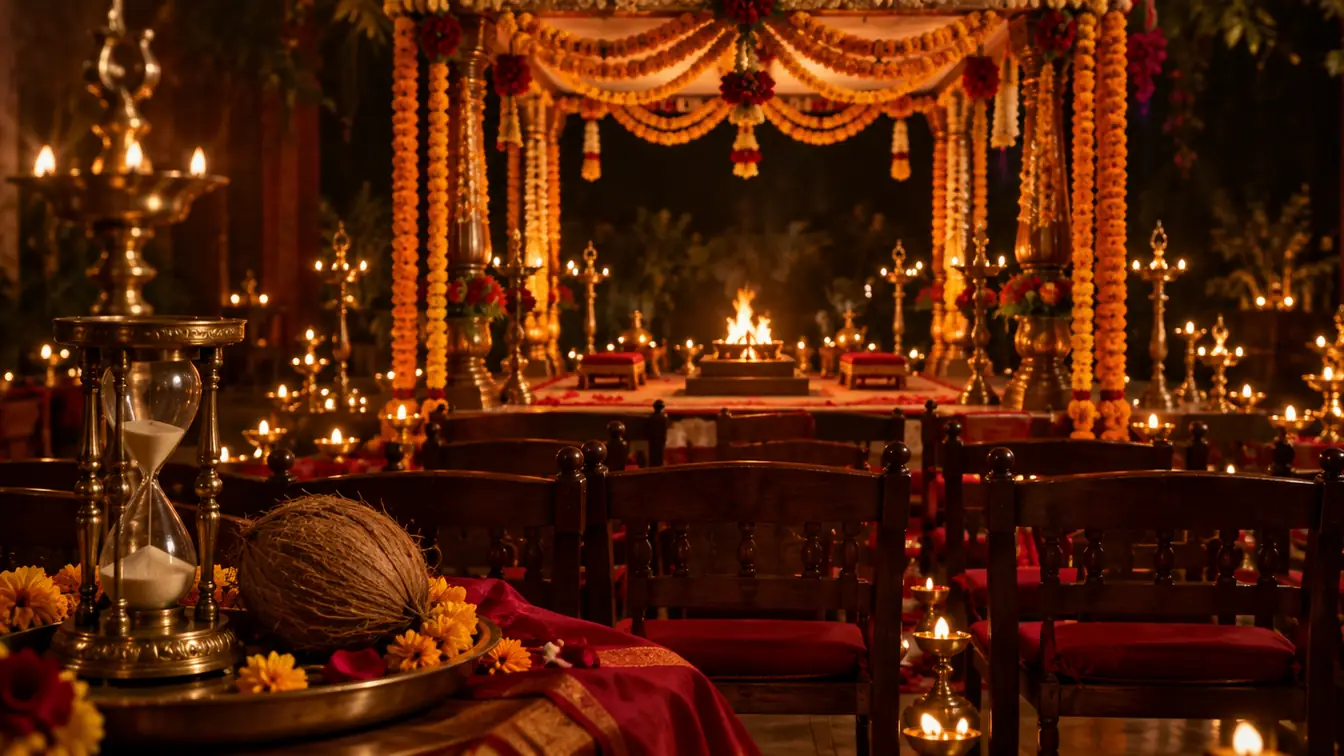
Wedding Muhurta Selection in Fort Worth
Wedding dates and ceremony times for North Texas weddings, worked out in Central Time and fitted around the venue calendar you actually have.
A wedding muhurta in Fort Worth is the auspicious date and time chosen for the main rites of a Hindu wedding, such as the pheras. It is calculated for local sunrise and the ceremony location in Central Time, then fitted around venue availability. Astrologer and Psychic Vijayram offers wedding muhurta selection by phone, WhatsApp or video, as traditional guidance.
Key takeaways
- Ideally the muhurta comes first, then the venue.
- Spring and fall are the comfortable months for outdoor ceremonies here.
- A Hindu ceremony and a Texas marriage license are separate things.
- Many Fort Worth weddings run over a long weekend: roka or engagement first, then mehndi, sangeet and haldi, then the wedding and reception.
- The reader can show each family how its own calendar treats the shortlisted dates, which usually narrows the choice to one or two that everyone can accept.
Choosing a wedding muhurta in Fort Worth means doing two things at once: following a tradition that is centuries old, and fitting it around a Texas venue calendar, guest flights and the weather. The muhurta is the auspicious window for the core rites, usually the pheras or saptapadi, and it is worked out for the place where the ceremony happens, in Central Time. Done well, it gives a family confidence in the date without turning planning into a fight.
How a wedding muhurta is chosen, step by step

1. Start with the couple
Both birth charts are checked so that the Moon's position on the chosen day suits each partner. If you have already had kundli matching, those charts are reused.
2. Rule out the seasons tradition avoids
Many families avoid the four-month period of Chaturmas, roughly the monsoon months in India, which falls across a Texas summer and early fall. Months when the Sun is in Sagittarius or Pisces, and periods when Venus or Jupiter are close to the Sun, are also commonly avoided. Customs vary by region and community, so tell the reader which ones your family keeps.
3. Shortlist the days
Within the remaining months, the Hindu calendar is searched for a suitable tithi, weekday and nakshatra. Birth stars traditionally favored for weddings include Rohini, Mrigashira, Magha, Uttara Phalguni, Hasta, Swati, Anuradha, Mula, Uttara Ashadha, Uttara Bhadrapada and Revati.
4. Choose the moment
On each candidate day, a rising sign is chosen for the central rite, with supportive planets and no clash with Rahu Kaal or other avoided windows worked out for Fort Worth sunrise.
5. Match it to the real calendar
The shortlist is laid next to venue availability, priest availability and travel. This is where most of the conversation happens.
Venue contract or muhurta first?
Ideally the muhurta comes first, then the venue. In practice, popular wedding venues around the Metroplex can book far ahead, and some couples have already put down a deposit. If you have a venue date, the reader works within it and finds the best window on that day. If you are still choosing, a short list of muhurta dates gives you something firm to take to venues. The post on venue contract or muhurta first goes through both routes.
North Texas seasons
Spring and fall are the comfortable months for outdoor ceremonies here. Summer brings long stretches near 100 degrees, and spring brings hail and tornado watches. If the baraat or the ceremony is outdoors, the date list notes which options carry the most weather risk. The post on spring or fall wedding seasons in North Texas compares the two in more detail.
The legal side comes first
A Hindu ceremony and a Texas marriage license are separate things. Check the current waiting period and validity rules with the Tarrant County Clerk, or the clerk in the county where you marry, and get the license dates right before you finalize anything. The post on the Texas marriage license and your muhurta explains how couples line up the two.
Multi-day weddings
Many Fort Worth weddings run over a long weekend: roka or engagement first, then mehndi, sangeet and haldi, then the wedding and reception. Each can have its own window if the family wishes, though only the main rite strictly needs one. Two posts help here: planning a wedding weekend by muhurta and hosting a roka at home in Tarrant County.
When the two families prefer different dates
It happens often: one side follows a North Indian calendar, the other a South Indian or Nepali one, or one grandparent has a strong feeling about a particular month. The reader can show each family how its own calendar treats the shortlisted dates, which usually narrows the choice to one or two that everyone can accept. Where customs truly conflict, the session explains the reasoning on each side so the couple can decide, rather than leaving it to whoever argues longest.
Finding a wedding muhurat online
Send both partners' birth details, the ceremony city, the months you are considering and any fixed constraints through the contact page. Astrologer and Psychic Vijayram prepares a shortlist and walks you through it by phone, WhatsApp or video: why each date was chosen, the exact window in Central Time, and the trade-offs between the strongest option and the most convenient one. You receive the list in writing to share with your priest, planner and family. For other ceremonies, such as a griha pravesh after the wedding, the general muhurta service applies.
What a wedding muhurta cannot do
A muhurta is a faith-based way of beginning a marriage with care. It cannot promise a happy marriage, good weather or a smooth day, and it never outranks the license, the law or your guests' safety. The commitment, kindness and patience of the couple will shape the marriage far more than the minute the pheras begin.
Common questions
Why do some wedding muhurtas fall late at night?
Because the strongest window, especially the rising sign chosen for the pheras, can fall after dark. The short answer on late-night wedding muhurtas explains why, and a reader can usually offer an evening alternative.
How far ahead should we ask for a muhurta?
Ideally before you sign with a venue, which for many couples means a year or more ahead. If the venue is already booked, the muhurta can still be found within that date.
Can the muhurta be on a weekday?
Yes, and weekday windows are often stronger simply because there are more of them. Many couples hold the main rites on a weekday muhurta and the reception at the weekend.
Does our temple priest need to agree with the muhurta?
It helps to share the written list with the priest early. Priests often have their own calendar and customs, and most are glad to work from a well-explained window or suggest a small adjustment.
We are holding the wedding in India. Can you still help?
Yes. The muhurta is then calculated for the Indian venue's location and time zone, and you receive the times in both Indian time and Central Time.
Related services
Married Couples' Yearly Chart Review, Fort Worth
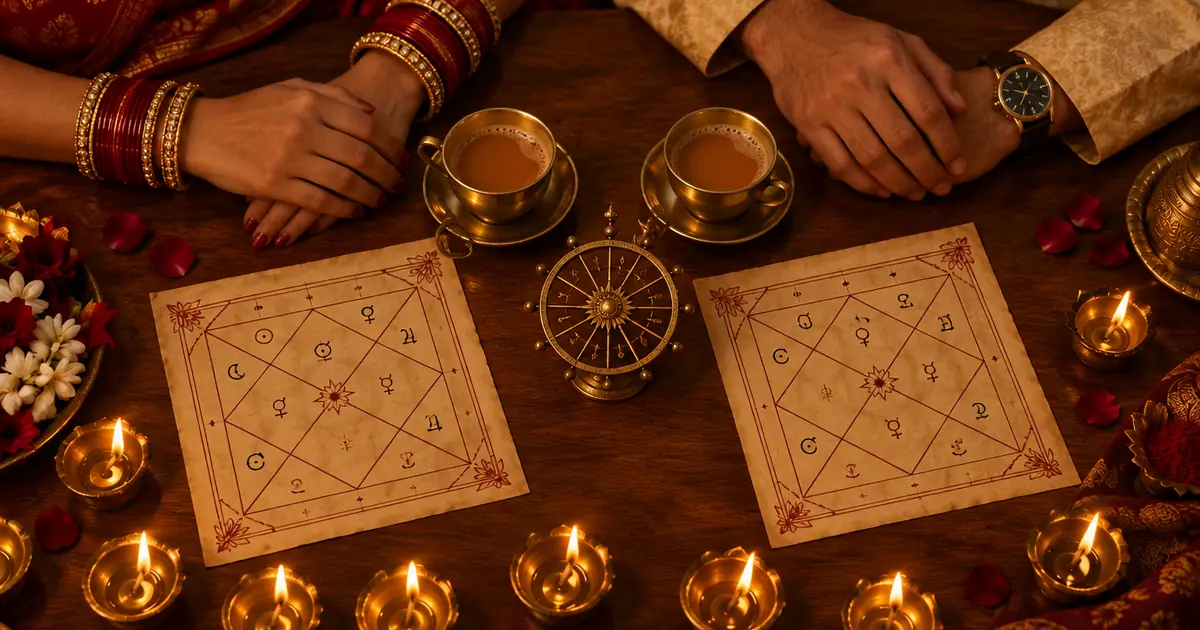
A couples astrology reading in Fort Worth for married partners: both charts compared for the year ahead, busy and quiet periods, and an anniversary muhurta.
View service →
Kundli Matching in Fort Worth
Kundli matching in Fort Worth: ashtakoota guna milan plus a full comparison of both charts for couples and families, explained honestly, by phone or video.
View service →Read more
Venue Contract or Muhurta First? Planning a Fort Worth Wedding
What is wedding muhurat, and should you get dates before signing a Fort Worth venue? Two planning routes, venue questions, and handling a date already fixed.
Read article →
Spring or Fall? Auspicious Wedding Seasons in North Texas
The best wedding months in Fort Worth for a muhurta: how traditional Hindu wedding seasons line up with North Texas springs, falls and 100-degree summers.
Read article →
Karwa Chauth on a Work Day: Fasting and Moonrise in Fort Worth
Karwa Chauth moonrise in Fort Worth, for a fast on a work day: planning sargi, the evening puja, cloudy skies and the health limits that come first.
Read article →
Boots Under the Lehenga: Hindu Weddings With a Texas Touch
Planning a Hindu American wedding in Fort Worth? Barbecue, two-step and ranch venue ideas that keep the muhurta, the pheras and the core rites intact.
Read article →
The Texas Marriage License and Your Muhurta
The Texas marriage license waiting period is 72 hours and the license lasts 90 days. How to line up the paperwork with your chosen wedding muhurta.
Read article →Quick answers
Why are some Hindu wedding muhurtas late at night?
Some Hindu wedding muhurtas fall late at night because the rising sign and nakshatra decide the time. How Fort Worth venues and families plan around it.
Read answer →Do gunas matter if we are already engaged?
If you are already engaged, guna scores still offer useful talking points, used as guidance rather than a veto. How kundli matching helps Fort Worth couples.
Read answer →Talk to Astrologer and Psychic Vijayram
Tell us what you are facing. If a reading is unlikely to help, you will be told that plainly.