

Explaining Spiritual Healing to a Skeptical Spouse or Parent
Spiritual healing is prayer-based support for the mind and spirit: a practitioner offers prayer, mantra, breath work and calm conversation, usually to help someone cope with illness, stress or grief. It does not diagnose or treat disease, and it never replaces a doctor. It works alongside medical care as comfort and steadiness, not as a cure.
Key takeaways
- A spiritual healer is someone who offers prayer, ritual and spiritual guidance for another person's wellbeing.
- Spiritual healing is real as a practice and as an experience; whether it does anything beyond comfort, relaxation and meaning has not been shown by science.
- Energy healing and chakra healing are real traditions with long histories, but the energy fields they describe have not been measured by science.
- Reiki is a Japanese practice developed in the 1920s, in which a practitioner places hands lightly on or just above the body with the aim of channeling healing energy.
- Read more on the spiritual healing service page .
You want to book a session. Your husband raises an eyebrow. Your father calls it superstition, or your mother worries you are being taken advantage of. If you have been asked "what is spiritual healing, anyway?" and found yourself stumbling, this post is for you. It gives you plain words for what a session involves, what it does not claim, and why it always sits beside medical care, never in place of it.
A two-minute explanation you can actually use
Try something like this:
"It is prayer and mantra, offered for me and with me, by someone who knows the tradition. We talk about what is weighing on me, the reader says prayers, and I learn a short daily practice. It is not medicine. I am still seeing my doctor and taking what I have been prescribed. It just helps me feel steadier."
That is honest, and it answers most of the worry. People usually object to one of three things: that you will be misled, that you will spend money you cannot afford, or that you will skip real treatment. Saying clearly that none of those is happening often settles the conversation.
What is a spiritual healer?
A spiritual healer is someone who offers prayer, ritual and spiritual guidance for another person's wellbeing. In Indian tradition, that may include Vedic mantras, a short puja, advice drawn from the birth chart and simple breath practices. The role is devotional. A good practitioner does not claim medical knowledge and does not pretend to have it.
Is spiritual healing real?
Spiritual healing is real as a practice and as an experience; whether it does anything beyond comfort, relaxation and meaning has not been shown by science. People who receive prayer often report feeling calmer, less alone and more able to cope, and that matters. But no reputable practitioner should tell you prayer will shrink a tumor or replace insulin.
Is energy healing real? Is chakra healing real?
Energy healing and chakra healing are real traditions with long histories, but the energy fields they describe have not been measured by science. Reviews of energy medicine find no reliable evidence that such fields exist or that manipulating them treats disease. Chakras are best understood as a spiritual map used for prayer and meditation, not as organs or anatomy. You do not have to believe in them for a session to feel calming; see whether you need to believe in chakras.
How Reiki healing works, and how this is different
Reiki is a Japanese practice developed in the 1920s, in which a practitioner places hands lightly on or just above the body with the aim of channeling healing energy. The National Center for Complementary and Integrative Health notes that Reiki has not been clearly shown to be useful for any health-related purpose. The sessions described on this site are not Reiki. They draw on Vedic prayer, mantra and breath, and they happen at a distance by phone or video, with nothing claimed about energy passing between bodies.
What a session actually involves
- A conversation about what is happening: an illness, a hard diagnosis in the family, grief, a long stretch of stress.
- Prayers and mantras offered by the reader, sometimes chosen from your birth chart.
- A short practice to keep at home: a mantra, a breath pattern, a few minutes of quiet.
- Honest notes on where other help is needed, such as a doctor, a counselor or a support group.
Read more on the spiritual healing service page. The breath-and-mantra side is set out in energy healing with breath and mantra, and the chanting side in chakra balancing with mantra.
What it never claims
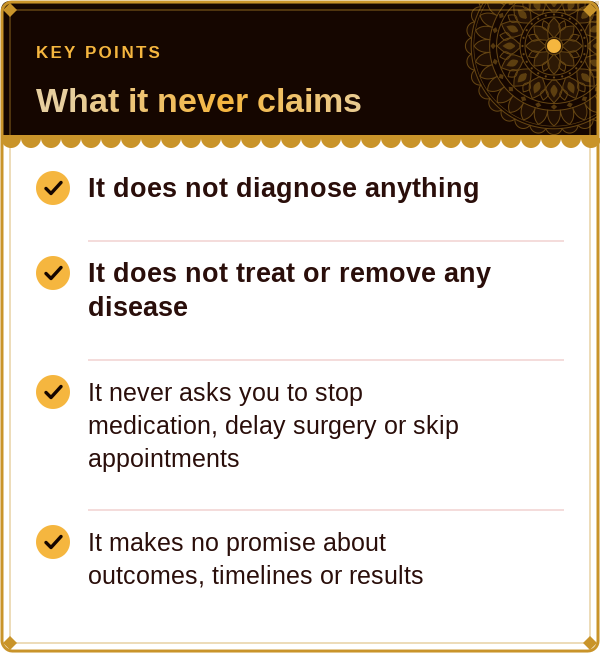
- It does not diagnose anything.
- It does not treat or remove any disease.
- It never asks you to stop medication, delay surgery or skip appointments.
- It makes no promise about outcomes, timelines or results.
Always alongside medical care
Health researchers draw a useful line between practices used together with conventional medicine and practices used instead of it. The NCCIH explains this difference between complementary and alternative approaches. Spiritual healing belongs firmly on the "together with" side. If you are pregnant, the answer page on spiritual healing during pregnancy covers the extra care involved.
Invite them to listen in
The simplest way to ease a skeptic's mind is to let them hear it. Ask your spouse or parent to sit beside you on the call. They can ask Astrologer and Psychic Vijayram any question they like: about fees, about what will be said, about what happens next. Most skepticism softens once people hear how ordinary and careful a session is.
Red flags you can agree on together
Skeptics often have good instincts. Agree in advance that you will walk away from anyone who promises results, creates urgency, asks you to stop treatment, keeps raising fees, demands secrecy or names a person as the cause of your trouble. The post on common myths about Indian astrologers and psychics lists more. A practitioner who welcomes your skeptic's questions is usually one worth hearing.
Common questions
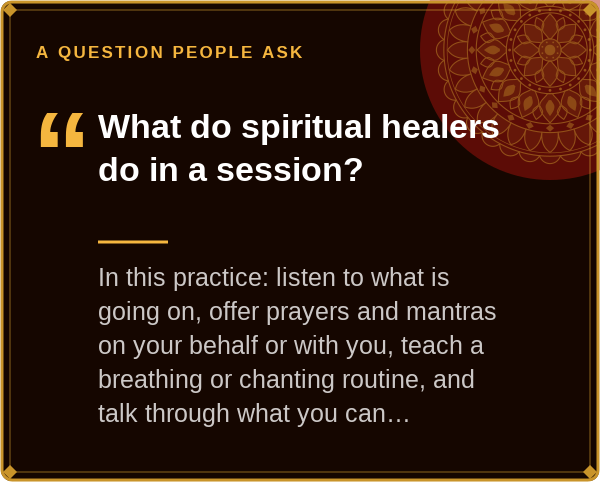
What do spiritual healers do in a session?
In this practice: listen to what is going on, offer prayers and mantras on your behalf or with you, teach a breathing or chanting routine, and talk through what you can do day to day. Nothing touches the body, and nothing is prescribed.
What does the term spiritual healer mean in Indian tradition?
It usually means someone who offers prayer, mantra and ritual for a person's wellbeing, often drawing on astrology to choose the prayers. It is a devotional role, not a medical one, and the best practitioners say so plainly.
Should I tell my doctor I am seeing a spiritual healer?
Yes. Doctors would rather know, and an honest practitioner will encourage it. If anyone asks you to keep it from your doctor, treat that as a reason to walk away.
Can my skeptical spouse sit in on the session?
Yes. Sessions run by phone, WhatsApp or video, so a partner or parent can listen in, ask questions and hear exactly what is and is not said.
Related service

Keep reading

Seed Syllables of the Chakras: Lam, Vam, Ram and the Rest
The seven chakras explained through their seed syllables, Lam, Vam, Ram, Yam, Ham and Om: how to sound each one, with a short chant as spiritual practice.
Read article →
Ten Minutes of Mantra on a TEXRail Ride or a Loop 820 Commute
A daily mantra practice for Fort Worth commuters: a silent ten-minute routine for TEXRail riders and a spoken one for drivers, eyes always on the road.
Read article →
Gayatri at Sunrise: Timing the Mantra to Fort Worth's Changing Dawn
The Gayatri mantra meaning, line by line, and how the sunrise practice shifts through a Fort Worth year, from 6:20 a.m. dawns in June to late ones in January.
Read article →Quick answers
Can I have spiritual healing while pregnant?
Yes, gentle spiritual healing while pregnant is possible: prayer and mantra only, nothing physical. Keep your obstetrician informed. A Fort Worth answer.
Read answer →Do I need to believe in chakras for a session to help?
You do not need to believe in chakras for a chakra balancing session to help you relax. What a Fort Worth session asks of a skeptic and what it never claims.
Read answer →Talk to Astrologer and Psychic Vijayram
Tell us what you are facing. If a reading is unlikely to help, you will be told that plainly.