

Three Cards for a Yes-or-No Question: A Worked Fort Worth Example
A yes or no tarot spread with three cards works by scoring each card as leaning yes, no or unclear, then reading the majority. Three agreeing cards give a strong leaning; a split means the question needs more thought. The result is a leaning to examine alongside the facts, never a verdict to obey.
Key takeaways
- Before shuffling, agree how each card will count.
- Daniel is a team lead at a warehouse in Saginaw.
- The odd card out is often the most important.
- Three cards cannot weigh Daniel's finances, his health, his marriage or the hiring manager's plans.
- Plenty of websites and apps offer an instant yes-or-no card.
Some questions really are binary. Take the job or turn it down. Sign the lease or keep looking. A yes or no tarot spread can help with those, as long as everyone understands what the answer means. Here is a three-card method Astrologer and Psychic Vijayram uses, shown step by step with a realistic Fort Worth example: a job offer at a distribution center in Alliance.
Step one: phrase the question precisely
"Should I take the job?" is too loose. Which job, on what terms, starting when? A good yes-or-no question names the specific choice: "Should I accept the shift supervisor offer at the Alliance distribution center, starting next month?" Precision keeps you from reading the cards against a vague hope.
Step two: decide how cards will be scored
Before shuffling, agree how each card will count. One simple scheme:
- Leans yes: cards of growth, success, clarity and movement, such as the aces, the Sun, the Star, the Six of Wands and the Eight of Pentacles.
- Leans no: cards of loss, collapse or exhaustion, such as the Tower, the Ten of Swords, the Five of Pentacles and the Ten of Wands.
- Unclear: cards of confusion, waiting or rest, such as the Moon, the Two of Swords, the Four of Swords and the Hanged Man.
Readers who use reversals sometimes let an upright card lean yes and a reversed card lean no. Either approach works if you choose it in advance.
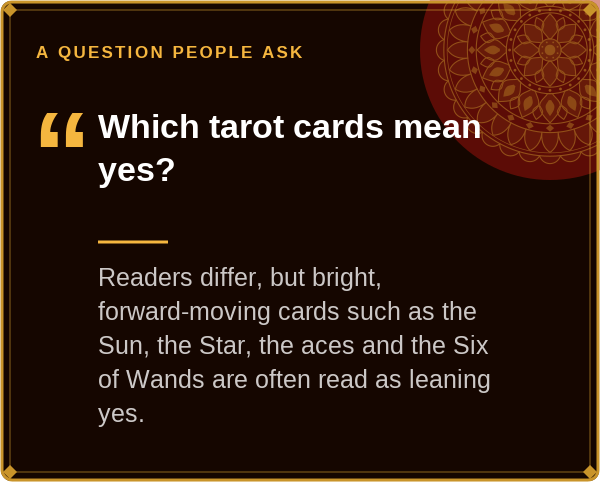
Step three: lay three cards and count
Three cards in a row. Then read the majority:
- Three yes: a strong leaning yes.
- Two yes, one other: a leaning yes, with the odd card pointing to a concern.
- Mixed or mostly unclear: the question is not ripe yet; something needs looking into first.
- Two or three no: a leaning no, with the cards showing why.
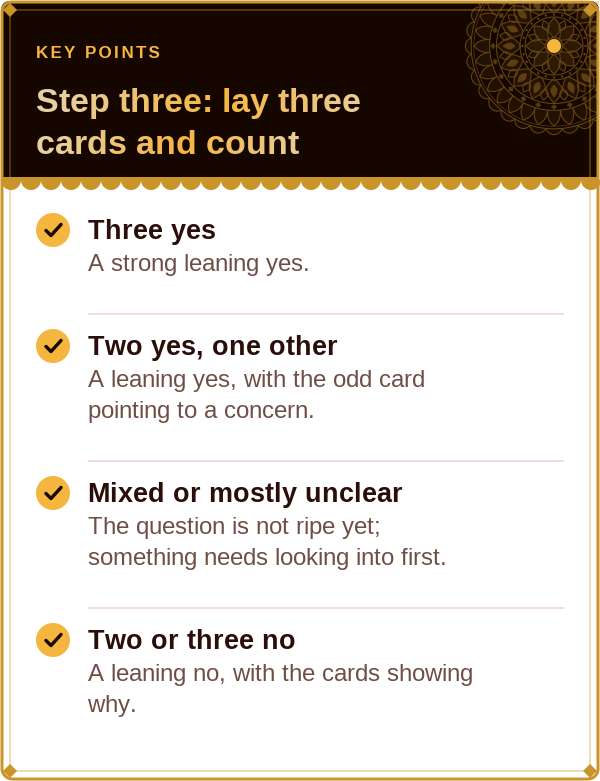
The worked example
Take a hypothetical case. Daniel is a team lead at a warehouse in Saginaw. He has been offered a shift supervisor job at a distribution center in Alliance, the big logistics hub that grew up around Perot Field Fort Worth Alliance Airport in north Fort Worth; the summary of Alliance, Texas gives some background. The new role pays more, but the shift is overnight, and he has two children in elementary school.
His question: "Should I accept the shift supervisor offer at the Alliance distribution center, starting next month?"
The cards:
- Eight of Pentacles: leans yes. Skilled, steady work and a step up in craft. The card fits a promotion earned by competence.
- Four of Swords: unclear. A figure lying still in a chapel. Rest, recovery, a pause.
- Six of Wands: leans yes. A rider crowned with a wreath, recognition from others.
Two yes, one unclear: a leaning yes. That is where many people stop. It is where a good reading starts.
Reading past the count
The odd card out is often the most important. Here the Four of Swords sits in the middle, between two cards about work and recognition. With an overnight shift in view, its message is not hard to find: rest. The reading says the role suits Daniel and could bring real recognition, and that the question is whether he can protect his sleep and his family time on nights.
That turns a yes into a set of practical questions. Will the schedule rotate or stay fixed? Who handles school drop-off? Is the drive up I-35W manageable after a night shift? Could he ask to start on a trial basis? Research matters too: the Labor Department's My Next Move shows typical duties and outlook for supervisor roles, which helps him check whether the step up is the career direction he wants. The post on readings for Alliance and airport shift crews looks at night work more broadly.
Why the answer is a leaning, not a verdict
Three cards cannot weigh Daniel's finances, his health, his marriage or the hiring manager's plans. A count of two to one is a nudge, and the cards beside it say what the nudge is about. Treating the result as an order would hand his decision to a shuffle. Treating it as a leaning lets him use it as one input among several. That is the same spirit in which the career tarot reading approaches every work question.
Tarot reading online, yes or no
Plenty of websites and apps offer an instant yes-or-no card. They can be a bit of fun, but they give one card, no context and no conversation. A booked session by phone or video lets a reader look at all three cards, ask about your circumstances and point out the card you might be tempted to skip. If you are weighing two offers rather than one, a different layout helps; see the answer on comparing two job offers with a spread. For other three-card layouts, read five ways to lay three cards.
Questions to keep out of yes or no
Some questions should never be reduced to a card count: whether a symptom is serious, whether a pregnancy will go well, whether you will win a case, or whether someone loves you. Those belong with a doctor, a lawyer or an honest conversation. A three-card leaning can help with your own choices. It cannot decide outcomes that rest with other people or with chance.
Common questions
Which tarot cards mean yes?
Readers differ, but bright, forward-moving cards such as the Sun, the Star, the aces and the Six of Wands are often read as leaning yes. Cards of loss or collapse, like the Tower or the Ten of Swords, often lean no. Cards of confusion or waiting, such as the Moon or the Two of Swords, are usually read as unclear.
Is a tarot reading online yes or no tool worth using?
Instant yes-or-no tools can be a bit of fun, but they give one card and no context. For a decision that matters, a reading where someone looks at all three cards and your actual situation will tell you far more.
Can I ask the same yes or no question twice?
It is better not to. Re-drawing until you get the answer you want simply teaches you which answer you wanted. Notice that, and use it.
What questions should not be asked as yes or no?
Questions about health, pregnancy, legal cases or another person's feelings. These need professional advice or a direct conversation, not a card count.
Related service

Keep reading

Choosing Your First Tarot Deck
Looking for the best tarot deck for beginners? What to check in a first deck, why Rider-Waite-Smith imagery is easiest to learn, and which decks can wait.
Read article →
The Fool Tarot Card: Meaning in Love and Work
The Fool tarot meaning: a card of new starts and trust in the first step. Upright and reversed, in love and at work, with questions to reflect on.
Read article →
The High Priestess Tarot Card: Meaning in Love and Work
The High Priestess tarot meaning: intuition and what is not yet spoken. Upright and reversed, the love meaning, the card at work, and questions to sit with.
Read article →Quick answers
Is a tarot spread useful when comparing two job offers?
A tarot spread can help when comparing two job offers by clarifying what you value. It never replaces checking pay, benefits and terms. A Fort Worth guide.
Read answer →How many cards are used in a tarot reading?
How many cards are used in a tarot reading? Usually one to ten from a 78-card deck, depending on the spread. A Fort Worth reader explains the common layouts.
Read answer →Talk to Astrologer and Psychic Vijayram
Tell us what you are facing. If a reading is unlikely to help, you will be told that plainly.