
Choosing Your First Tarot Deck
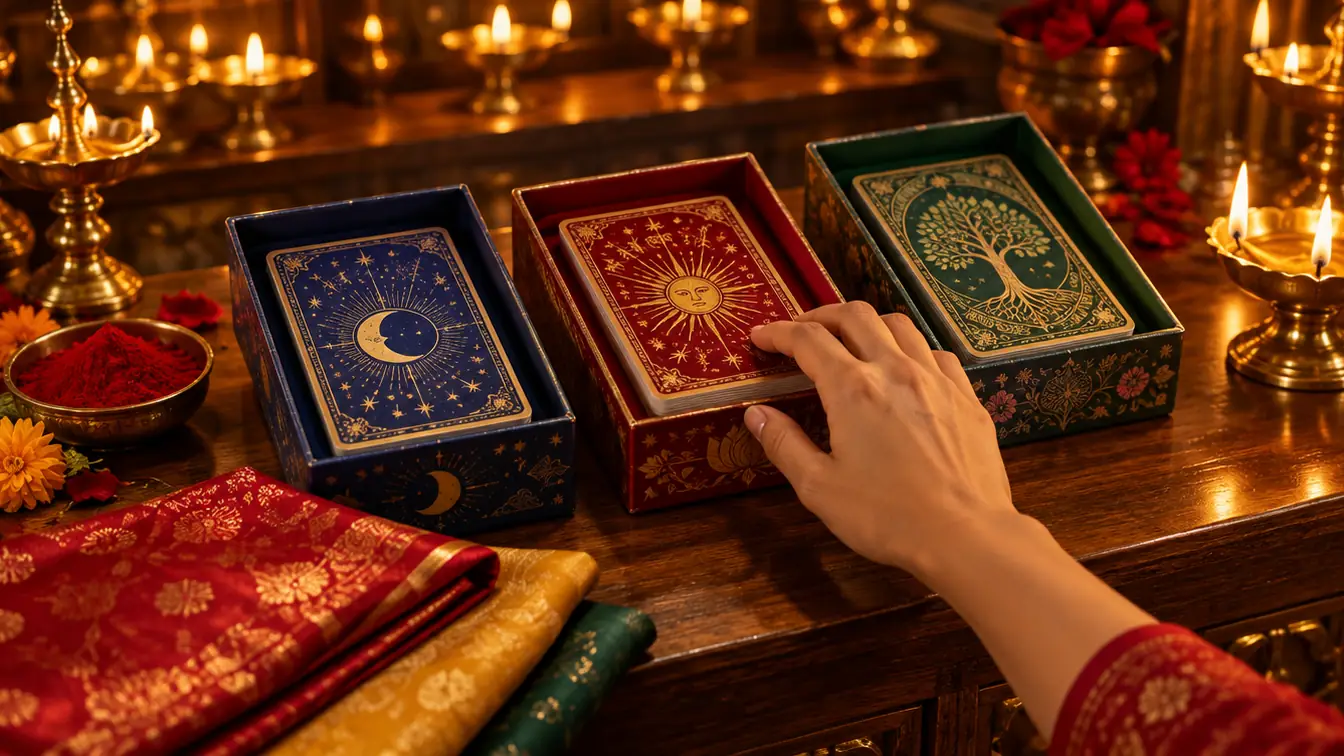
The best tarot deck for beginners is usually one based on the Rider-Waite-Smith images from 1909, because every card, including the 40 numbered minor cards, shows a scene you can read. Choose a full 78-card deck with art you enjoy, a size that fits your hands, sturdy card stock and a clear guidebook.
Key takeaways
- The Rider-Waite-Smith deck was designed by A.
- Some famous decks are wonderful but harder to learn on.
- Bookstores and metaphysical shops around the city usually carry a few decks, and holding a deck before you buy lets you check size and card stock.
- Many beginners buy a deck because a relationship is on their mind.
- No deck, however beautiful or traditional, makes tarot predictive.
Walk into a bookstore or metaphysical shop and the shelf of tarot decks can be overwhelming: cats, botanicals, gothic art, gold foil, decks with unfamiliar card names. If you are looking for the best tarot deck for beginners, the honest answer is less exciting than the shelf suggests. Start with a deck that follows the Rider-Waite-Smith images, or one closely based on them. Here is why, what else to check, and which decks are better saved for later.
Why the Rider-Waite-Smith images are easiest to learn
The Rider-Waite-Smith deck was designed by A. E. Waite, drawn by the artist Pamela Colman Smith and published in London in 1909. Its great gift to beginners is that the numbered cards in each suit, the forty "pip" cards from Ace to Ten, all show scenes with people doing things. Older decks often showed those cards as simple arrangements of cups, coins, swords or batons, like playing cards. A scene is far easier to read than a pattern of five cups: in the Rider-Waite-Smith Five of Cups, a cloaked figure mourns three spilled cups while two still stand behind, and the meaning is right there in the picture.
There is a practical reason too. Most beginner books, online references and classes use these images. Learn on a deck that matches them, and every explanation you read will match the card in your hand. The Victoria and Albert Museum's article on the history of tarot cards shows how the deck fits into the longer story, from Italian card games to modern reading.
You do not need the original edition. Many decks redraw the same scenes in new styles or colors, and these "clones" work just as well for learning as long as the scenes are recognizably the same.
What to check before you buy
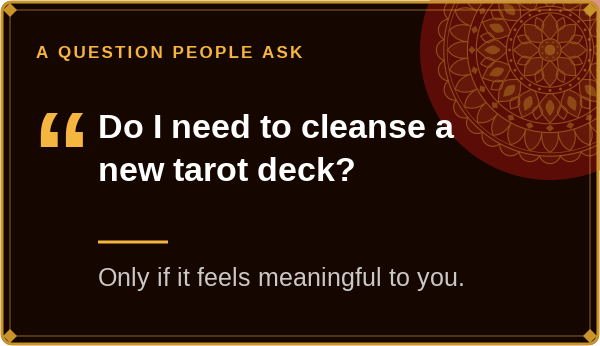
- All 78 cards. Twenty-two major arcana and fifty-six minor arcana. Some mini or themed decks drop cards; avoid those for learning.
- A scene on every card. Flip through the minor arcana if you can. If the Seven of Swords is just seven swords, look for another deck.
- Standard names. Pages, Knights, Queens and Kings, and the usual major arcana titles. Renamed cards make cross-referencing a chore.
- A size that fits your hands. Tarot cards are larger than playing cards. If you have small hands, a slightly smaller edition makes shuffling easier.
- Sturdy card stock. Thin cards crease; very thick ones are hard to shuffle. Matte finishes resist sticking in humid summer weather.
- A clear guidebook. A short booklet with upright and reversed meanings is enough to start.
- Art you enjoy looking at. You will spend a lot of time with these pictures. If one version of the classic images appeals to you more than another, that is a good reason to choose it.
Decks that can wait
Some famous decks are wonderful but harder to learn on. Marseille-style decks, the older French pattern, have plain pip cards without scenes, so reading them relies on number and suit alone. Decks in the Thoth tradition rename several cards and change some meanings, so beginner books based on Rider-Waite-Smith do not line up. Highly stylized art decks can obscure the details a reader uses, such as which way a figure is facing or what is in the background. None of these is wrong. They are simply easier to appreciate once you know the standard images.
Oracle decks are a separate category altogether. They are often gentler and more encouraging, with no fixed structure. If that sounds appealing, the gentle oracle card sessions explain how they are used, but keep them separate from tarot while you are learning.
Where to buy in Fort Worth
Bookstores and metaphysical shops around the city usually carry a few decks, and holding a deck before you buy lets you check size and card stock. The post on metaphysical shops and psychic fairs in Fort Worth covers what to expect when you visit. Buying online is fine too; look for photos of several minor arcana cards before you order.
Your first week with a new deck
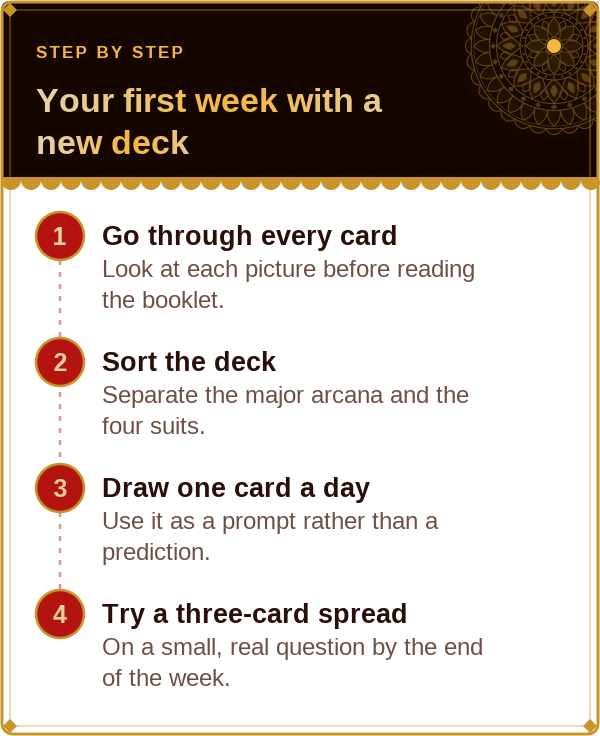
- Go through every card. Look at each picture before reading the booklet. Jot down your first impression.
- Sort the deck. Separate the major arcana and the four suits. Lay each suit from Ace to Ten and notice how the story moves.
- Draw one card a day. Use it as a prompt rather than a prediction. The one-card walking reflection is an easy way to start.
- Try a three-card spread on a small, real question by the end of the week.
Practicing with love questions
Many beginners buy a deck because a relationship is on their mind. That is fine, but practice on your own side of things: "What do I bring to this relationship?" rather than "What does she feel?" The love tarot reading works the same way, and seeing how Astrologer and Psychic Vijayram reads a relationship spread live can teach you a lot about how cards combine.
What a deck cannot do
No deck, however beautiful or traditional, makes tarot predictive. A good beginner deck makes the pictures easy to read and the meanings easy to learn. What you get from it depends on the questions you ask and the honesty you bring, not on the price or the box.
Common questions
Is it bad luck to buy your own tarot deck?
No. The idea that a first deck must be a gift is a popular superstition, not a rule of the tradition. Most readers bought their own first deck.
Do I need to cleanse a new tarot deck?
Only if it feels meaningful to you. Some people shuffle each card once, keep the deck wrapped in cloth or say a short prayer before first use. None of it is required.
Is an oracle deck the same as a tarot deck?
No. Tarot has a fixed structure of 78 cards in major and minor arcana. Oracle decks vary in size and theme and follow no shared system, which makes them gentler but less suited to learning tarot.
How long does it take to learn a tarot deck?
Most people feel comfortable with the basic meanings after a few months of regular practice. Reading cards together fluently takes longer, and keeps developing for years.
Related service
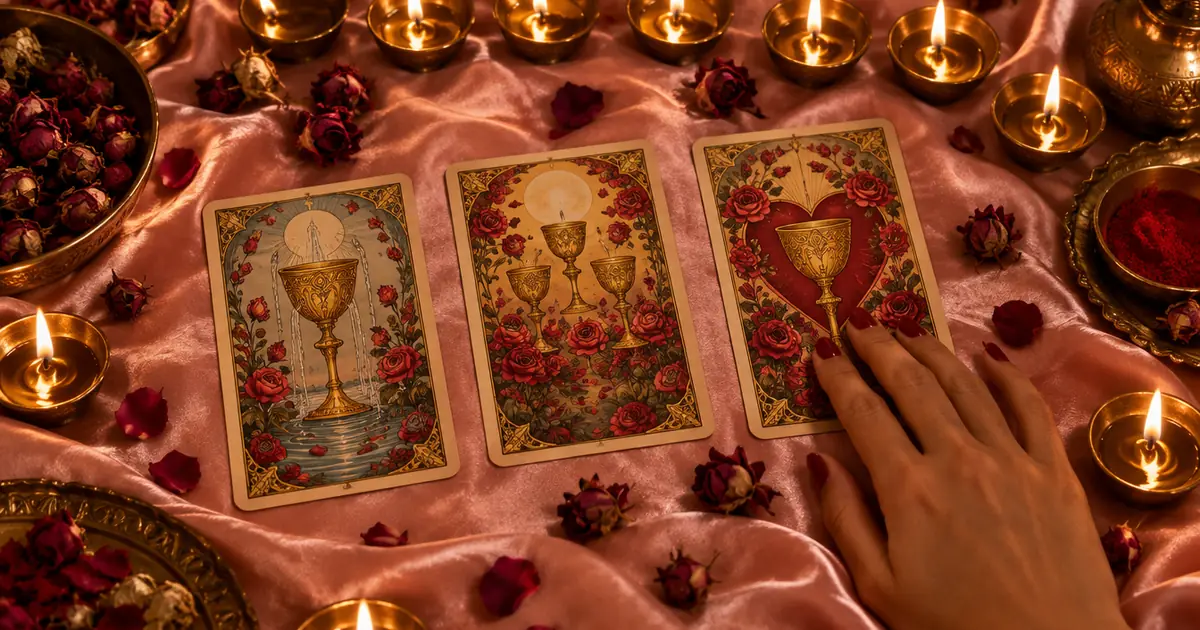
Keep reading

The Fool Tarot Card: Meaning in Love and Work
The Fool tarot meaning: a card of new starts and trust in the first step. Upright and reversed, in love and at work, with questions to reflect on.
Read article →
The High Priestess Tarot Card: Meaning in Love and Work
The High Priestess tarot meaning: intuition and what is not yet spoken. Upright and reversed, the love meaning, the card at work, and questions to sit with.
Read article →
The Empress Tarot Card: Meaning in Love and Work
The Empress tarot meaning: care, comfort and steady growth. Upright and reversed, in love and at work, with a quick table and questions to reflect on.
Read article →Quick answers
How many cards are used in a tarot reading?
How many cards are used in a tarot reading? Usually one to ten from a 78-card deck, depending on the spread. A Fort Worth reader explains the common layouts.
Read answer →Is a tarot spread useful when comparing two job offers?
A tarot spread can help when comparing two job offers by clarifying what you value. It never replaces checking pay, benefits and terms. A Fort Worth guide.
Read answer →Talk to Astrologer and Psychic Vijayram
Tell us what you are facing. If a reading is unlikely to help, you will be told that plainly.