
A Trinity Trails Walking Reflection With One Card
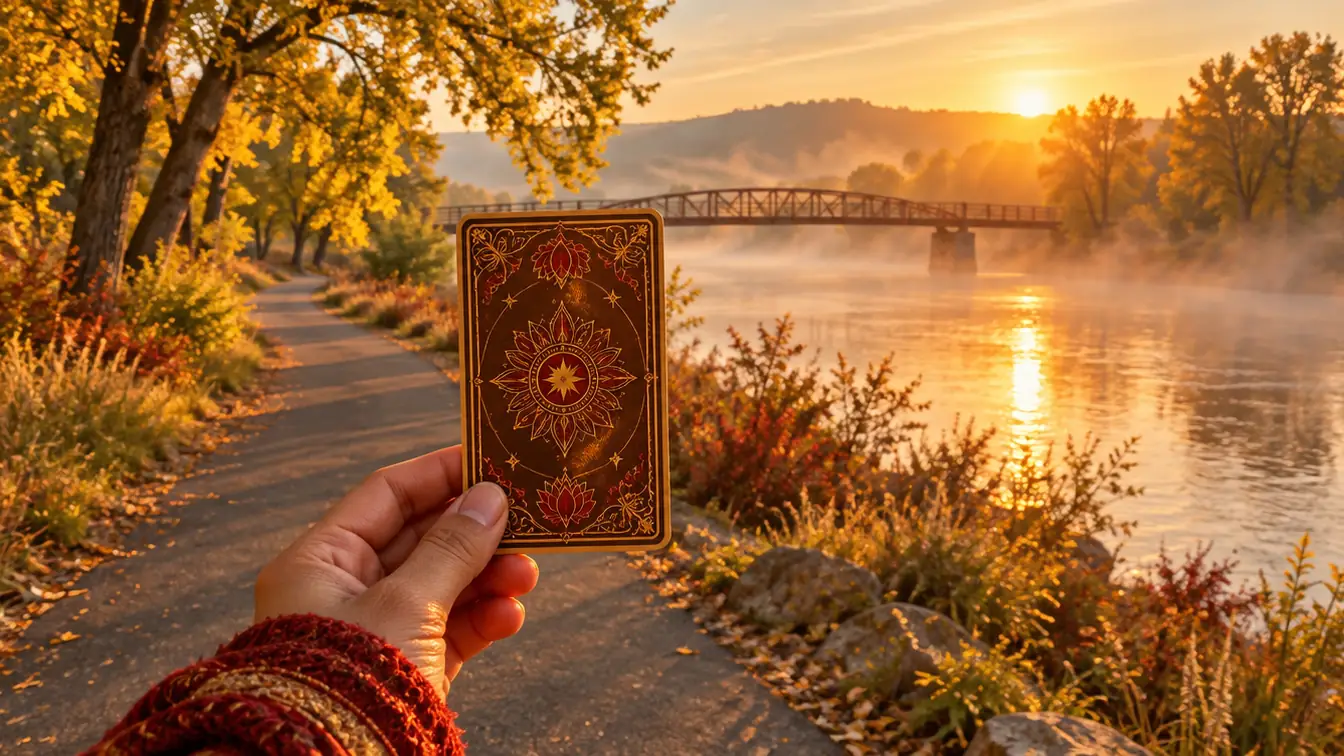
A daily tarot card practice can be as small as one card drawn before a walk. Look at the picture, leave the guidebook closed, and carry one question along the Trinity Trails: where does this card show up in my day? Write a line when you get home. It is a prompt for attention, not a forecast.
Key takeaways
- One card asks for nothing except attention.
- Choose a section you can reach easily and walk safely at the hour you prefer.
- Sooner or later you will draw the Tower, the Ten of Swords or Death before breakfast.
- A notebook by the door, or a note on your phone, is all it takes.
- Some clients bring a month of daily cards to a tarot card reading and ask what the pattern says.
Some people meditate before work. Some read a verse or say a prayer. A daily tarot card practice sits comfortably beside any of those: a single card, drawn before you lace up your shoes, then carried along the river for half an hour. Fort Worth has a ready-made path for it. The Trinity Trails follow the Trinity River for many miles through the city, close enough to downtown, Trinity Park and a string of neighborhoods that most residents can reach a stretch of trail without much driving.
This post describes one simple routine. It takes about five minutes on either side of a walk you might be taking anyway.
Why one card is enough
A full spread asks your mind to hold several pictures and the relationships between them. That is useful for a real question, and tiring as a daily habit. One card asks for nothing except attention. You notice its colors, the figure's posture, what the figure holds, and then you let the walk do the rest.
A single card is also harder to misuse. Nobody can build a dramatic story from one image drawn on a Tuesday. It stays what it should be: a prompt.
The routine, step by step
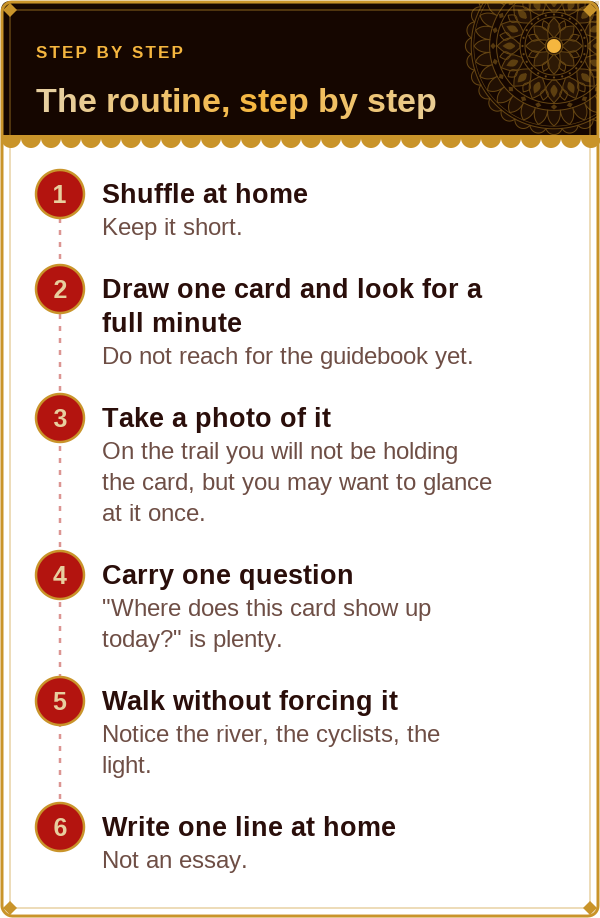
- Shuffle at home. Keep it short. Think of the day ahead in a sentence: "a long shift," "my mother's appointment," "nothing special."
- Draw one card and look for a full minute. Do not reach for the guidebook yet. What is the first detail your eye goes to? A cup, a road, a figure turning away?
- Take a photo of it. On the trail you will not be holding the card, but you may want to glance at it once.
- Carry one question. "Where does this card show up today?" is plenty.
- Walk without forcing it. Notice the river, the cyclists, the light. Let the card sit at the back of your mind.
- Write one line at home. Not an essay. One honest line about what the card came to mean on the walk.
Picking your stretch of trail
Choose a section you can reach easily and walk safely at the hour you prefer. For a lot of people that means a familiar loop near home rather than a scenic drive. In a Fort Worth summer, go early, carry water and turn back sooner than your pride suggests; many days come close to or pass 100 degrees. In spring, check the forecast before you go, since storms with lightning and hail can build fast across North Texas. A reflection practice is not worth a heatstroke or a soaking.
If the river path is too far on weekdays, a neighborhood block works. The card does not need water views. It needs you to walk at a pace that leaves room to think. For a gentler, breath-led version of the same idea, the post on a sunrise reflection walk on the Trinity Trails skips the cards entirely.
What the card might look like on the walk
Here is a sample week to show how ordinary this can be.
- Monday, Eight of Pentacles. A figure carving coins one by one. On the walk you notice a man repainting a bench. Your line: "Do the dull part of the report properly."
- Tuesday, Two of Cups. Two people exchanging cups. You think of a friend you have not called since spring. Your line: "Text Priya back."
- Wednesday, the Hermit. A lone figure with a lantern. You find you are glad the trail is quiet. Your line: "Say no to the extra meeting."
- Thursday, Five of Swords. A figure collecting swords while others walk away. You replay an argument with your brother. Your line: "Winning that point was not worth it."
- Friday, the Star. A kneeling figure pouring water under a bright sky. You simply enjoy the morning. Your line: "Rested for once."
None of these lines predicts anything. Each one is a small piece of self-knowledge that the picture helped bring to the surface.
When the card looks gloomy
Sooner or later you will draw the Tower, the Ten of Swords or Death before breakfast. Breathe. Major cards like these describe themes such as upheaval, exhaustion and endings, as the summary of the major arcana makes clear, and on a daily draw they usually point to something small: a plan that needs to change, a worry you have been carrying, a habit that has run its course. Ask the same question you always ask, "where does this show up today?", and you will usually find a modest, manageable answer.
If you read with reversed cards and find them heavy for a daily habit, try the deck upright-only for a while. The post on reading tarot without reversals explains how that works.
Keeping the journal
A notebook by the door, or a note on your phone, is all it takes. Write the date, the card and your one line. After a month, read it back. Patterns show up that you would never notice day to day: a suit that keeps appearing during a stressful project, or a run of Cups during a season of family visits. Writing regularly is a well-known aid to emotional wellbeing, and the University of Rochester's note on journaling for emotional wellness gives practical tips such as writing at the same time each day and not worrying about grammar.
Bringing it to a reading
Some clients bring a month of daily cards to a tarot card reading and ask what the pattern says. That can be a rich session. Astrologer and Psychic Vijayram looks at which suits and numbers dominate, which major cards turned up, and what your one-line notes reveal about where your attention has been going. If you are just starting out and still choosing a deck, read the guide to choosing your first tarot deck before you buy.
What a daily card cannot do
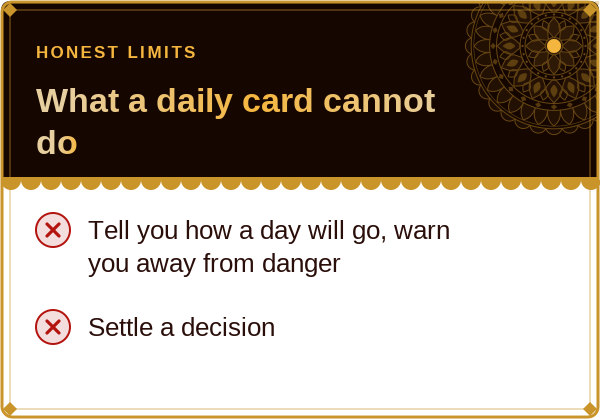
A morning card cannot tell you how a day will go, warn you away from danger or settle a decision. If you notice you are drawing card after card until one feels right, or avoiding plans because of a picture, set the deck aside for a week. The practice should leave you calmer and more observant. If it does the opposite, stop.
Common questions
Should I draw my daily card in the morning or the evening?
Morning suits most people, because the card becomes a lens for the day ahead. Evening draws work too if you prefer to look back. Pick one time and keep it for a few weeks so the habit settles.
What if I draw the same card several days running?
Shuffle more thoroughly first, since cards that were laid together tend to stay together. If it keeps coming, treat it as a theme worth a longer look in your journal rather than a warning.
Can I do this without a deck?
Yes. Some people use a card-of-the-day app or a photo of a single card. A physical deck tends to slow you down in a good way, but the habit matters more than the tool.
Is a one card tarot draw enough for a big decision?
No. One card is a nudge for a single day. A decision about a move, a marriage or a job deserves a fuller spread, your own research and conversations with the people involved.
Related service
Keep reading
Tarot Questions Fort Worth Clients Ask Most
The common tarot questions Fort Worth clients bring, about love, work, family, moves and timing, and how each can be phrased so a reading actually helps.
Read article →
Rewriting 'Will He Call?' Into a Question the Cards Can Help With
How to ask tarot questions that help: worked before-and-after examples that turn worries about other people into open questions about your own choices.
Read article →
Five Ways to Lay Three Cards: Situation, Action, Outcome and More
Five three card tarot spread ideas, from situation-action-outcome to option A, option B and advice, with when each helps and how to read the three together.
Read article →Quick answers
How many cards are used in a tarot reading?
How many cards are used in a tarot reading? Usually one to ten from a 78-card deck, depending on the spread. A Fort Worth reader explains the common layouts.
Read answer →Can tarot and astrology be combined in one session?
Tarot and astrology can be combined in one session: the chart gives timing and background, the cards focus on one question. How it works in Fort Worth.
Read answer →Talk to Astrologer and Psychic Vijayram
Tell us what you are facing. If a reading is unlikely to help, you will be told that plainly.