

Rewriting 'Will He Call?' Into a Question the Cards Can Help With
To ask tarot questions that help, make yourself the subject, use an open "what" or "how" instead of "will" or "does," and keep the time frame near. "Will he call?" becomes "What do I need to feel settled this month, whether he calls or not?" The cards can work with that; they cannot read his phone.
Key takeaways
- A closed question about another person's future action has three problems.
- Most real questions involve someone else, and that is fine.
- For a broader look at what people ask, see the round-up of tarot questions Fort Worth clients ask most .
- A better question gives you a better conversation with the cards.
It is ten at night. The message was read at four and there is still no reply. The question that forms is simple and sharp: will he call? It is also the hardest question to bring to a reading, because the answer sits in someone else's hands. Learning how to ask tarot questions is mostly learning to move the question back into your own. This post shows how, with real before-and-after wording.
Why "will he call?" stalls a reading
A closed question about another person's future action has three problems. It can only be answered yes or no. It depends entirely on someone who is not part of the session. And it invites us to hear what we already hope or fear. Psychologists call that last tendency confirmation bias: we notice what supports our belief and quietly discard the rest. Lay three cards for "will he call?" and a hopeful mind will find a yes in almost any picture, while an anxious one will find a no.
The reading that follows is often thin, and it leaves you exactly where you started, refreshing your phone.
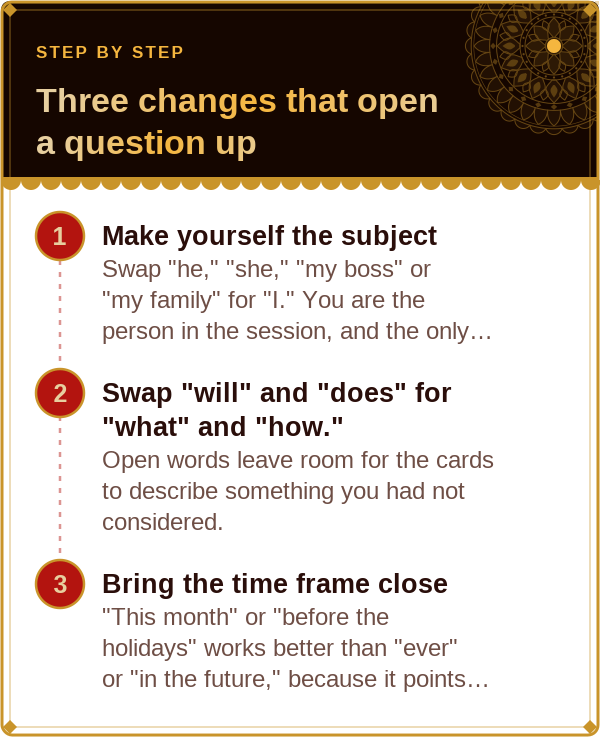
Three changes that open a question up
- Make yourself the subject. Swap "he," "she," "my boss" or "my family" for "I." You are the person in the session, and the only person whose choices you can change.
- Swap "will" and "does" for "what" and "how." Open words leave room for the cards to describe something you had not considered.
- Bring the time frame close. "This month" or "before the holidays" works better than "ever" or "in the future," because it points toward action.
Seven worked examples
1. The silent phone
Before: Will he call?
After: What do I need to feel settled this month, whether he calls or not?
The second question can produce a reading about rest, self-respect or a conversation you have been avoiding. The first produces suspense.
2. The tense job
Before: Is my manager going to let me go?
After: What can I do in the next few weeks to strengthen my position, and what would a sensible backup plan look like?
This is a common question in a city with big employers that reorganize from time to time. The open version gives you something to do on Monday.
3. The visiting in-law
Before: Does my mother-in-law dislike me?
After: How can I make her three-month visit easier on myself and on my marriage?
Her feelings are hers. The length of the visit, your boundaries and your conversations with your spouse are yours.
4. The house hunt
Before: Will we get the house in Benbrook?
After: What matters most to us in our next home, and are we stretching further than feels wise?
Offers are decided by sellers and lenders. Priorities and limits are decided at your kitchen table.
5. The ex with someone new
Before: Is my ex happier with her new partner?
After: What am I still holding onto from that relationship, and what would help me let it go?
This rewrite can feel uncomfortable, which is usually a sign it is the right one. The breakup and reconciliation guidance session works with questions of exactly this kind.
6. The exam season
Before: Will my son pass his exams?
After: How can I support my son through exam season without adding to his pressure?
You cannot sit the exam for him. You can shape the atmosphere at home.
7. The coworker
Before: Is my coworker talking about me behind my back?
After: How do I want to handle the tension with this coworker, and what outcome would I be content with?
The open question might point to a direct, calm conversation, which no amount of guessing can replace.
Questions about people who are not in the room
Most real questions involve someone else, and that is fine. What a careful reader avoids is treating the cards as a window into another person's private thoughts, health or plans. That person has not agreed to be read, and the cards cannot reliably show such things anyway. The short answer on reading an ex's chart without consent explains the same principle in astrology. If you have been left without explanation, the answer on whether a love reading helps after ghosting is a gentle next read.
Tarot reading tips for the day of your session
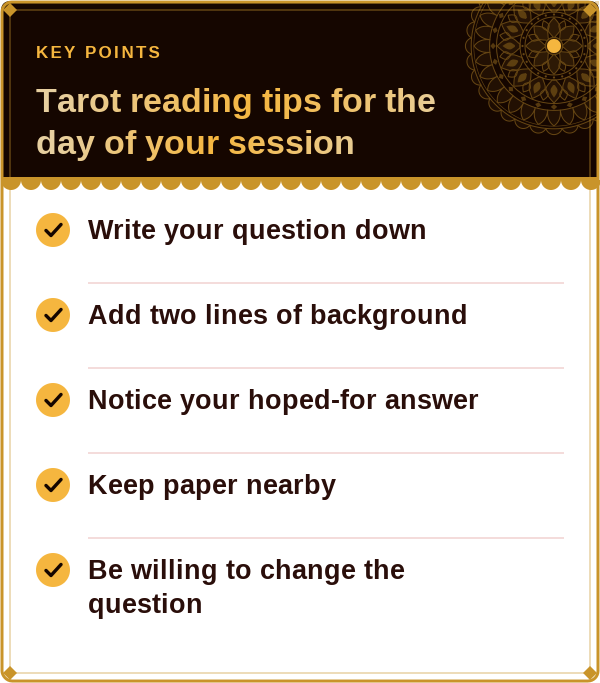
- Write your question down. One sentence. If it runs to three, you probably have two questions.
- Add two lines of background. Enough for the reader to understand the situation, not a full history.
- Notice your hoped-for answer. Say it out loud to yourself before the session. Knowing it helps you listen past it.
- Keep paper nearby. Whether you join by phone or video, you will want to note the cards and one or two phrases.
- Be willing to change the question. Astrologer and Psychic Vijayram may suggest a rewording in the first few minutes. That is not a dodge; it is often the most useful part of the reading.
If you want to try your question in a full session, the tarot card reading page explains how a session runs. For a broader look at what people ask, see the round-up of tarot questions Fort Worth clients ask most.
What even a well-phrased question cannot do
A better question gives you a better conversation with the cards. It does not turn tarot into a forecast, and it cannot tell you what someone else will choose. The aim is clarity about your own next step, which is something you can carry out of the session and use.
Common questions
Is it wrong to ask about someone else in a tarot reading?
It is not wrong to have them on your mind, and most questions involve other people. The reading simply stays with your side: your feelings, your choices and how you want to respond. It does not claim to know what they think or plan.
Can I still ask a yes-or-no question?
You can, and some readers use a simple three-card method for them. The result is best read as a leaning that you then examine, not a verdict. Open questions usually give you more to work with.
What if I cannot put my question into words?
Tell the reader the situation in a few sentences and say you are not sure what to ask. Shaping the question together is part of the session, and it often clears your head before a single card is turned.
Related service

Keep reading

Five Ways to Lay Three Cards: Situation, Action, Outcome and More
Five three card tarot spread ideas, from situation-action-outcome to option A, option B and advice, with when each helps and how to read the three together.
Read article →
The Celtic Cross Staff: Positions Seven to Ten in Depth
The Celtic Cross tarot spread's right-hand column in depth: self, surroundings, hopes and fears, and likely direction, with a worked example and common errors.
Read article →
Upright-Only Tarot: How Meaning Comes From Neighboring Cards
Tarot without reversals: the case for and against upright-only reading, how neighboring cards carry the nuance instead, and how to tell your reader.
Read article →Quick answers
How many cards are used in a tarot reading?
How many cards are used in a tarot reading? Usually one to ten from a 78-card deck, depending on the spread. A Fort Worth reader explains the common layouts.
Read answer →Can tarot and astrology be combined in one session?
Tarot and astrology can be combined in one session: the chart gives timing and background, the cards focus on one question. How it works in Fort Worth.
Read answer →Talk to Astrologer and Psychic Vijayram
Tell us what you are facing. If a reading is unlikely to help, you will be told that plainly.