
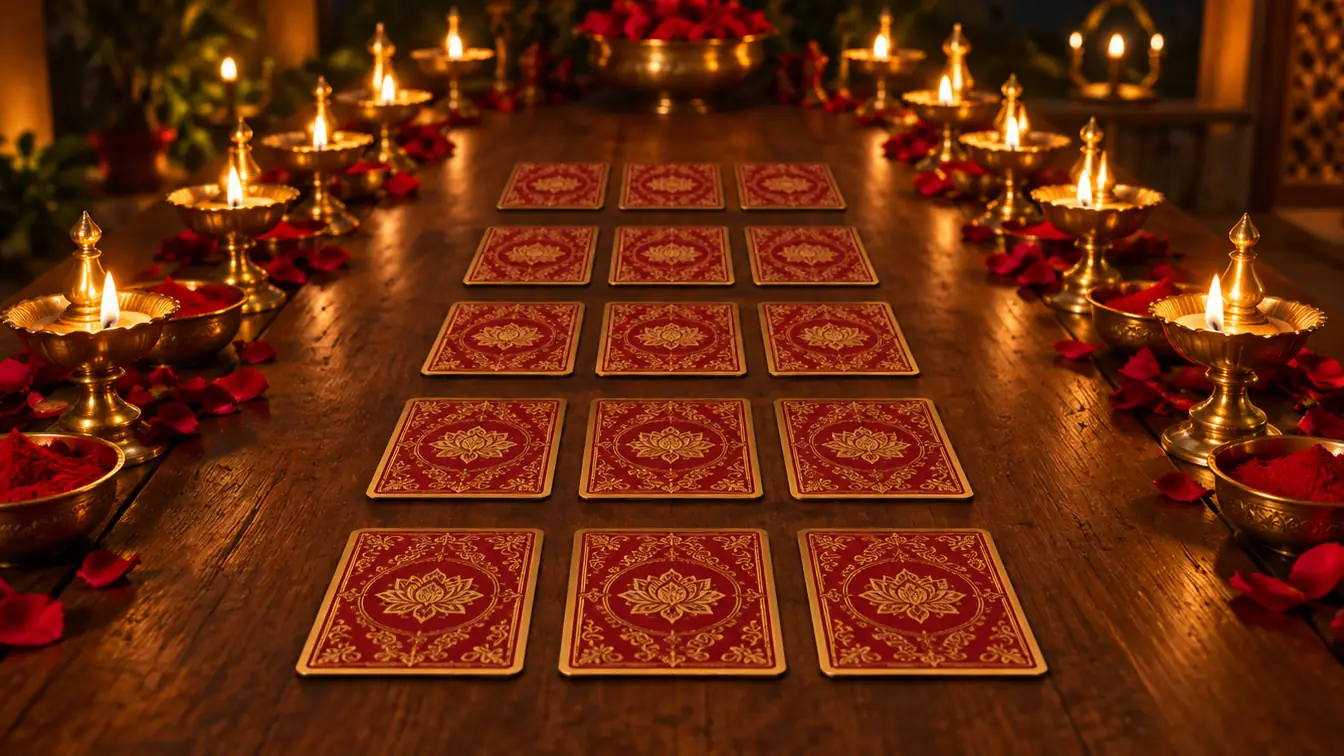
Five Ways to Lay Three Cards: Situation, Action, Outcome and More
Five useful three card tarot spread ideas are situation, action, outcome; mind, body, spirit; option A, option B, advice; keep, release, try; and you, the connection, what helps. Each suits a different kind of question. The key is to name the three positions before shuffling, then read the cards as one sentence.
Key takeaways
- Best for: a practical problem where you want a next step.
- Best for: a personal check-in when nothing specific is wrong but something feels off.
- Best for: a new season, a birthday or the start of a school year.
- Best for: relationships of any kind: partner, parent, friend or coworker.
- A three-card layout comes alive when you stop reading the cards one at a time.
Three cards are the workhorse of tarot. They are quick to lay, easy to remember and flexible enough for nearly any question. The trick is choosing what the three positions mean before you shuffle. Below are five three card tarot spread ideas that Astrologer and Psychic Vijayram uses often, with the kind of question each suits, a short example, and the mistake to watch for.
1. Situation, action, outcome
Best for: a practical problem where you want a next step.
The first card describes the situation as it really is, which may differ from how you have been telling it to yourself. The second suggests an approach. The third shows the likely direction if you take that approach. A teacher in Wedgwood unsure whether to apply for an assistant principal role might draw the Eight of Pentacles, the Page of Swords and the Six of Wands: steady, skilled work; an approach based on asking questions and learning the new role's demands; and a direction toward recognition. The reading does not say "apply." It says the preparation is there and curiosity is the way in.
Watch for: treating the outcome card as a promise. It describes a direction, and directions change as you do.
2. Mind, body, spirit
Best for: a personal check-in when nothing specific is wrong but something feels off.
The first card reflects your thoughts, the second your energy and physical routines, the third your sense of meaning. It suits the tired weeks of late summer or the stretch after a big event. A Ten of Wands in the body position often simply means you are carrying too much.
Watch for: reading the body card as anything medical. It describes how you are pacing yourself, not your health. Symptoms belong with a doctor.
3. Option A, option B, advice
Best for: a choice between two paths.
Lay one card for each option and a third, in the middle or below, for advice that applies whichever way you go. A nurse choosing between a day position and a night position at two Near Southside hospitals might find that the cards for each option say less than the advice card, which might show the Four of Swords: whatever you choose, protect your rest. That is often how this spread helps. The answer on using a spread to compare two job offers says more about this layout at work.
Watch for: choosing the option with the prettier card. Read what each card says about the trade-off, not which image you like better.
4. Keep, release, try
Best for: a new season, a birthday or the start of a school year.
The first card names something worth keeping, the second something to let go, the third something to try. It is gentle and forward-looking, which makes it a good spread for people who find tarot intimidating. A Three of Cups to keep (friendships), a Five of Pentacles to release (a habit of worrying about money you actually have), and an Ace of Wands to try (the class you keep postponing) gives a clear, human plan.
Watch for: using the release card to judge yourself. It names a pattern, not a failing.
5. You, the connection, what helps
Best for: relationships of any kind: partner, parent, friend or coworker.
The first card shows what you bring, the second the state of the connection between you, the third what would help it. Notice what is missing: there is no card for what the other person secretly thinks. That is deliberate. A spread built around your side of the relationship gives you something to act on, which is the approach the love tarot reading takes too.
Watch for: sliding the middle card into a statement about the other person's feelings. It describes the space between you, which you both shape.
Choosing among the five
| Your question sounds like | Try |
|---|---|
| "What do I do about this?" | Situation, action, outcome |
| "Why do I feel so flat?" | Mind, body, spirit |
| "This or that?" | Option A, option B, advice |
| "What should change this year?" | Keep, release, try |
| "How do we get along better?" | You, the connection, what helps |
If your question is genuinely yes or no, there is a separate method for that, shown in the worked yes-or-no example. If three cards feel too few for what you are facing, the Celtic Cross staff positions show how a ten-card layout adds depth.
Reading three cards as one sentence
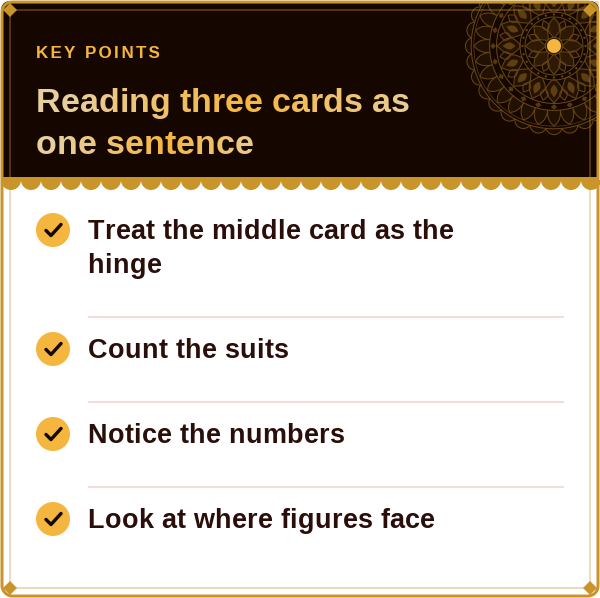
A three-card layout comes alive when you stop reading the cards one at a time. Some habits that help:
- Treat the middle card as the hinge. In most layouts it connects the other two.
- Count the suits. Two Cups suggests feeling is driving the question. Two Swords suggests thinking, or overthinking. The overview of the minor arcana suits is a quick refresher.
- Notice the numbers. Aces and twos lean toward beginnings, nines and tens toward completion.
- Look at where figures face. A figure looking away from the next card can suggest a disconnect between two parts of the question.
Readers differ in how they combine cards, and the general summary of how tarot card reading works notes how much interpretation varies from one tradition to another. That variety is a reason to choose one method and practice it, not a reason to give up.
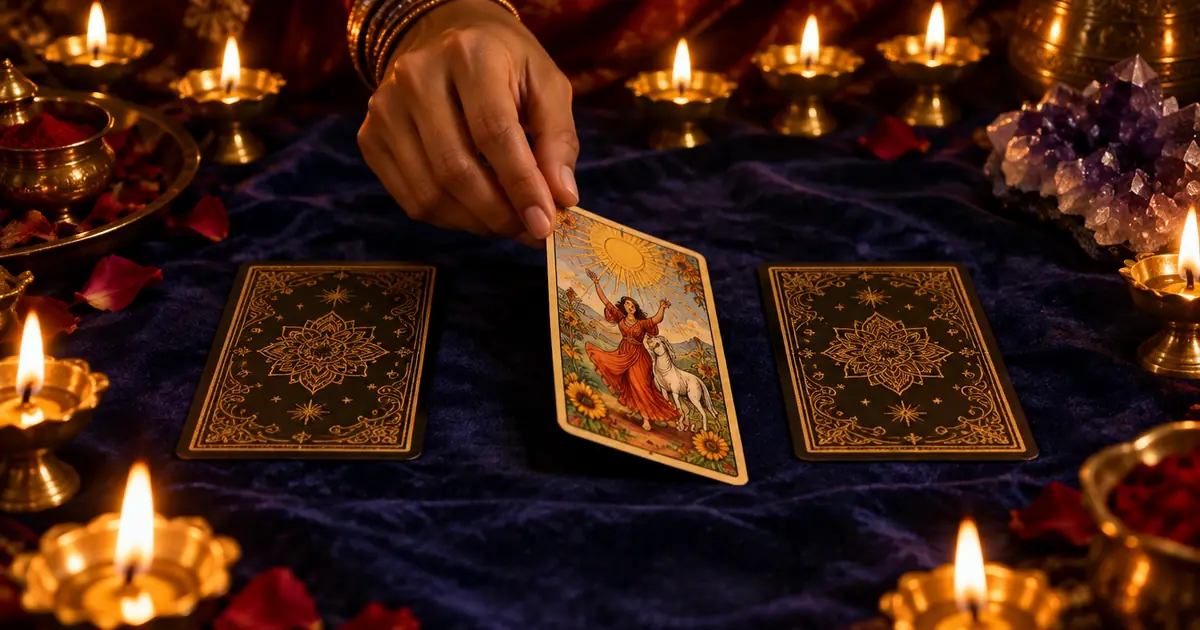
Where three cards stop
Three cards cannot cover every angle of a complicated situation, and they cannot predict how other people will act. They give you a clear, compact picture to think with. For help laying one live, by phone or video, see the tarot card reading session, or read the short answer on how many cards a reading uses.
Common questions
What is the most common three card spread?
Past, present, future is the best known. Many readers now prefer a version phrased as what led here, where things stand, and where things head if nothing changes, because it keeps the last card as a direction rather than a fixed result.
Should I decide the positions before I shuffle?
Yes. Naming the positions first stops you from rearranging the meaning after you see the cards. Write them down if it helps.
Can a three card spread answer a big question?
It can open one up. For a tangled situation with several people and pressures, a larger layout gives more room, but three cards are often enough to show where to start.
What if all three cards are major arcana?
Many readers take that as a sign the question touches a significant theme in your life rather than a passing matter. It is a reason to slow down, not a reason for alarm.
Related service
Keep reading
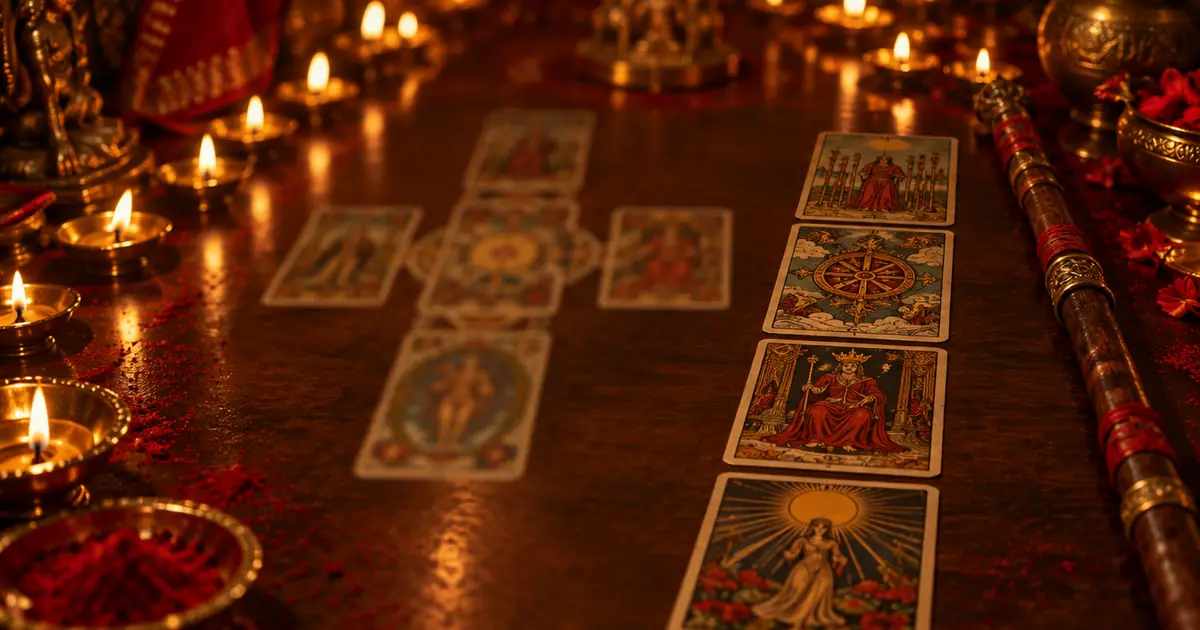
The Celtic Cross Staff: Positions Seven to Ten in Depth
The Celtic Cross tarot spread's right-hand column in depth: self, surroundings, hopes and fears, and likely direction, with a worked example and common errors.
Read article →
Upright-Only Tarot: How Meaning Comes From Neighboring Cards
Tarot without reversals: the case for and against upright-only reading, how neighboring cards carry the nuance instead, and how to tell your reader.
Read article →
Learning the Tarot Suits Through Fort Worth Scenes
Minor arcana suits meaning made easy: Cups, Pentacles, Swords and Wands pictured as a family dinner, a paycheck, a hard talk and a new venture in Fort Worth.
Read article →Quick answers
How many cards are used in a tarot reading?
How many cards are used in a tarot reading? Usually one to ten from a 78-card deck, depending on the spread. A Fort Worth reader explains the common layouts.
Read answer →Can tarot and astrology be combined in one session?
Tarot and astrology can be combined in one session: the chart gives timing and background, the cards focus on one question. How it works in Fort Worth.
Read answer →Talk to Astrologer and Psychic Vijayram
Tell us what you are facing. If a reading is unlikely to help, you will be told that plainly.