
The Celtic Cross Staff: Positions Seven to Ten in Depth
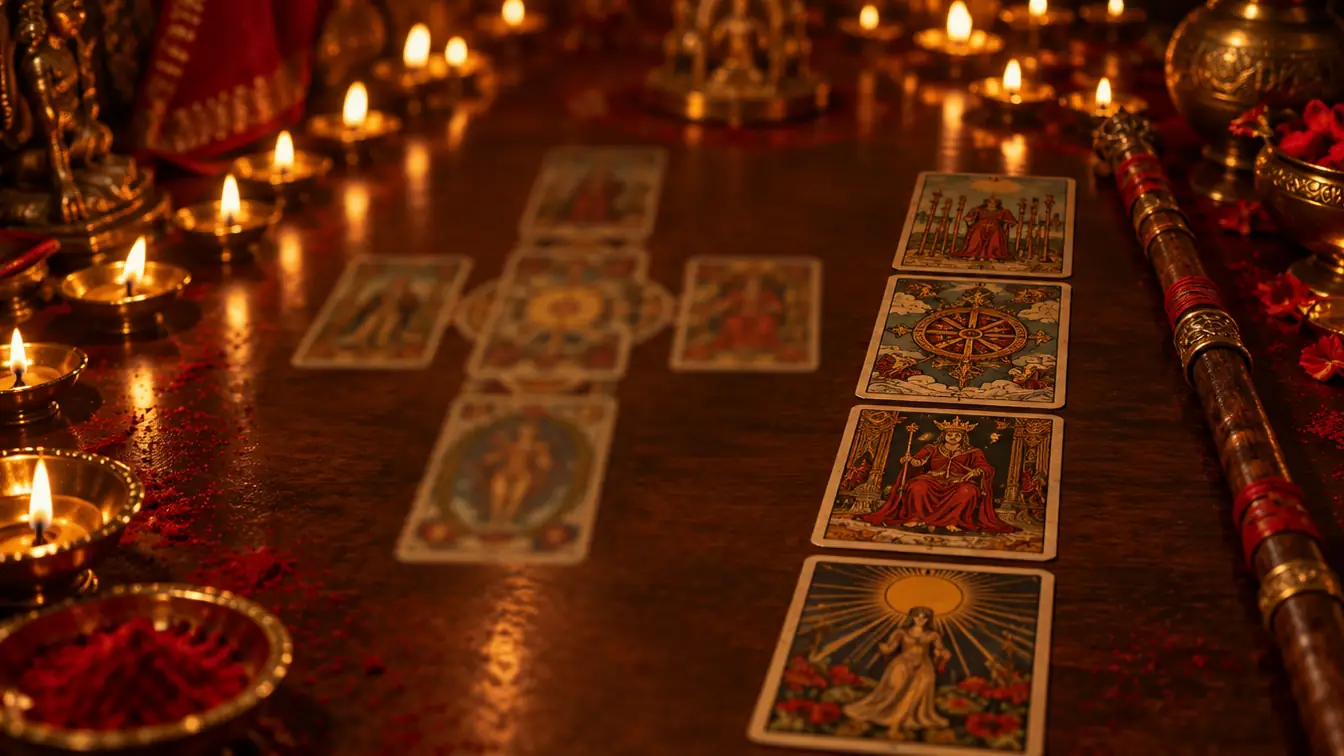
In the Celtic Cross tarot spread, positions seven to ten form the staff, a column to the right of the cross. Seven shows your own stance, eight your surroundings and the people around you, nine your hopes and fears, and ten the likely direction if things continue. Read them as a column, bottom to top, not as four separate answers.
Key takeaways
- Waite's description, which most modern readers follow in some form, the cross is laid first:
- Card seven is about you: your attitude toward the question, the position you are taking, the role you have slipped into.
- Waite called this "his house," and modern readers widen it to the setting and the people around you: family, coworkers, friends, the culture of a workplace, the expectations of a community.
- One position holds both, because what we hope for and what we dread are often the same thing seen from two sides.
- Waite called the last card "what will come," the result that the other cards point toward.
The Celtic Cross tarot spread is the ten-card layout most people picture when they think of a full reading. Six cards form a cross on the left; four more stand in a column on the right. That column is called the staff, and it is where many readings quietly go wrong. Readers lavish attention on the cross, then hurry through cards seven to ten as if they were a summary. They are not. The staff is where the reading turns from describing the situation to describing you inside it.
The whole layout in one glance
In A. E. Waite's description, which most modern readers follow in some form, the cross is laid first:
- 1. What covers you: the heart of the matter.
- 2. What crosses you: the obstacle or opposing force.
- 3. What crowns you: the aim or the best available result.
- 4. What lies beneath: the foundation.
- 5. What is behind: the influence now passing.
- 6. What is before: the influence coming into play.
Then the staff is built from the bottom up. Waite's own wording for each position can be read in The Pictorial Key to the Tarot, in the section on an ancient Celtic method of divination. His names were brief: "himself," "his house," "his hopes or fears," and "what will come." Each deserves more than a line.
Position seven: your own stance
Card seven is about you: your attitude toward the question, the position you are taking, the role you have slipped into. It is easiest to read alongside card one. If card one describes the situation as tense and card seven shows the Four of Pentacles, the reading might be that you are holding on tightly, perhaps more tightly than the situation requires.
Ask: is this stance helping me? Seven is the card in the spread you have the most power to change.
Position eight: your surroundings
Waite called this "his house," and modern readers widen it to the setting and the people around you: family, coworkers, friends, the culture of a workplace, the expectations of a community. A Fort Worth reading might see the Three of Pentacles here and talk about a team at work; or the King of Cups and talk about a steady, kind relative whose opinion carries weight.
Card eight is not a verdict on any one person. It describes the climate you are working in. Ask: what support or pressure surrounds this question, and what can I do with it?
Position nine: hopes and fears
This is the most human card in the spread. One position holds both, because what we hope for and what we dread are often the same thing seen from two sides. A person hoping to be asked to lead a project may fear being found out as unready. A person hoping a relationship becomes serious may fear losing their independence.
When a hard card lands here, such as the Nine of Swords, it often describes worry rather than circumstances. When a bright one lands, such as the Sun, ask whether some part of you is afraid of getting what you want.
Position ten: the likely direction
Waite called the last card "what will come," the result that the other cards point toward. A careful reader treats it as a direction, not a fixed event. It answers: if things continue as the other nine cards describe, where are they heading? That framing matters. Change your stance in card seven, or respond differently to the pressures in card eight, and the direction can change too.
Read card ten against card three. If the crown shows what you are aiming for and the final card shows where things are heading, the gap between them is the real subject of the reading.
Reading the staff as a column
Read upward, the staff tells a short story: this is how you stand, this is the world around you, this is what you hope and fear, and this is where it leads. A reader who takes the four cards together will catch things single cards miss. A run of Swords up the staff suggests a question being fought out in the head. A major card at seven and minor cards above it suggests a big inner theme meeting ordinary daily conditions.
A worked example
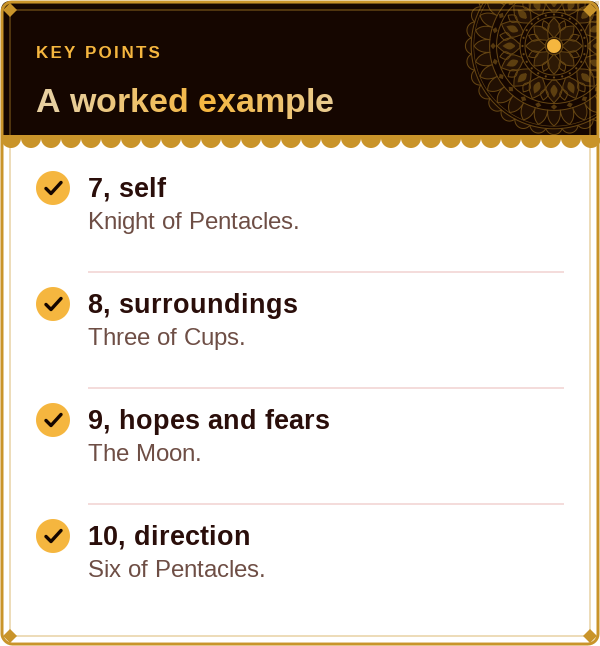
Here is an illustrative case. A woman in her forties working full time in Haltom City is weighing whether to enroll in evening classes at Tarrant County College. The staff shows:
- 7, self: Knight of Pentacles. Slow, steady, dependable, but perhaps waiting for perfect conditions.
- 8, surroundings: Three of Cups. Friends and family who would celebrate with her.
- 9, hopes and fears: the Moon. Uncertainty, the fear of not knowing how it will feel to be a student again.
- 10, direction: Six of Pentacles. Exchange and balance: giving time and receiving something back.
Read as a column, the staff says her support is there, her fear is about the unknown rather than about any real obstacle, and the direction points toward a fair exchange of effort for reward. The reading does not tell her to enroll. It shows her that the hesitation is mostly hers, and that is something she can work with.
Where the Celtic Cross fits in a year-ahead session
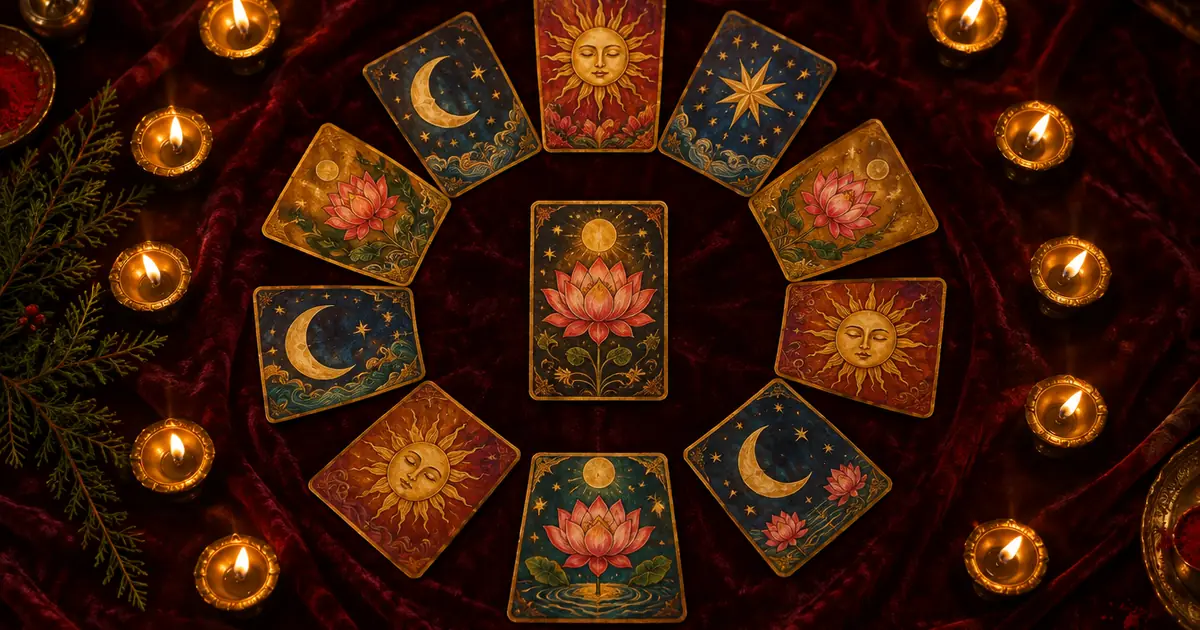
Some clients like to open a year-ahead tarot reading with a Celtic Cross on one central question for the year, then lay the twelve monthly cards. The cross gives depth on the main theme; the months give a rhythm to plan around. For a lighter version tied to your birthday, see the twelve-card birthday spread. For quick questions, the five three-card layouts are a better fit than ten cards.
Common mistakes with cards seven to ten
- Reading card ten first and letting it color everything else.
- Treating card eight as a judgment of a specific person.
- Skipping the fear side of card nine because the card looks cheerful.
- Reading the staff from the top down when it was laid from the bottom up, or the reverse.
How readers handle reversed cards in the staff also varies widely, as the general account of tarot card reading notes. Some read upright only, drawing meaning from neighbors, an approach covered in the post on upright-only tarot.
What ten cards still cannot show
A Celtic Cross gives more detail than a short spread, but more cards do not make a forecast. The final card describes a direction under present conditions, and it cannot know what you or other people will decide next week. Astrologer and Psychic Vijayram reads it as a starting point for your choices, not the last word on them.
Common questions
Which position in the Celtic Cross is the outcome?
Position ten. Waite called it what will come, meaning the result the other cards point toward. Most readers today describe it as the likely direction, since it depends on the stance and choices shown in the rest of the spread.
Why do hopes and fears share one position?
Because they are often the same wish seen from two sides. Someone longing for a promotion may also dread the responsibility it brings. One card in that position lets the reader explore both.
Is the Celtic Cross too complicated for a first reading?
Not if the reader explains it. For a beginner reading alone, a three-card spread is easier, but in a guided session ten cards simply give more room to see a complicated situation.
Does the order the staff is laid matter?
In Waite's layout the staff is laid from the bottom up, seven to ten. Some readers lay it top down. Either works if you know which convention you are using before you start.
Related service
Keep reading
Upright-Only Tarot: How Meaning Comes From Neighboring Cards
Tarot without reversals: the case for and against upright-only reading, how neighboring cards carry the nuance instead, and how to tell your reader.
Read article →
Learning the Tarot Suits Through Fort Worth Scenes
Minor arcana suits meaning made easy: Cups, Pentacles, Swords and Wands pictured as a family dinner, a paycheck, a hard talk and a new venture in Fort Worth.
Read article →
Linking Tarot Court Cards to Elements in Your Birth Chart
Tarot court cards meaning, linked to the fire, earth, air and water signs of a Vedic chart: how readers draw the link, where it helps and where it is forced.
Read article →Quick answers
How many cards are used in a tarot reading?
How many cards are used in a tarot reading? Usually one to ten from a 78-card deck, depending on the spread. A Fort Worth reader explains the common layouts.
Read answer →Is a tarot spread useful when comparing two job offers?
A tarot spread can help when comparing two job offers by clarifying what you value. It never replaces checking pay, benefits and terms. A Fort Worth guide.
Read answer →Talk to Astrologer and Psychic Vijayram
Tell us what you are facing. If a reading is unlikely to help, you will be told that plainly.