
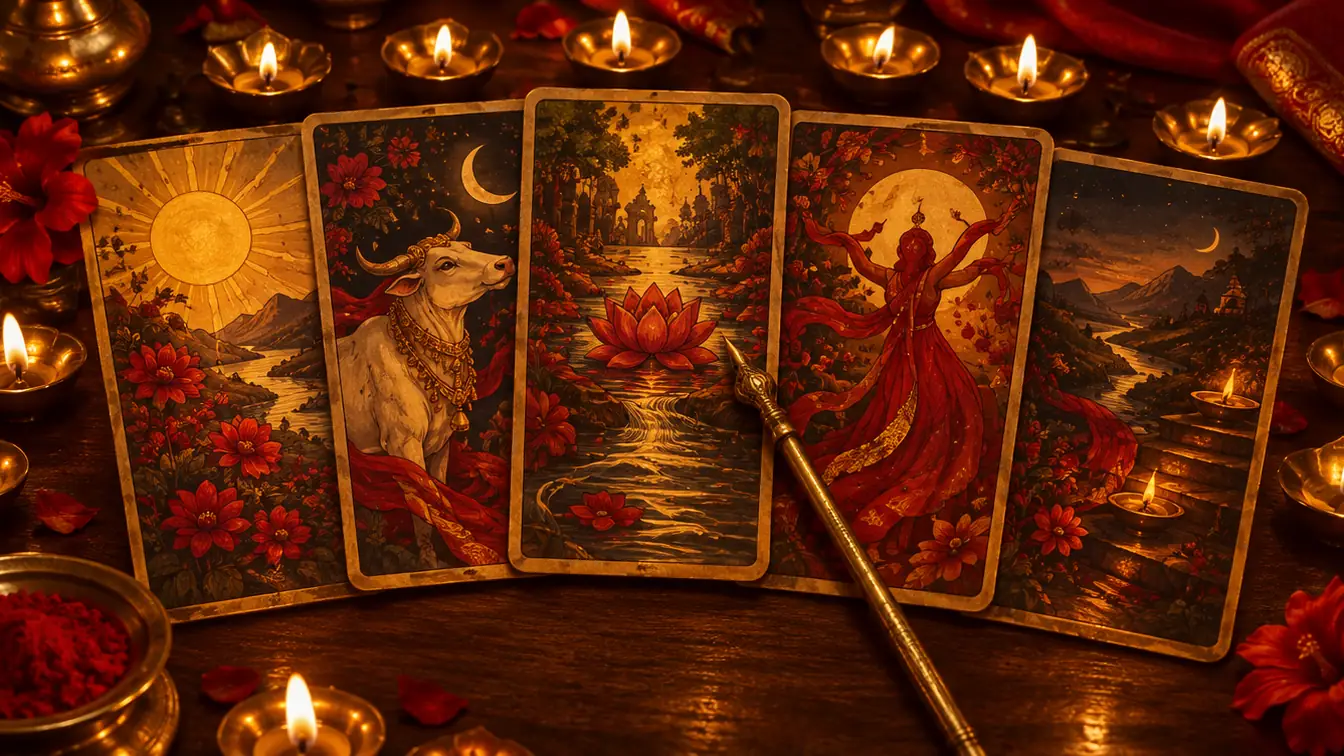
Upright-Only Tarot: How Meaning Comes From Neighboring Cards
Reading tarot without reversals means every card is read upright, and the shading a reversal would add comes from the cards beside it instead. Neighbors of the same suit or element strengthen a card; clashing ones soften or complicate it. It is a common, respected approach, and you can simply ask your reader to use it.
Key takeaways
- Common approaches treat a reversal as the card's energy blocked, delayed, turned inward, or pushed too far.
- The useful question is which method you, or your reader, can apply consistently.
- Several habits do the work reversals would otherwise do.
- Take the Six of Cups, a card of memory and simple kindness.
- Astrologer and Psychic Vijayram will prepare the deck to suit you, turning every card upright before the shuffle if that is your choice.
Ask three tarot readers about reversed cards and you may hear three answers. One reads every upside-down card as its own meaning. One turns them all upright before starting. One uses them only for certain questions. Tarot without reversals is a long-standing way of working, and it is not a shortcut. It simply moves the subtlety from the card's direction to the company it keeps. This post sets out the case for and against, explains how neighboring cards take over the job, and covers how to tell your reader which you prefer.
What reversals are meant to add
When a card comes out of the deck upside down, readers who use reversals give it a modified meaning. Common approaches treat a reversal as the card's energy blocked, delayed, turned inward, or pushed too far. A reversed Queen of Cups might be care that has tipped into self-neglect; a reversed Ace of Pentacles might be an opportunity not yet ready.
The habit is old. A. E. Waite listed a reversed meaning for every card in The Pictorial Key to the Tarot, and many of those meanings are terse lists of words rather than explanations. Readers since then have built very different systems on top of them, which is part of why reversals confuse beginners.
The case for upright-only reading
- The images were drawn upright. A figure pouring water or walking a road reads naturally one way up. Turning it over can obscure what the picture shows.
- Seventy-eight meanings, not 156. Learning each card deeply is easier than learning two versions of each shallowly.
- Shuffling is not neutral. How many cards come out reversed depends partly on how a deck was shuffled and stored. Some readers are uneasy giving that much weight to handling.
- Less fear. Clients who already feel anxious often hear "reversed" as "bad." Upright reading removes that jolt.
The case for keeping reversals
- Extra nuance in small spreads. With one or three cards, a reversal gives information that neighbors cannot, because there are few neighbors.
- A clear signal of tension. A spread with many reversals can flag that the whole question feels stuck.
- Tradition. Many readers learned this way and read fluently with it.
Both sides have a point. The useful question is which method you, or your reader, can apply consistently.
How neighboring cards carry the meaning
Upright-only readers look sideways. Several habits do the work reversals would otherwise do.
Suit and element agreement
In a system often called elemental dignities, each suit is linked to an element: Wands to fire, Cups to water, Swords to air, Pentacles to earth. Cards of the same or friendly elements strengthen each other. Fire and water are treated as opposed, and so are air and earth; a card flanked by opposing elements is weakened or complicated. A Ten of Wands between two Cups, for instance, reads as a heavy load softened by care from others, or a burden carried for emotional reasons.
Flanking cards
A single card between two others is read as being shaped by both. The Three of Swords with the Six of Cups and the Star on either side tells a story of an old hurt beginning to ease. The same card between the Five of Swords and the Nine of Swords describes a grievance that is still being replayed.
Direction of gaze
In the Rider-Waite-Smith deck many figures face left or right. A figure looking toward the next card suggests connection; looking away suggests distance or avoidance.
Majors among minors
A major arcana card surrounded by minors stands out as the central theme. Several majors together suggest the question touches something larger than daily life.
One card, two readings
Take the Six of Cups, a card of memory and simple kindness. A reader using reversals who draws it upside down might say: you are stuck in the past. An upright-only reader looks at its neighbors instead. With the Five of Cups on one side and the Eight of Cups on the other, the same idea appears: grief over what was, then walking away. With the Ace of Cups and the Two of Cups beside it, the Six of Cups becomes something warm: an old connection renewed. The neighbors tell you which way the memory is pulling.
Telling your reader which you prefer
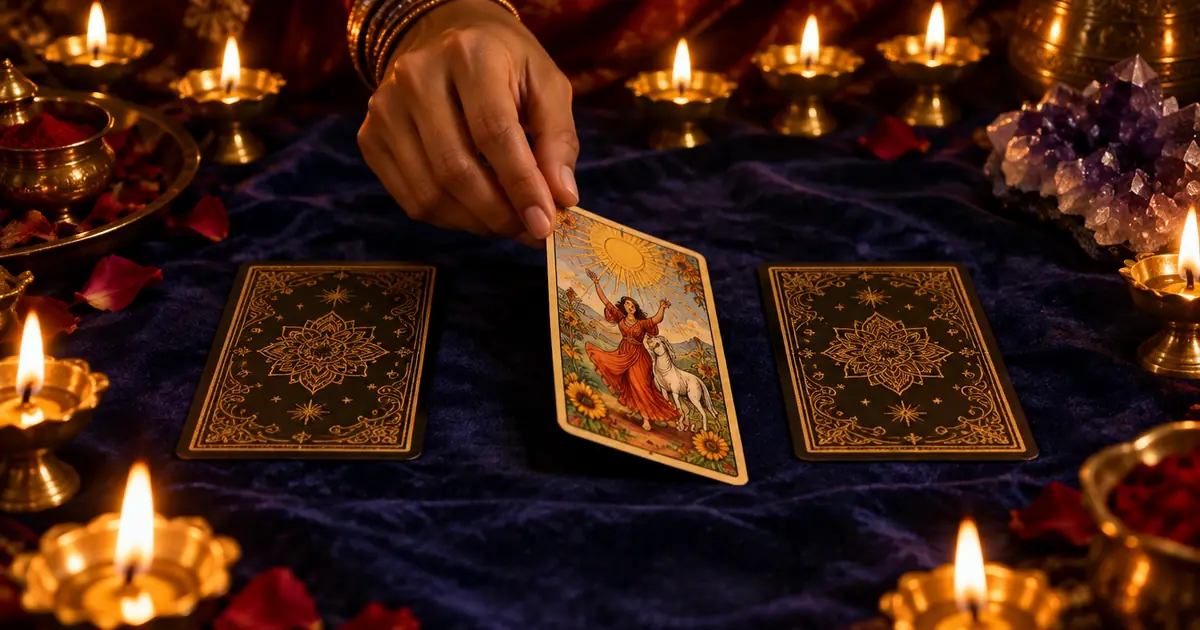
If you book a tarot card reading, say at the start whether you want reversals used. Astrologer and Psychic Vijayram will prepare the deck to suit you, turning every card upright before the shuffle if that is your choice. On video you will see the cards laid; on the phone each card is named, along with its position. If you have no preference, ask how the reader usually works and why. A good reader can explain the approach in a sentence.
Larger layouts give neighbors more to say. The Celtic Cross staff is a good example, because each card in the column sits between two others. For a gentle daily habit, many people find upright reading easier, as the one-card walking reflection suggests.
Trying both yourself
If you read for yourself, try a month each way. Keep a short note of each draw. Many people find that one method feels natural and the other forced, and the difference tells you more than any rule. The general summary of tarot card reading shows how widely readers vary on this and many other points of method.
The limit either way
Neither method makes tarot more accurate in the sense of predicting events. Reversals and neighboring cards are two ways of adding nuance to a reflective conversation. A reading cannot tell you what will happen or what someone else intends, whichever way up the cards come out.
Common questions
Are reversed tarot cards bad?
No. A reversed card is not a bad omen. Readers who use reversals usually take them to mean a quality that is blocked, delayed, turned inward or overdone. Many readers do not use them at all.
Do professional readers use reversals?
Some do and some do not. It is a matter of method rather than skill. What matters is that the reader is consistent and explains the approach before the cards are laid.
What are elemental dignities?
An old method for reading cards by their neighbors. Each suit is linked to an element, and cards are thought to strengthen or weaken each other depending on whether their elements agree or clash.
Related service
Keep reading
Learning the Tarot Suits Through Fort Worth Scenes
Minor arcana suits meaning made easy: Cups, Pentacles, Swords and Wands pictured as a family dinner, a paycheck, a hard talk and a new venture in Fort Worth.
Read article →
Linking Tarot Court Cards to Elements in Your Birth Chart
Tarot court cards meaning, linked to the fire, earth, air and water signs of a Vedic chart: how readers draw the link, where it helps and where it is forced.
Read article →
Pairing a Tarot Spread With Your Current Dasha
A tarot and astrology reading, step by step: read your running dasha and antardasha first, then lay a five-card spread on how to work with that period.
Read article →Quick answers
How many cards are used in a tarot reading?
How many cards are used in a tarot reading? Usually one to ten from a 78-card deck, depending on the spread. A Fort Worth reader explains the common layouts.
Read answer →Can tarot and astrology be combined in one session?
Tarot and astrology can be combined in one session: the chart gives timing and background, the cards focus on one question. How it works in Fort Worth.
Read answer →Talk to Astrologer and Psychic Vijayram
Tell us what you are facing. If a reading is unlikely to help, you will be told that plainly.