
Linking Tarot Court Cards to Elements in Your Birth Chart
Tarot court cards meaning combines two parts: rank (Page, Knight, Queen, King) shows a stage or style, and suit shows an element. Some readers link that element to fire, earth, air and water signs in a Vedic chart, so a fire-heavy chart may echo the Wands court. The link can help self-reflection but is a modern overlay.
Key takeaways
- Pages are students and messengers: curiosity, first attempts, news.
- Jyotish, the Indian astrological tradition summarized in the overview of Hindu astrology , groups the twelve rashis by element:
- The simplest version matches suit to element: Wands to fire signs, Cups to water, Swords to air, Pentacles to earth.
- Jyotish grew from a different tradition over a much longer period.
- Tarot cards work as a structured set of images that prompt reflection; they do not transmit hidden information about you.
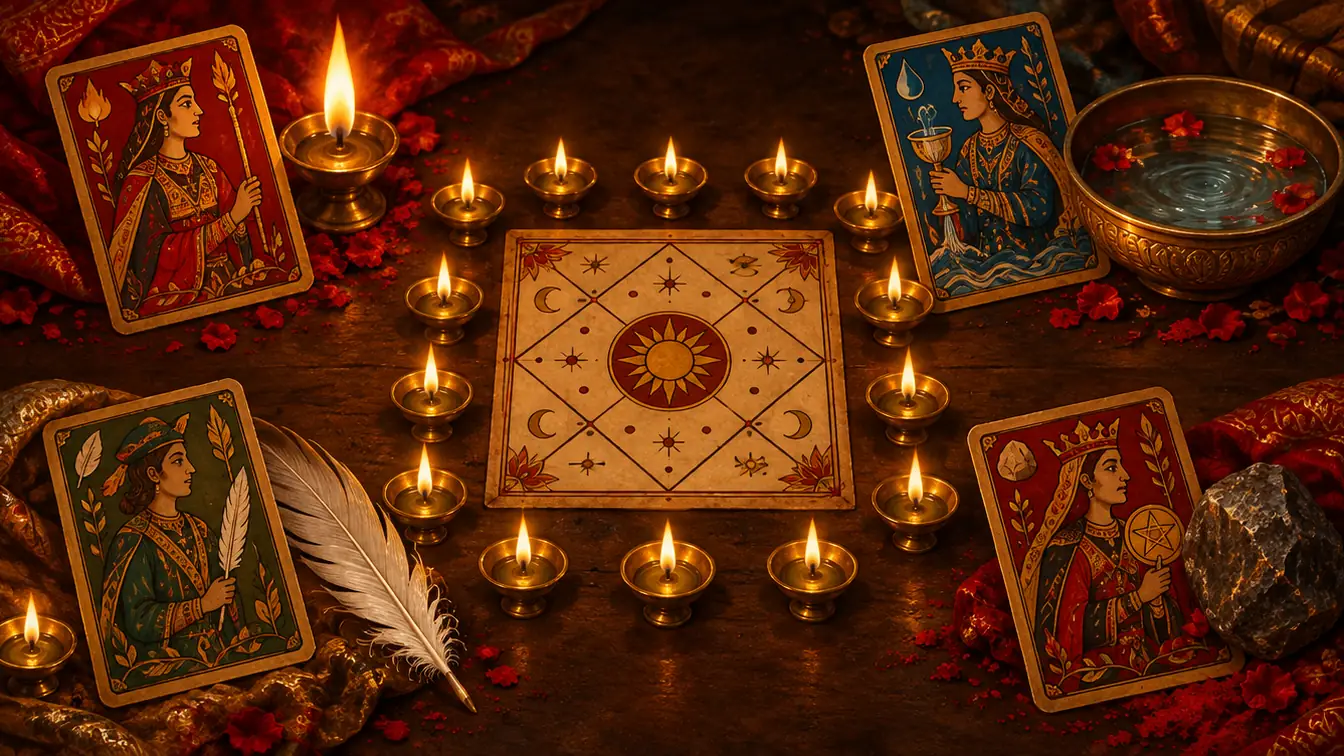
Sixteen cards in the tarot deck wear crowns, ride horses or carry messages: the Pages, Knights, Queens and Kings. Tarot court cards meaning has two layers. The rank describes a stage or style, from the curious beginner to the established authority. The suit describes an element: fire, water, air or earth. Because a Vedic birth chart also sorts its twelve signs into those same four elements, some readers like to connect the two. This post explains how that link is made, where it genuinely helps, and where it becomes a stretch.
The court in one paragraph
Pages are students and messengers: curiosity, first attempts, news. Knights are movement: pursuit, zeal, and sometimes recklessness. Queens hold mastery inwardly: steadiness, care, deep knowledge. Kings turn mastery outward: authority, responsibility, decisions that affect others. Pair a rank with a suit and you get a portrait. The Knight of Swords charges into an argument; the Queen of Pentacles runs a household with practical warmth; the King of Cups stays calm while everyone else is upset.
The four elements in a Vedic chart
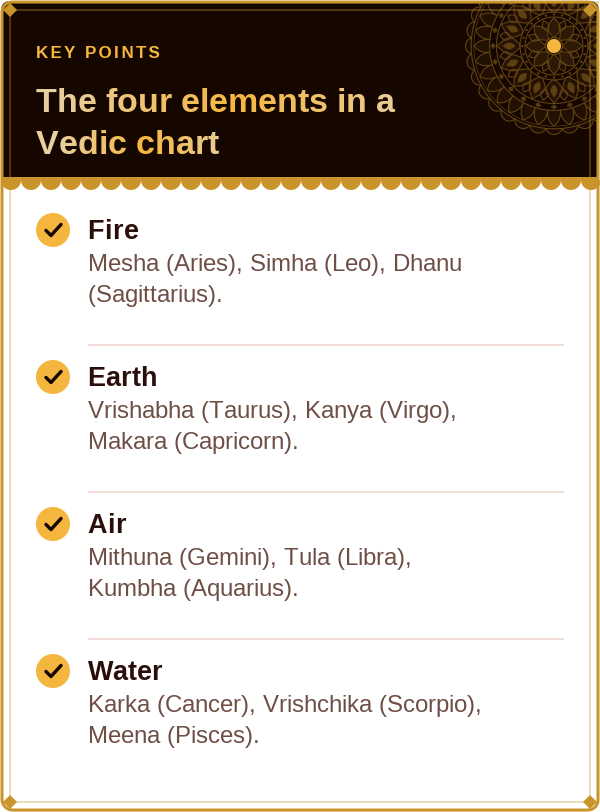
Jyotish, the Indian astrological tradition summarized in the overview of Hindu astrology, groups the twelve rashis by element:
- Fire: Mesha (Aries), Simha (Leo), Dhanu (Sagittarius).
- Earth: Vrishabha (Taurus), Kanya (Virgo), Makara (Capricorn).
- Air: Mithuna (Gemini), Tula (Libra), Kumbha (Aquarius).
- Water: Karka (Cancer), Vrishchika (Scorpio), Meena (Pisces).
In a Vedic reading the ascendant (lagna) and the Moon sign carry the most weight for temperament, and planets spread across other signs add their own colors. Almost every chart contains several elements.
How the link is usually drawn
The simplest version matches suit to element: Wands to fire signs, Cups to water, Swords to air, Pentacles to earth. A person with the lagna and Moon in fire signs might recognize themselves in the Wands court and find the Pentacles court foreign.
A second layer gives each rank an element too. In one widely used scheme, Pages are earth, Knights air, Queens water and Kings fire; other readers swap Knights and Kings. Combine the two and each court card becomes a blend: the Queen of Wands is the water of fire, warm confidence with emotional depth; the Page of Cups is the earth of water, feeling made practical and new.
Here is how that might play out. Someone born in Fort Worth with a Simha lagna and the Moon in Karka might find the Queen of Wands an uncannily good mirror: outgoing and generous on the surface, deeply feeling underneath. That recognition can open a useful conversation about how they lead at work and care at home.
Where the link helps
- It gives shared language. Clients who know their chart often grasp a court card faster when it is tied to an element they already understand.
- It flags imbalance. A chart with little earth and a spread full of Pentacles court cards can prompt a good question: is the practical side of life asking for attention?
- It helps choose a significator. Some readers pick a court card to represent the client, and the chart offers a reasoned way to choose one.
Where the link is forced
Honesty requires a few cautions. The element scheme in tarot comes largely from nineteenth-century Western occult circles, especially the Hermetic Order of the Golden Dawn, whose members included both Waite and Smith, the designer and artist of the Rider-Waite-Smith deck. Jyotish grew from a different tradition over a much longer period. The overlap in elements is real but the systems were not built together.
The Golden Dawn also tied court cards to spans of the zodiac, but it used the tropical zodiac. Vedic astrology uses the sidereal zodiac, which currently sits roughly 24 degrees away, as the explanation of sidereal and tropical astrology sets out. Borrow those degree spans into a Vedic chart and they no longer line up. It is better to stay with the broad element link and leave the detailed attributions alone.
Finally, no person is one element. Reducing someone to "a fire person" because of one sign ignores the rest of the chart and the rest of the person.
How tarot cards work in this kind of reading
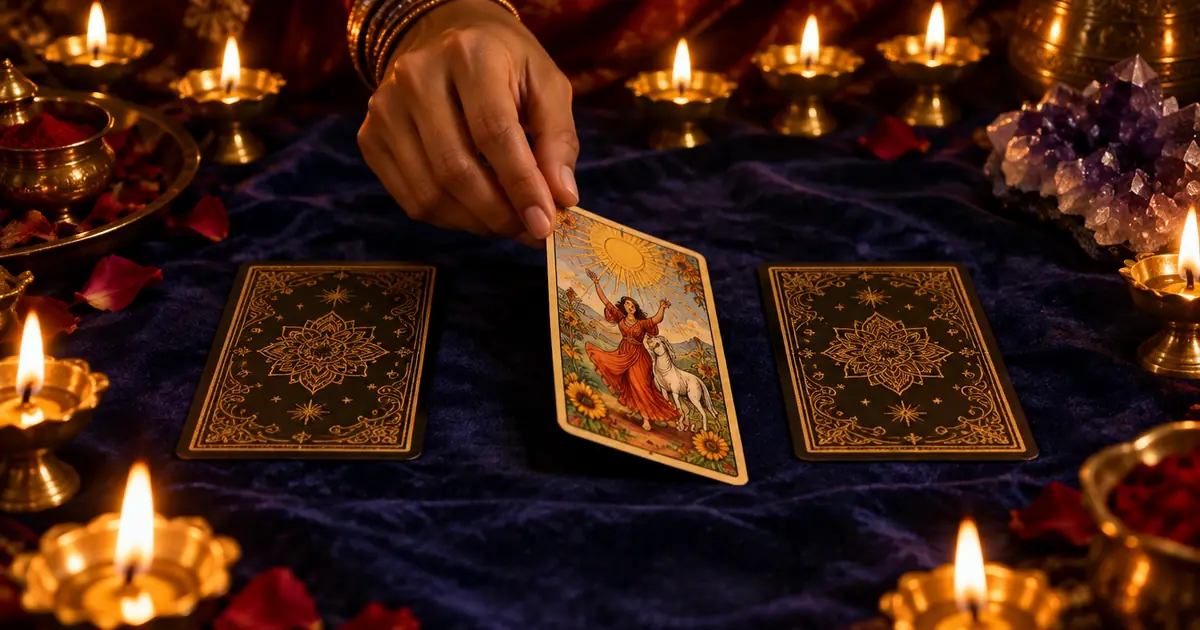
Tarot cards work as a structured set of images that prompt reflection; they do not transmit hidden information about you. In a combined session, the chart sets out lasting tendencies and the current period, and the cards are laid on a specific question. Court cards then act as mirrors: does this portrait fit how you are behaving, or how you wish you were? The answer on combining tarot and astrology in one session explains how the time is shared, and the post on pairing a tarot spread with your dasha shows a full worked method.
Trying it in a session
If you would like to explore your chart's elements and the court cards together, start with a tarot card reading and mention that you know your birth details, or book a full kundli and birth chart reading if the chart is your main interest. Astrologer and Psychic Vijayram will tell you plainly when a court card seems to fit your chart and when the match looks like wishful thinking. For element pairings between two people, the post on water and fire Moons in couple charts takes a different angle.
What the comparison cannot do
Linking a court card to your chart does not make it a description of a real person in your life, and it cannot predict love, money or timing. It is a lens for self-reflection. Used lightly, it can sharpen a reading. Pressed too hard, it turns two rich traditions into a personality quiz.
Common questions
How many tarot cards are in a deck?
A standard tarot deck has 78 cards: 22 major arcana and 56 minor arcana. Sixteen of the minor arcana are court cards, a Page, Knight, Queen and King in each of the four suits.
How are tarot cards made?
Modern decks are printed on coated card stock from a designer's artwork, then cut, sometimes edge-gilded and boxed. The most copied design, the Rider-Waite-Smith deck, was illustrated by Pamela Colman Smith to A. E. Waite's directions and first published in London in 1909.
Can tarot cards predict love?
No. Tarot cards can help you reflect on what you feel, want and fear in love, and on your own next step. They cannot foretell who you will meet or decide what another person will feel.
Do I need my birth chart to read court cards?
No. Most readers interpret court cards without any astrology. The chart link is an optional extra for people who already know their signs and find the comparison useful.
Related service
Keep reading
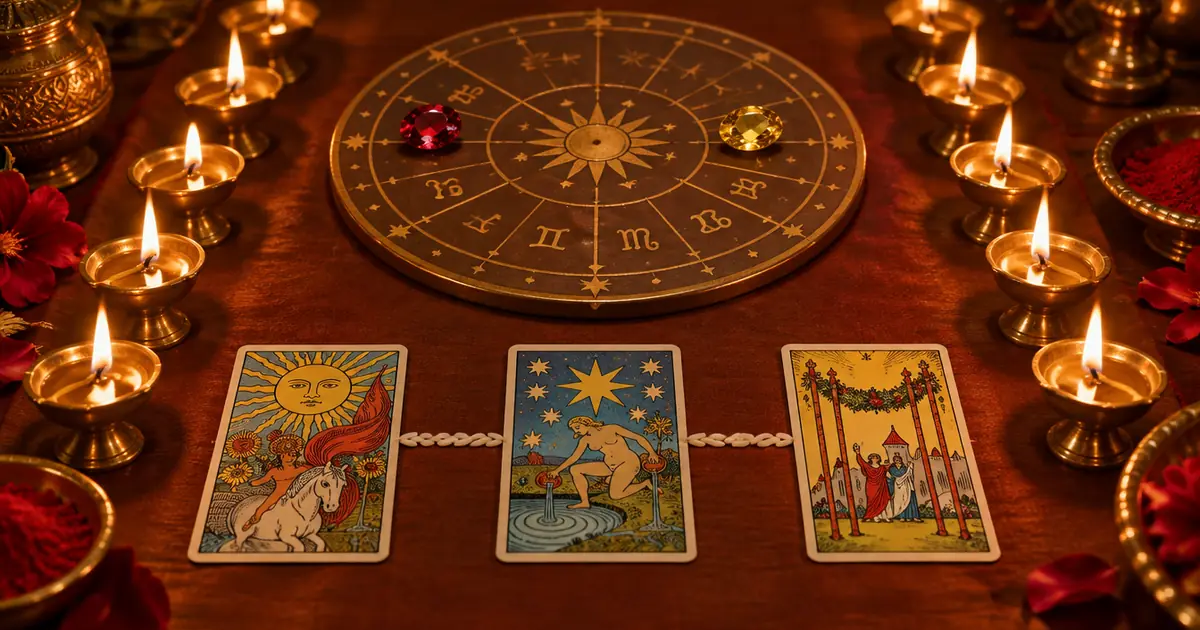
Pairing a Tarot Spread With Your Current Dasha
A tarot and astrology reading, step by step: read your running dasha and antardasha first, then lay a five-card spread on how to work with that period.
Read article →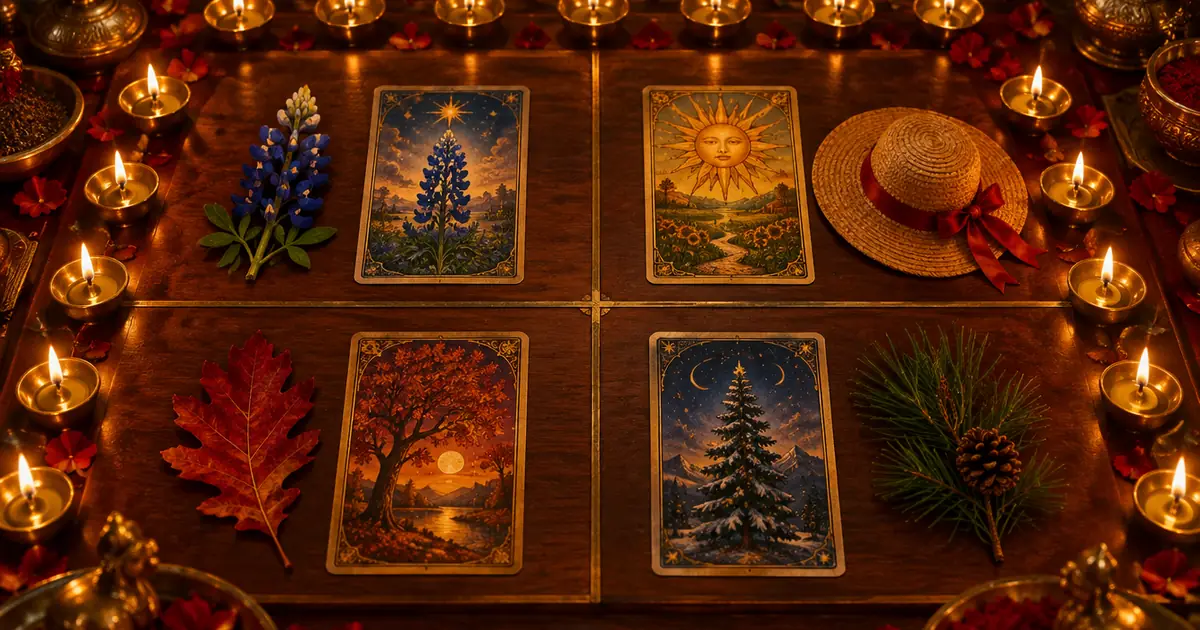
Seasonal Tarot Check-Ins: Four Readings Around the Texas Year
How often to get a tarot reading? A quarterly rhythm tied to the Fort Worth year, from Stock Show winter to fall festivals, works better than repeat pulls.
Read article →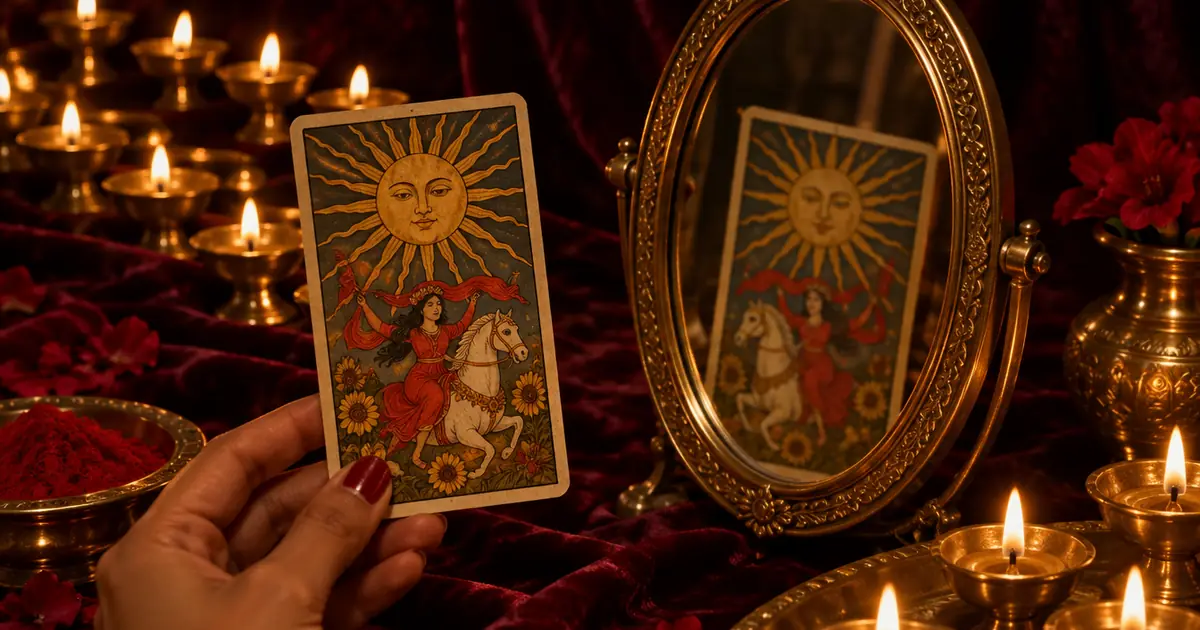
Tarot as a Mirror, Not a Forecast: Reading Patterns in the Present
Can tarot predict the future? An honest answer: cards reflect present patterns and likely directions, what that means for date questions and how to use it.
Read article →Quick answers
How many cards are used in a tarot reading?
How many cards are used in a tarot reading? Usually one to ten from a 78-card deck, depending on the spread. A Fort Worth reader explains the common layouts.
Read answer →Can tarot and astrology be combined in one session?
Tarot and astrology can be combined in one session: the chart gives timing and background, the cards focus on one question. How it works in Fort Worth.
Read answer →Talk to Astrologer and Psychic Vijayram
Tell us what you are facing. If a reading is unlikely to help, you will be told that plainly.