
Pairing a Tarot Spread With Your Current Dasha
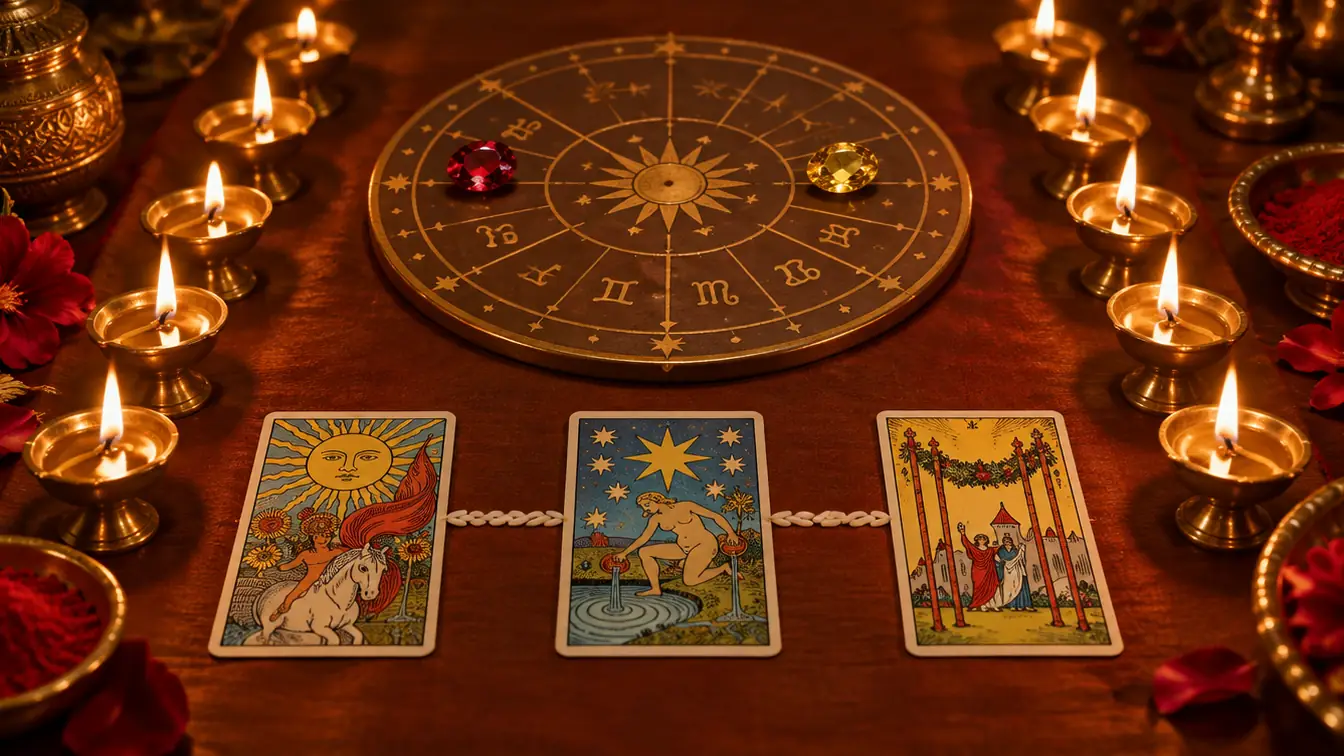
A tarot and astrology reading can start with the chart and finish with the cards. First the running dasha and antardasha are read to name the season you are in. Then a short spread is laid on how to work with that season: what it asks, what helps and what drains you. The chart sets context; the cards add detail.
Key takeaways
- In Vedic astrology, a person's life is divided into planetary periods called dashas.
- The details here are illustrative rather than a real client's.
- A Venus period in a chart where Venus rules the tenth house may be more about work than romance.
- Putting a chart and a spread together does not turn either into a forecast.
Some clients want a tarot reading. Some want their chart read. A growing number want both, and ask how the two fit together without one simply repeating the other. Here is a concrete method Astrologer and Psychic Vijayram uses for a tarot and astrology reading: read the running dasha first to name the season you are in, then lay a spread on how to work with that season. Below are the steps, followed by an example session explained card by card.
Why start with the dasha
In Vedic astrology, a person's life is divided into planetary periods called dashas. The most widely used scheme, Vimshottari, runs through nine planets over a 120-year cycle, beginning from the nakshatra the Moon occupied at birth; the overview of dasha periods lists the lengths, from six years for the Sun to twenty for Venus. Each major period (mahadasha) is subdivided into sub-periods (antardashas), and the combination colors the months or years you are living through.
A dasha describes a season, not a single event. That makes it an ideal frame for tarot, which is good at the specific and the immediate. The chart answers "what kind of time is this?" The cards answer "how do I meet it?"
The method, step by step
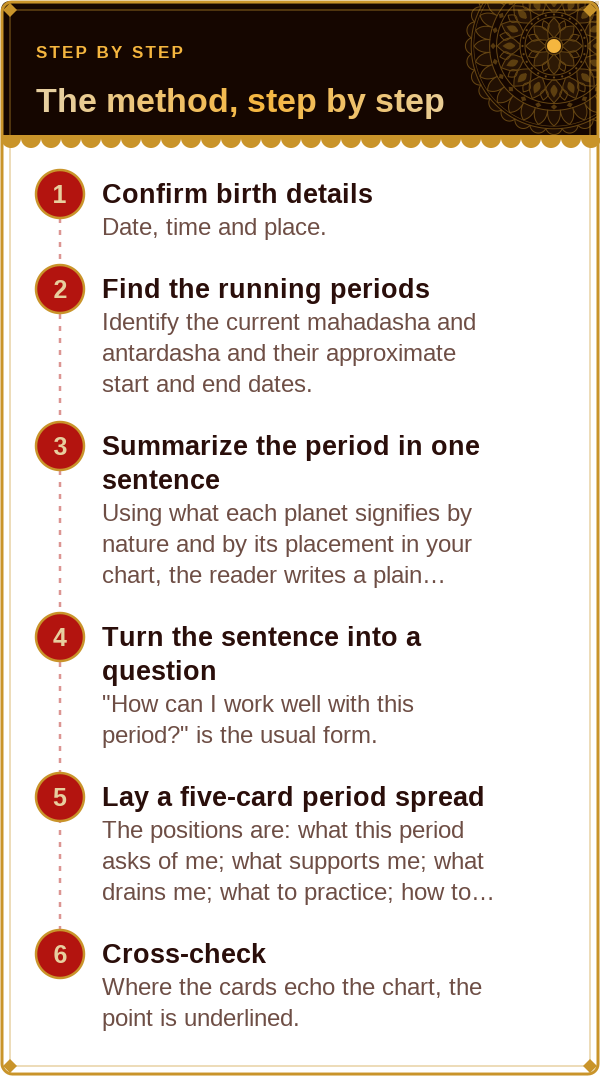
- Confirm birth details. Date, time and place. For anyone born in Fort Worth, the reader checks whether daylight saving time was in effect; for anyone born in India, the time is taken in Indian Standard Time and converted correctly.
- Find the running periods. Identify the current mahadasha and antardasha and their approximate start and end dates. Different apps sometimes give slightly different dates, a point the answer on why two kundli apps disagree on your dasha explains.
- Summarize the period in one sentence. Using what each planet signifies by nature and by its placement in your chart, the reader writes a plain sentence such as "a time of slow, steady work that rewards learning."
- Turn the sentence into a question. "How can I work well with this period?" is the usual form. It stays practical and open.
- Lay a five-card period spread. The positions are: what this period asks of me; what supports me; what drains me; what to practice; how to close this sub-period well.
- Cross-check. Where the cards echo the chart, the point is underlined. Where they diverge, the reader asks you about it.
An example session
The details here are illustrative rather than a real client's. A man in his late thirties from North Richland Hills works in logistics and feels stuck. His chart shows he is in a Saturn mahadasha with a Mercury antardasha running for a little under three years. In his chart Saturn sits in the tenth house of career and Mercury in the ninth, the house of learning and teachers.
The period sentence: "Career moves slowly in this time and rewards patient skill; this sub-period favors study, training and good mentors."
The question: "How can I make the most of this sub-period at work?"
The cards:
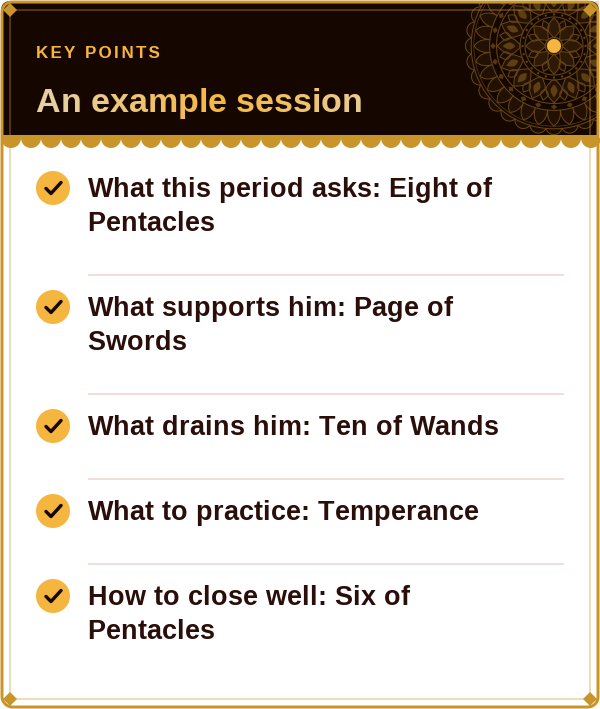
- What this period asks: Eight of Pentacles. An apprentice carving coin after coin. A near-perfect echo of the period sentence: practice, repetition, craft.
- What supports him: Page of Swords. Curiosity and questions. Mercury's sub-period in the house of learning is favorable for this, and the card agrees: ask, research, enroll.
- What drains him: Ten of Wands. Carrying too much alone. He admits he has been covering for two vacant roles.
- What to practice: Temperance. Patience and measured blending. Saturn's lesson in a single card.
- How to close well: Six of Pentacles. Fair exchange: giving effort and receiving recognition, or a fair conversation about workload and pay.
Reading it together: the chart says this is a slow, skill-building season; the cards agree, and add something the chart could not: the overload is the real obstacle. The practical outcome was a decision to ask his manager about the vacant roles and to look into a certification course. Neither the chart nor the cards told him what would happen. Together they made the season easier to understand and the next steps clearer.
Choosing which planets to emphasize
Each of the nine grahas, described in the overview of the Navagraha, carries natural themes: Saturn discipline and endurance, Jupiter growth and teaching, Venus comfort and relationship, Mercury learning and trade, and so on. In this method the reader uses those themes only as far as your chart supports them. A Venus period in a chart where Venus rules the tenth house may be more about work than romance. That is why the period sentence is written before any card is drawn.
Where this fits among the services
This combined approach sits naturally inside a year-ahead tarot reading, where the dasha gives the year's backdrop and the twelve monthly cards fill it in. If you mainly want precise period dates and transits, the dasha and transit reading is the better booking. For a plain-English explanation of sub-periods and the smaller divisions inside them, see the post on antardasha and pratyantardasha.
What a combined reading cannot do
Putting a chart and a spread together does not turn either into a forecast. A dasha describes the likely tone of a period, and a spread reflects your situation as it stands. Neither can promise a promotion, a marriage or a date for anything. You will not be frightened about a period, and nothing is sold through fear. What you get is a clearer picture of the season you are in and a practical way to work with it.
Common questions
Do I need my exact birth time for this method?
It helps a great deal. The dasha sequence starts from the Moon's position at birth, so an error of an hour or two can shift period dates. If your time is uncertain, the reader will say so and treat dates as approximate.
What if the cards and the chart seem to disagree?
That is useful, not a failure. Disagreement usually points to something the client has not mentioned, or to a choice still open. The reader raises it as a question rather than picking a winner.
How often is it worth doing a dasha and tarot session?
Many people find once per antardasha is plenty, since sub-periods last months to a few years. A session at the start of a new sub-period tends to be the most useful.
Related service

Keep reading

Seasonal Tarot Check-Ins: Four Readings Around the Texas Year
How often to get a tarot reading? A quarterly rhythm tied to the Fort Worth year, from Stock Show winter to fall festivals, works better than repeat pulls.
Read article →
Tarot as a Mirror, Not a Forecast: Reading Patterns in the Present
Can tarot predict the future? An honest answer: cards reflect present patterns and likely directions, what that means for date questions and how to use it.
Read article →
A Tarot Spread for the Anniversary of a Loss
Tarot for grief on the anniversary of a death: a gentle five-card spread for memory and gratitude, with grief support in Tarrant County and the Suicide and Crisis Lifeline listed first.
Read article →Quick answers
How many cards are used in a tarot reading?
How many cards are used in a tarot reading? Usually one to ten from a 78-card deck, depending on the spread. A Fort Worth reader explains the common layouts.
Read answer →Is a tarot spread useful when comparing two job offers?
A tarot spread can help when comparing two job offers by clarifying what you value. It never replaces checking pay, benefits and terms. A Fort Worth guide.
Read answer →Talk to Astrologer and Psychic Vijayram
Tell us what you are facing. If a reading is unlikely to help, you will be told that plainly.