
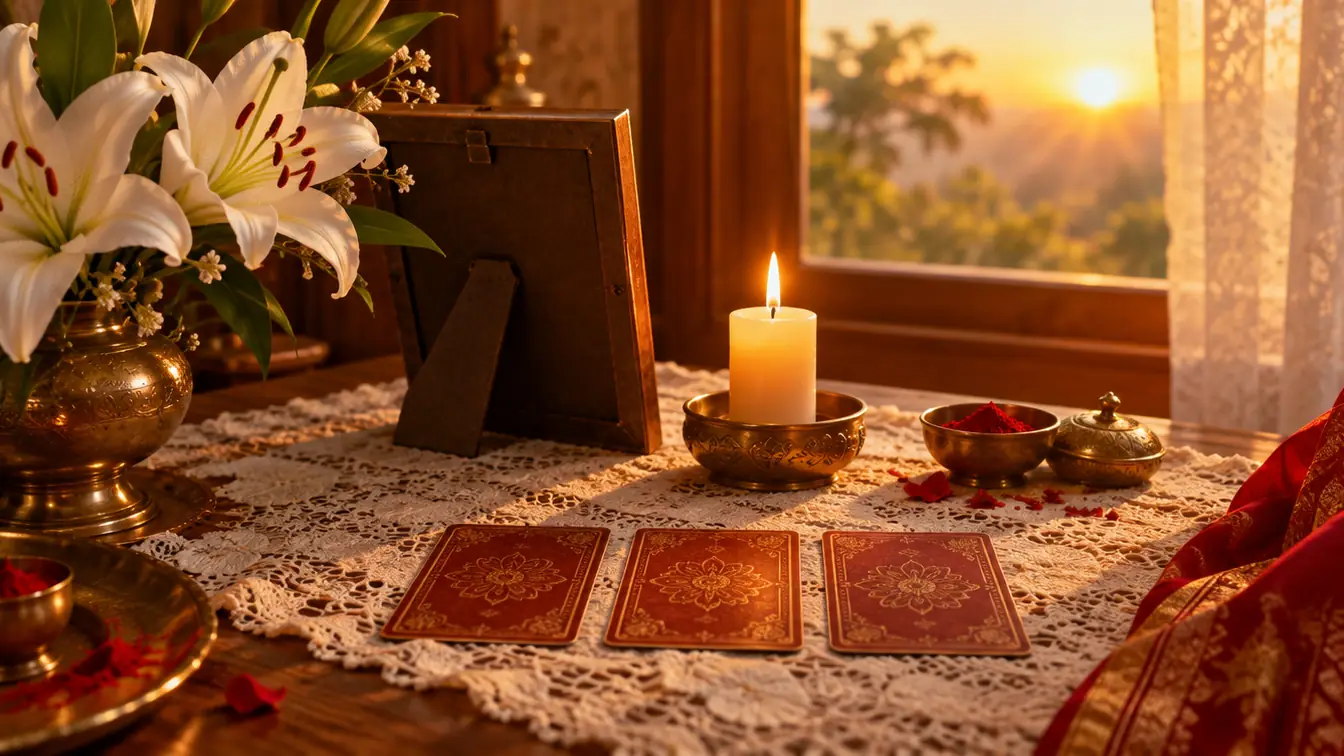
A Tarot Spread for the Anniversary of a Loss
Tarot for grief works best as a quiet space for remembering, not as contact with the person who died. On an anniversary, a five-card spread can hold a memory, a thank-you, what still hurts, a way to honor them this year and the support to ask for. If grief feels unbearable, contact the Suicide and Crisis Lifeline first.
Key takeaways
- Grief tends to crowd everything into one heavy feeling.
- Lay five cards in a gentle arc, left to right.
- Choose a quiet time on or near the date.
- Many families already have ways of marking the anniversary.
- In a grief spread you may draw Death, the Three of Swords or the Five of Cups.
The first anniversary of a death often arrives with a weight people do not expect. Later anniversaries can be gentler, or can land hard in a year when life is already stretched. Tarot for grief is not about reaching the person who has gone. It is about giving the day some shape: a small, quiet ritual for memory, gratitude and honesty about what still hurts. This post offers one spread for that purpose. Before it, though, comes the support that matters more than any cards.
Before the cards: support that comes first
- If you are in crisis, or having thoughts of ending your life, contact the Suicide and Crisis Lifeline, the Suicide and Crisis Lifeline, at any hour. In an emergency, call emergency services.
- If grief is affecting sleep, eating or work for weeks on end, talk with your doctor. Prolonged, heavy grief is something doctors and counselors can help with, and asking is not a weakness.
- If your loved one was in hospice care, contact that hospice. Under Medicare rules, hospices must offer bereavement services to families for up to a year after a death, and many run support groups across Tarrant County.
- For information on what grief can feel like and where to find help, the National Library of Medicine's page on bereavement is a calm, reliable starting point.
- Your faith community, whether a temple, church, gurdwara or mosque, may hold a remembrance on the date or simply have someone who will sit with you.
A reading never replaces any of these. It sits alongside them, for people who find meaning in reflection with the cards.
What a grief spread can offer
Grief tends to crowd everything into one heavy feeling. A spread separates it into parts you can look at one at a time: a happy memory, a thank-you, an ache, an intention. Laying cards for each part slows you down and gives you permission to feel each one fully, without rushing to be "over it." It does not speak for the person who died, predict how long grief will last, or tell you whether you did enough. Those are questions no card can answer.
The anniversary spread
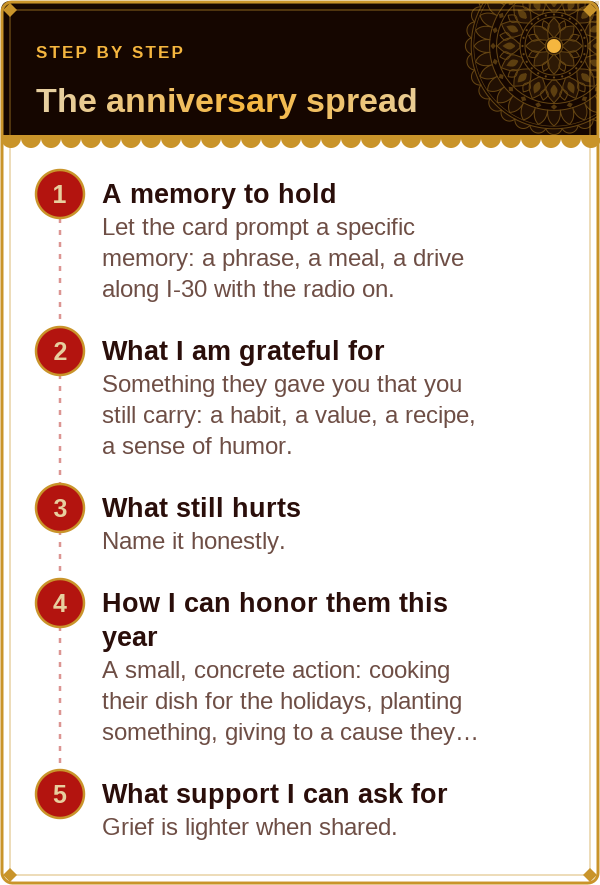
Lay five cards in a gentle arc, left to right.
- A memory to hold. Let the card prompt a specific memory: a phrase, a meal, a drive along I-30 with the radio on. You do not need to interpret the card cleverly. Let it bring someone back to mind.
- What I am grateful for. Something they gave you that you still carry: a habit, a value, a recipe, a sense of humor.
- What still hurts. Name it honestly. An unfinished conversation, a hard final month, a role in the family that now feels empty.
- How I can honor them this year. A small, concrete action: cooking their dish for the holidays, planting something, giving to a cause they cared about, telling their stories to the grandchildren.
- What support I can ask for. Grief is lighter when shared. Who could you call? What would you ask them for?
Write a line for each card. Keep the page with the person's photo or in a place you will find it next year.
Setting the space
Choose a quiet time on or near the date. Many people prefer early morning, before the day's calls and messages begin. A photo, a lamp or candle, a cup of tea and a box of tissues are enough. If family members live in other cities, the spread can be laid on a video call, with each person sharing a memory for the first card. Agree in advance that anyone can step away whenever they need to.
Traditions that already hold the date
Many families already have ways of marking the anniversary. Hindu families often observe an annual shraddha on the lunar date of the death, and Pitru Paksha each year is set aside for honoring ancestors; the post on Pitru Paksha and remembrance explains the customs. Catholic families may have an anniversary Mass said. Many Hispanic families in Fort Worth build an altar for Día de los Muertos. A tarot spread does not compete with any of these. If your tradition already holds the day, the cards can be a private reflection afterward, or not at all.
When the hard cards appear
In a grief spread you may draw Death, the Three of Swords or the Five of Cups. These describe endings, heartache and mourning. They are reflecting what you already know you are carrying; they are not warnings of something worse. If a card frightens you, set it aside and come back to it, or ask the reader to explain it plainly.
Having the spread read for you
Some people prefer to have someone else lay and read the cards, especially in the first year. Astrologer and Psychic Vijayram can do this gently by phone, WhatsApp or video, often as part of a year-ahead tarot reading when an anniversary falls near a birthday or New Year. For deeper support with faith at its center, see spiritual support in grief, and for local, practical options, read about hospice, shraddha and faith support in Tarrant County.
What a grief spread cannot do
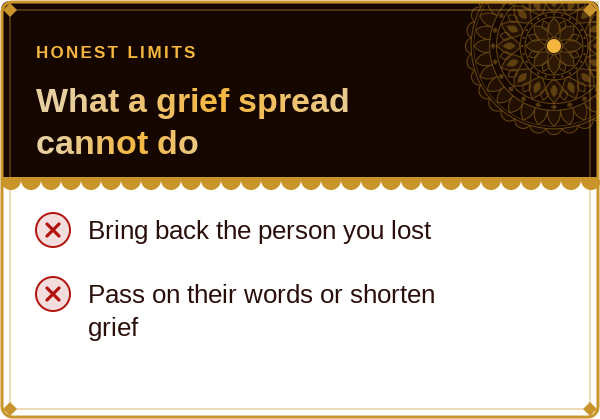
A spread cannot bring back the person you lost, pass on their words, or shorten grief. It is not therapy and not medical care. It is a small, structured way to remember with honesty and tenderness, and if it adds weight rather than easing it, put the cards away and reach for people instead.
Common questions
Can a tarot reading let me talk to someone who has died?
No. A tarot spread does not carry messages from the dead, and this practice does not present it that way. It offers a structured, gentle way to remember, reflect and notice what you need now.
Is it too soon to do a grief spread in the first year?
There is no rule. Some people find it comforting at the first anniversary; others prefer to wait. If the cards feel like too much, close the deck. Talking with a counselor or a trusted friend may suit you better for now.
Can my family do the spread together on a video call?
Yes. Relatives in different cities, or in India, can join one call while the cards are laid and each person can share a memory for the first position. Agree beforehand that anyone can step away at any time.
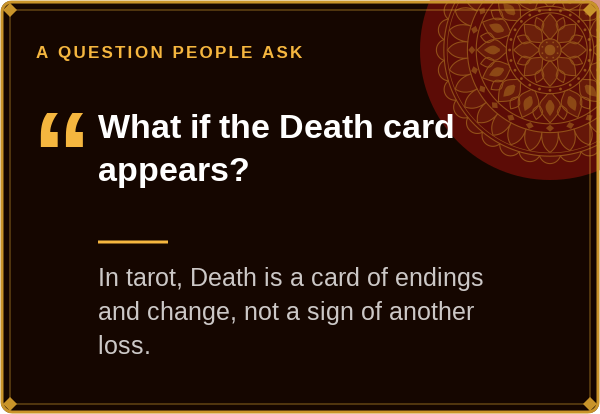
What if the Death card appears?
In tarot, Death is a card of endings and change, not a sign of another loss. In a grief spread it usually simply reflects what you are living through. The reader will say that plainly.
Related service

Keep reading
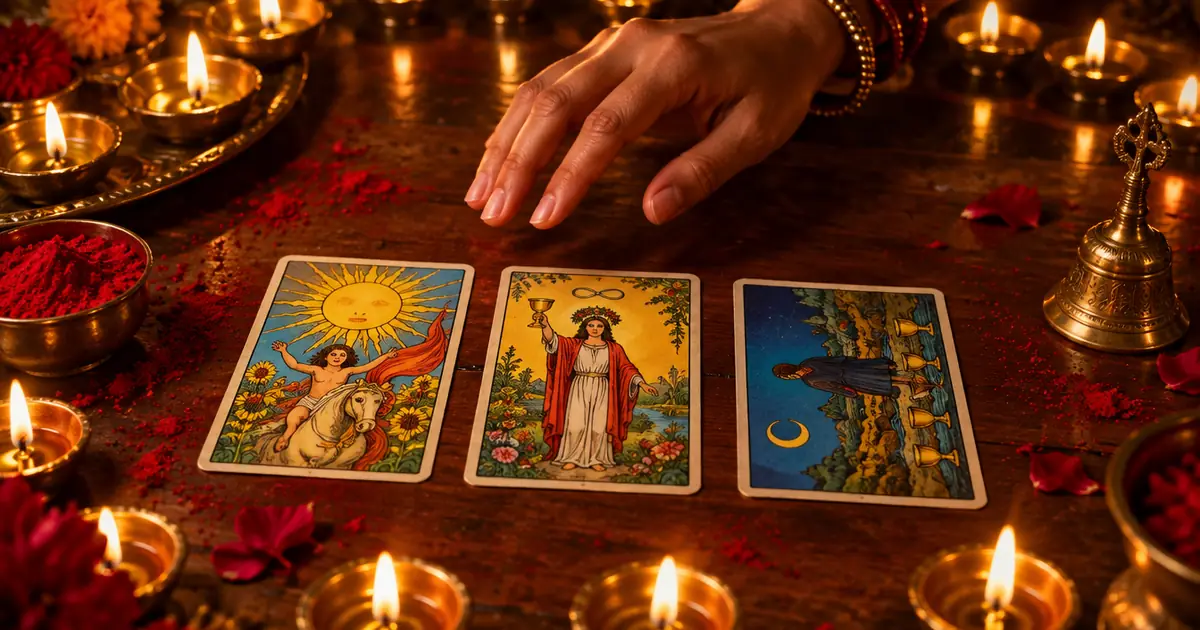
Three Cards for a Yes-or-No Question: A Worked Fort Worth Example
A yes or no tarot spread with three cards, worked through a sample question about a job offer in Alliance, and why the result is a leaning, not a verdict.
Read article →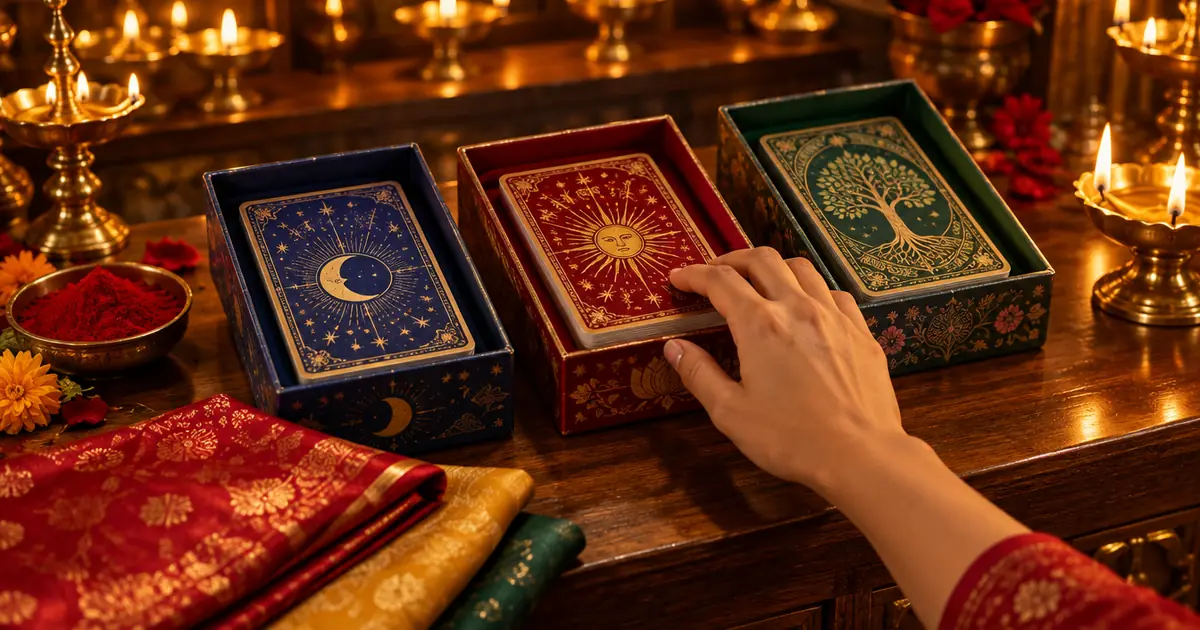
Choosing Your First Tarot Deck
Looking for the best tarot deck for beginners? What to check in a first deck, why Rider-Waite-Smith imagery is easiest to learn, and which decks can wait.
Read article →
The Fool Tarot Card: Meaning in Love and Work
The Fool tarot meaning: a card of new starts and trust in the first step. Upright and reversed, in love and at work, with questions to reflect on.
Read article →Quick answers
How many cards are used in a tarot reading?
How many cards are used in a tarot reading? Usually one to ten from a 78-card deck, depending on the spread. A Fort Worth reader explains the common layouts.
Read answer →Is a tarot spread useful when comparing two job offers?
A tarot spread can help when comparing two job offers by clarifying what you value. It never replaces checking pay, benefits and terms. A Fort Worth guide.
Read answer →Talk to Astrologer and Psychic Vijayram
Tell us what you are facing. If a reading is unlikely to help, you will be told that plainly.