

Antardasha and Pratyantardasha: The Sub-Periods Inside Your Dasha
Vimshottari dasha explained simply: a 120-year cycle of nine planetary periods. Each major period (mahadasha) splits into nine sub-periods (antardashas) in a fixed order, each sized in proportion to its planet's years, and those split again into pratyantardashas. Readings focus on the current antardasha because it colors everyday life most.
Key takeaways
- A mahadasha is a major planetary period.
- Every mahadasha is divided into nine antardashas, also called bhuktis.
- The length is the three planets' years multiplied together and divided by 14,400 (that is, 120 x 120).
- Think of the mahadasha as the season and the antardasha as the weather this month.
- Suppose a table shows Jupiter-Saturn running from March 2026 to September 2028.
Open almost any kundli printout and, somewhere after the chart diagrams, there is a page of planet names and dates that looks like a train timetable. That page is the Vimshottari dasha table, and it is the part of a Vedic chart people most often ask to have decoded. What follows is Vimshottari dasha explained from the inside out: not only the long periods everyone has heard about, but the smaller periods nested inside them, which is where most of the practical detail sits.
Mahadasha meaning: the long chapter
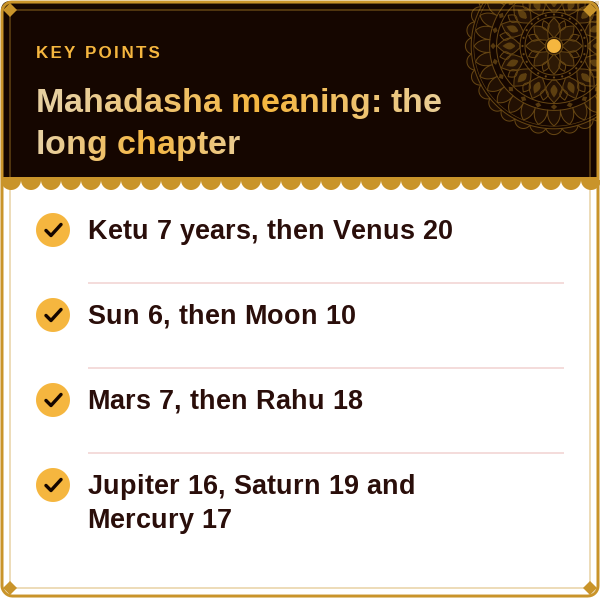
A mahadasha is a major planetary period. The Vimshottari scheme, the one used by almost every Indian astrologer and kundli app, spreads 120 years across the nine grahas in a fixed sequence:
- Ketu 7 years, then Venus 20
- Sun 6, then Moon 10
- Mars 7, then Rahu 18
- Jupiter 16, Saturn 19 and Mercury 17
Where you enter that cycle depends on the nakshatra the Moon occupied at birth. Each of the 27 lunar mansions belongs to one of the nine planets, and the list of nakshatras and their rulers repeats the same nine lords three times around the zodiac. If your Moon sat in Punarvasu, for example, life began in a Jupiter mahadasha. How far the Moon had already traveled through that nakshatra decides how much of the first period was left, which is why the first row on a table is often an odd length such as 9 years 4 months. The summary of the dasha system sets out the arithmetic; the post on finding your birth nakshatra and its pada shows where to look on your own chart.
Antardasha explained: nine chapters inside each period
Every mahadasha is divided into nine antardashas, also called bhuktis. Two rules decide them. First, the opening sub-period always belongs to the mahadasha planet itself, and the rest follow in the same fixed order as above. Second, each sub-period is a share of the whole in proportion to its planet's years. The length in years is the mahadasha years multiplied by the antardasha planet's years, divided by 120.
Here is how a 16-year Jupiter mahadasha divides, rounded to the nearest day:
| Sub-period | Working | Length |
|---|---|---|
| Jupiter-Jupiter | 16 x 16 / 120 | 2 years 1 month 18 days |
| Jupiter-Saturn | 16 x 19 / 120 | 2 years 6 months 12 days |
| Jupiter-Mercury | 16 x 17 / 120 | 2 years 3 months 6 days |
| Jupiter-Ketu | 16 x 7 / 120 | 11 months 6 days |
| Jupiter-Venus | 16 x 20 / 120 | 2 years 8 months |
| Jupiter-Sun | 16 x 6 / 120 | 9 months 18 days |
| Jupiter-Moon | 16 x 10 / 120 | 1 year 4 months |
| Jupiter-Mars | 16 x 7 / 120 | 11 months 6 days |
| Jupiter-Rahu | 16 x 18 / 120 | 2 years 4 months 24 days |
The nine lengths add back up to exactly sixteen years. The same method works for any mahadasha, so once you know the rule you can check a printout with a calculator.
Pratyantardasha: months and weeks
The splitting does not stop there. Each antardasha divides again into nine pratyantardashas, starting with the antardasha planet and following the same order. The length is the three planets' years multiplied together and divided by 14,400 (that is, 120 x 120). Inside Jupiter-Saturn, the first pratyantardasha is Saturn's: 16 x 19 x 19 / 14,400, or roughly 4 months 24 days. Some software goes two levels further, to sookshma and prana dashas lasting days or hours, but that level of detail asks more of a birth time than most birth records can give.
Why readings focus on the current antardasha
Think of the mahadasha as the season and the antardasha as the weather this month. A Saturn mahadasha might set nineteen years of steady, effortful building, but the Saturn-Venus stretch inside it can feel noticeably warmer, more social or more focused on comfort and partnership than the Saturn-Mars stretch that comes later. The antardasha lord brings forward the houses it rules and occupies in your chart, so it decides which rooms of the house are lit up at a given time.
A reader also looks at how the two lords relate. Are they natural friends? Do they sit in houses six or eight apart from each other, a pairing tradition treats as awkward? Does one rule a house the other occupies? Those questions turn a bare pair of names into something you can recognize in daily life, and they are where a dasha and transit reading spends most of its time. Slow transits are laid over the top: the post on the three phases of Sade Sati shows how a long Saturn transit can coincide with, and color, whatever sub-period you happen to be running.
How to read the dates on a printed dasha table
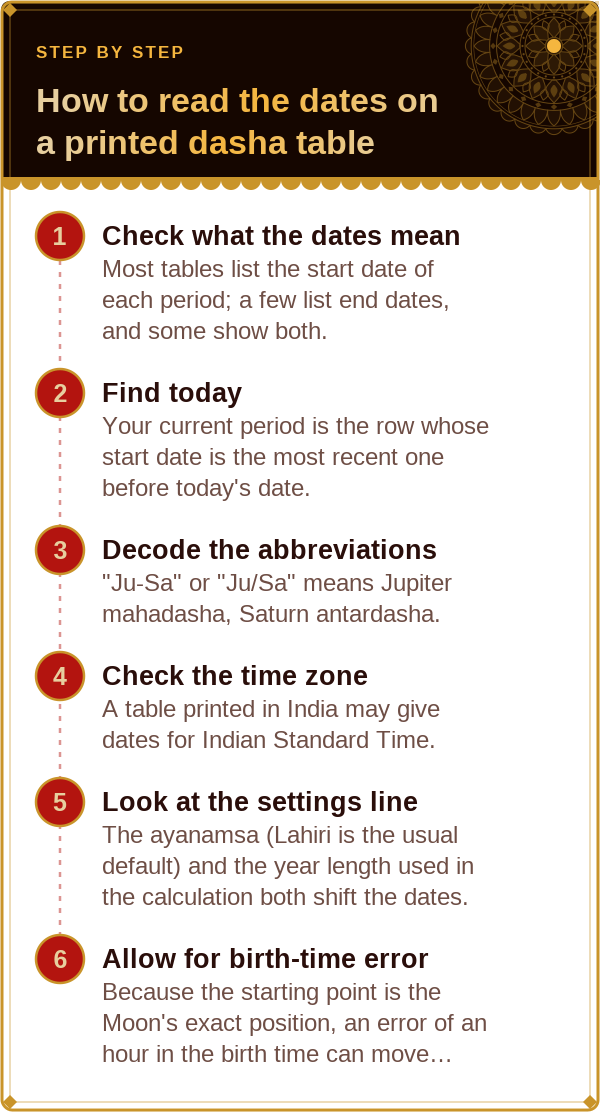
- Check what the dates mean. Most tables list the start date of each period; a few list end dates, and some show both. The header usually says which.
- Find today. Your current period is the row whose start date is the most recent one before today's date.
- Decode the abbreviations. "Ju-Sa" or "Ju/Sa" means Jupiter mahadasha, Saturn antardasha. A third name, as in "Ju/Sa/Me", is the pratyantardasha.
- Check the time zone. A table printed in India may give dates for Indian Standard Time. For births in Texas, the chart must be drawn in Central Time with the daylight saving rule of the birth year; the post on older Texas birth times and war time explains why that matters.
- Look at the settings line. The ayanamsa (Lahiri is the usual default) and the year length used in the calculation both shift the dates. That is the usual reason two programs disagree, as covered in why dasha dates differ between apps.
- Allow for birth-time error. Because the starting point is the Moon's exact position, an error of an hour in the birth time can move every date on the page by several months.
A quick worked example
Suppose a table shows Jupiter-Saturn running from March 2026 to September 2028. In plain English: the broad chapter is Jupiter's, so growth, learning, teachers and family expansion are the background themes; the current sub-chapter brings Saturn's habits of patience, duty and slow progress to the front. If Saturn rules the tenth house in that chart, the reader might talk about a demanding stretch at work that rewards persistence. If it rules the fourth, home and property questions may come up instead. The same pair of planets means different things in different charts, which is why no general list of "Jupiter-Saturn effects" can replace looking at your own. The posts on Jupiter in the birth chart and Saturn in the birth chart describe each planet in more depth.
What a dasha table cannot tell you
A dasha table is a calendar of emphasis as the tradition understands it. It is faith-based guidance, not a schedule of events, and it cannot tell you that something specific will happen on a specific date. Treat any reading that predicts disaster on a printed date with suspicion. Used calmly, the table helps you notice which season you are in and plan around it; some people even pair it with cards, as in a tarot spread matched to your current dasha. If you would like your own periods worked out in Central Time and explained line by line, Astrologer and Psychic Vijayram prepares the full table before a session by phone, WhatsApp or video.
Common questions
How do I find my current antardasha?
Look down the dasha table for the row whose start date is the latest one before today. The planet pair on that row, such as Jupiter-Saturn, is your current mahadasha and antardasha. If the table lists end dates instead, pick the first row that ends after today.
Is the sub-period more important than the mahadasha?
Neither outranks the other. The mahadasha sets the broad theme for many years, and the antardasha decides which part of that theme is in front of you now. A reader always looks at both lords together and at how they sit relative to each other in your chart.
What is dasha sandhi?
Sandhi means junction. It is the stretch of a few months either side of the change from one mahadasha to the next. Many people describe it as a time of loose ends and new beginnings overlapping, and traditional advice is simply to avoid rushing big commitments while the change settles.
Do I need to know my pratyantardasha?
Usually not. It helps a reader fine-tune timing for a specific question, such as when to start a project inside a two-year window, but for general reflection the mahadasha and antardasha say plenty. Going smaller than that rarely adds clarity and can feed worry.
Related service

Keep reading

The Three Phases of Sade Sati: Rising, Peak and Setting
Sade Sati explained phase by phase: what tradition links to Saturn's rising, peak and setting years around your Moon sign, and how to stay steady, not afraid.
Read article →
Aries Moon Sign (Mesha Rashi): Temperament and Needs
Aries Moon sign in Vedic astrology: the Mesha rashi temperament, what steadies a quick, Mars-ruled mind, and why it may not match your Western sun sign.
Read article →
Taurus Moon Sign (Vrishabha Rashi): Temperament and Needs
Taurus Moon sign in Vedic astrology: why the Moon is exalted in Vrishabha, what a steady, comfort-loving mind needs, and how it differs from a Western Taurus.
Read article →Quick answers
Does Sade Sati affect everyone in the family at once?
Sade Sati does not affect everyone in the family at once. It is read from each person's own Moon sign, so relatives who share a sign are still read separately.
Read answer →Why does my dasha differ between two kundli apps?
Your dasha can differ between two kundli apps because of ayanamsa settings, birth-time rounding and time-zone entry. How a Fort Worth astrologer checks it.
Read answer →Talk to Astrologer and Psychic Vijayram
Tell us what you are facing. If a reading is unlikely to help, you will be told that plainly.