

Ten Minutes of Mantra on a TEXRail Ride or a Loop 820 Commute
A daily mantra practice can fit inside a commute. On TEXRail, repeat a short mantra silently for ten minutes between two stations, counting on your fingers. In the car, say it aloud softly with your eyes on the road, never with a mala or app in hand. Ten steady minutes a day matter more than one long session.
Key takeaways
- Mantra chanting is the repetition of a sacred sound, word or short phrase, aloud or silently, with attention.
- Mantra chanting works by giving a restless mind one simple thing to hold.
- Japa is the Sanskrit word for repeating a mantra, often counted on a string of beads, and it is one of the oldest forms of meditation in India.
- A devotional mantra such as Om namah Shivaya or Hare Krishna names a deity.
- Stations make natural markers for a practice.
Most people who want a daily mantra practice say the same thing: "I don't have time." Yet many Fort Worth residents spend twenty minutes or more each way on a train or behind the wheel. That time can become practice. This post sets out two ten-minute routines: a silent one for TEXRail riders and a spoken one for drivers on Loop 820, I-35W or the Chisholm Trail Parkway, with one firm rule for the drivers: eyes on the road, always.
What is mantra chanting?
Mantra chanting is the repetition of a sacred sound, word or short phrase, aloud or silently, with attention. In Indian traditions the words are often Sanskrit and may name a deity, a planet or a quality like peace. The history of mantra shows how the practice runs through Hindu, Buddhist, Jain and Sikh traditions in different forms.
How mantra chanting works
Mantra chanting works by giving a restless mind one simple thing to hold. When attention drifts to email or traffic, the sound is there to come back to. Repeating the same words also tends to slow the breath into a steady rhythm. The National Center for Complementary and Integrative Health notes that meditation practices may help some people with stress, with results that vary from person to person. In plain terms, many people who chant daily say they feel a little less reactive. That is a modest claim and an honest one.

Is mantra japa meditation?
Yes. Japa is the Sanskrit word for repeating a mantra, often counted on a string of beads, and it is one of the oldest forms of meditation in India. Some people think of it as prayer, some as concentration practice. It can be both.
Is mantra chanting religious?
It can be, but it does not have to be. A devotional mantra such as Om namah Shivaya or Hare Krishna names a deity. A sound such as so hum, which simply follows the breath, names none. Choose what fits your faith, or your lack of one.
Track one: the TEXRail rider
TEXRail runs 27 miles between downtown Fort Worth, at T&P and Central stations, and DFW Airport Terminal B, with stops at North Side, Mercantile Center, North Richland Hills (Iron Horse and Smithfield) and Grapevine/Main Street, according to Trinity Metro's description of the line. Stations make natural markers for a practice.
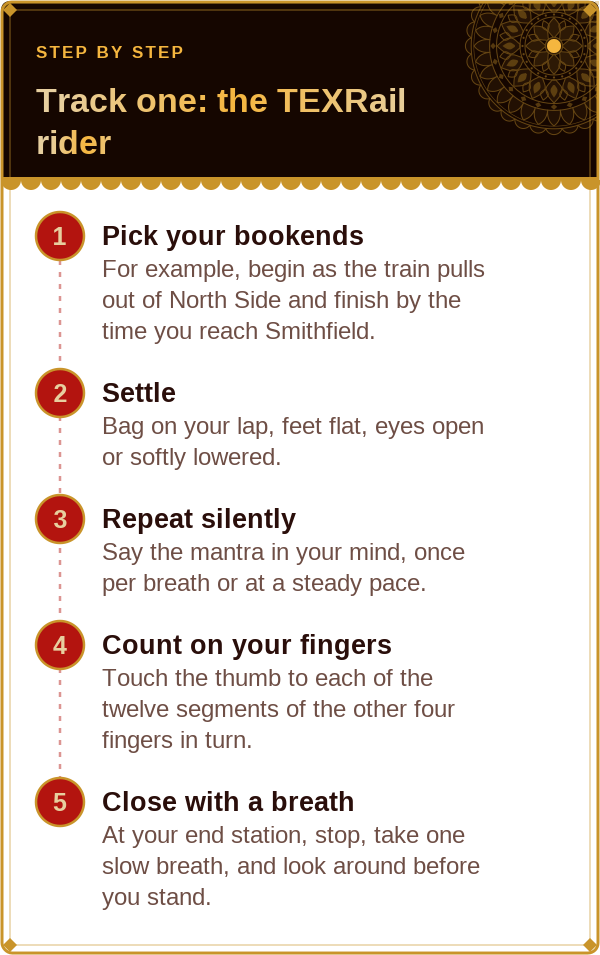
- Pick your bookends. For example, begin as the train pulls out of North Side and finish by the time you reach Smithfield. Your stops become the start and end of the session.
- Settle. Bag on your lap, feet flat, eyes open or softly lowered. Earbuds with nothing playing are a polite "do not disturb."
- Repeat silently. Say the mantra in your mind, once per breath or at a steady pace.
- Count on your fingers. Touch the thumb to each of the twelve segments of the other four fingers in turn. Nine passes make 108. No beads needed.
- Close with a breath. At your end station, stop, take one slow breath, and look around before you stand.
Stay aware of your stop and your belongings. Japa does not require closing your eyes.
Track two: the Loop 820 driver
Driving changes everything. Your attention belongs to the road first, and the mantra second.
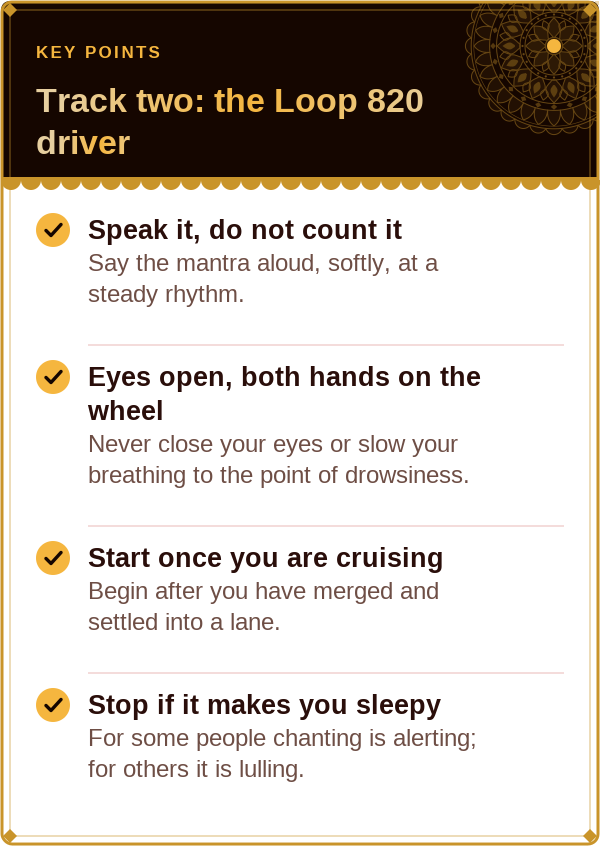
- Speak it, do not count it. Say the mantra aloud, softly, at a steady rhythm. No mala, no counting app, no phone in hand.
- Eyes open, both hands on the wheel. Never close your eyes or slow your breathing to the point of drowsiness.
- Start once you are cruising. Begin after you have merged and settled into a lane. Pause during busy interchanges, construction zones and bad weather.
- Stop if it makes you sleepy. For some people chanting is alerting; for others it is lulling. If it lulls you, switch to the radio and save the mantra for the parked car.
A good option is to finish with one minute of practice in the parked car, engine off, before you walk into work.
Ten minutes, structured
Whichever track you use, the shape is the same: one minute to settle, about eight minutes of repetition, and one minute of quiet at the end in which you set a single intention for the day. That closing minute is often where people notice the practice has worked.
Choosing your mantra
Short is best for a commute. If you would like a mantra chosen from your birth chart or your family's tradition, Astrologer and Psychic Vijayram offers personal mantra and meditation guidance by phone, WhatsApp or video. For something with a long history, read about the Gayatri mantra and its sunrise practice. To give each day its own sound, see navagraha mantras matched to the weekdays. Rail and airport workers with irregular hours may also find career astrology for aviation, rail and logistics workers useful, and riders who live along the line can read the North Richland Hills page.
What a commute mantra cannot do
Ten minutes of mantra can make a commute calmer, and many people find it the most dependable part of their practice. It does not treat anxiety or depression, and it is never worth a moment of lost attention on the road. If stress is affecting your health, talk to your doctor and keep the mantra as company, not as the cure.
Common questions
What is mantra meditation, compared with mindfulness?
Mantra meditation uses a repeated sound as its anchor, while breath-based mindfulness uses the breath or the body. Both train the habit of noticing when the mind wanders and coming back. Many people find a sound easier to hold than the breath.
How many times should I repeat a mantra?
The traditional full round is 108, which is why a mala has 108 beads. On a commute, counting by time works just as well: ten minutes is roughly one to two rounds for most mantras.
Can I listen to a recorded chant instead?
Yes, and for drivers it is often the simpler choice. Listening is different from repeating, but it still turns the drive into a quieter space. Keep the volume low enough to hear sirens and horns.
Is it fine to chant silently at my desk?
Yes. Silent repetition is invisible to anyone around you. A few rounds before a meeting or after a difficult call is a common way to use it.
Related service

Keep reading

Gayatri at Sunrise: Timing the Mantra to Fort Worth's Changing Dawn
The Gayatri mantra meaning, line by line, and how the sunrise practice shifts through a Fort Worth year, from 6:20 a.m. dawns in June to late ones in January.
Read article →
Breath Before Belief: Alternate-Nostril Breathing Step by Step
Pranayama for calm, taught slowly: alternate-nostril breathing with counts, cautions for heart or breathing conditions, and a version for before a meeting.
Read article →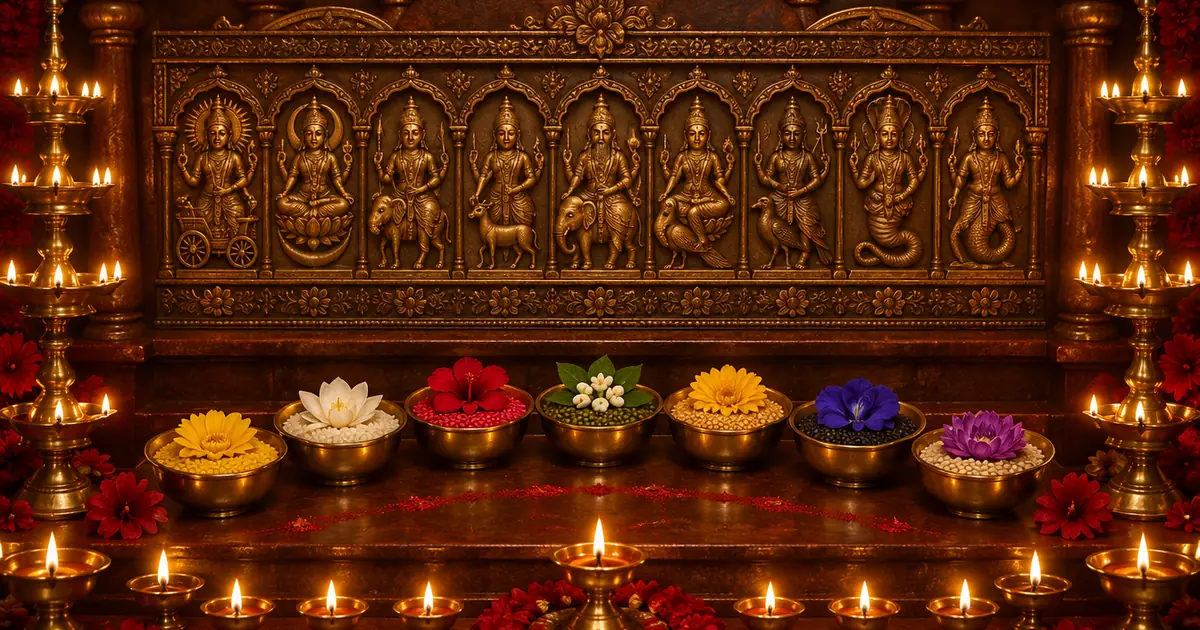
One Planet a Day: Navagraha Mantras Matched to the Weekdays
A simple navagraha mantra rotation matched to the weekdays, from Surya on Sunday to Shani on Saturday, with small counts, Rahu and Ketu notes and no promises.
Read article →Quick answers
Can I have spiritual healing while pregnant?
Yes, gentle spiritual healing while pregnant is possible: prayer and mantra only, nothing physical. Keep your obstetrician informed. A Fort Worth answer.
Read answer →Do I need to believe in chakras for a session to help?
You do not need to believe in chakras for a chakra balancing session to help you relax. What a Fort Worth session asks of a skeptic and what it never claims.
Read answer →Talk to Astrologer and Psychic Vijayram
Tell us what you are facing. If a reading is unlikely to help, you will be told that plainly.