

Gayatri at Sunrise: Timing the Mantra to Fort Worth's Changing Dawn
The Gayatri mantra asks the divine light of the sun, Savitr, to inspire our minds: we meditate on the radiant glory of that divine one; may it stir our thoughts. It is traditionally chanted at sunrise. In Fort Worth that means about 6:20 a.m. in mid-June and about 7:30 a.m. in early January, with jumps when clocks change.
Key takeaways
- Translations vary, and scholars debate fine points of grammar.
- The tradition marks three junctions of the day, the sandhyas : dawn, midday and dusk.
- Naval Observatory's sun and moon data for one day , entering Fort Worth as the location.
- In a Texas summer, this sunrise habit has a practical bonus: you are finished before the heat arrives.
- The tradition says the Gayatri clears and brightens the mind.
Few verses are as widely chanted as the Gayatri. Families recite it at the start of a puja, students murmur it before exams, and grandparents repeat it on a mala before the household wakes. Many people know the sound by heart without knowing the words. This post gives the Gayatri mantra meaning line by line, then looks at something practical: how its traditional sunrise practice moves through the year in Fort Worth, where dawn can arrive at 6:20 a.m. in June and well after 7:30 in January.
The mantra
Om bhur bhuvah svah,
tat savitur varenyam,
bhargo devasya dhimahi,
dhiyo yo nah prachodayat.
The verse comes from the Rigveda and is traditionally attributed to the sage Vishvamitra. It takes its name from its meter, the gayatri, three lines of eight syllables each. The opening words, Om bhur bhuvah svah, were added before the verse in later practice. The history of the Gayatri mantra traces how it became central to daily Hindu prayer.
Gayatri mantra meaning, line by line
| Sanskrit | Plain meaning |
|---|---|
| Om | The sacred syllable, the sound of the whole |
| bhur bhuvah svah | Earth, the space between, and the heavens |
| tat savitur varenyam | That most excellent light of Savitr, the sun as the power that sets life moving |
| bhargo devasya dhimahi | We meditate on the radiance of the divine |
| dhiyo yo nah prachodayat | May it inspire and awaken our minds |
Translations vary, and scholars debate fine points of grammar. The heart of it is clear, though: it is a prayer for a bright, awake mind, not for wealth or success. That is part of why it has lasted.
Why sunrise?
The tradition marks three junctions of the day, the sandhyas: dawn, midday and dusk. The Gayatri is the center of the morning rite, sandhyavandanam, and Savitr is the sun at the moment it rises and sets the world in motion. Chanting as the sky brightens, facing east, ties the words to what they describe.
Fort Worth's changing dawn
Here is how sunrise moves through a Fort Worth year, in Central Time. These are approximate; for an exact date, use the U.S. Naval Observatory's sun and moon data for one day, entering Fort Worth as the location.
| Time of year | Approximate sunrise |
|---|---|
| Mid-June | 6:20 a.m. (earliest of the year) |
| Mid-August | 6:50 a.m. |
| Late September | 7:15 a.m. |
| Early November, before clocks fall back | 7:50 a.m. (latest on the clock) |
| Early November, after clocks fall back | 6:50 a.m. |
| Late December to mid-January | 7:25 to 7:30 a.m. |
| Early March, before clocks spring forward | 6:45 a.m. |
| Just after clocks spring forward | 7:40 a.m. |
| Mid-April | 7:00 a.m. |
Two moments catch people out. In early November, just before daylight saving time ends, sunrise is the latest it gets all year by the clock, close to 7:50. Then, overnight, it jumps an hour earlier. In March the opposite happens: one weekend you are chanting at 6:45, the next at 7:40. If you keep a fixed alarm, your practice drifts away from the actual dawn. The post on setting up a panchang app for Fort Worth shows how to get local sunrise times automatically, and why Rahu Kaal times differ from India explains why sunrise-based timings must be worked out locally.
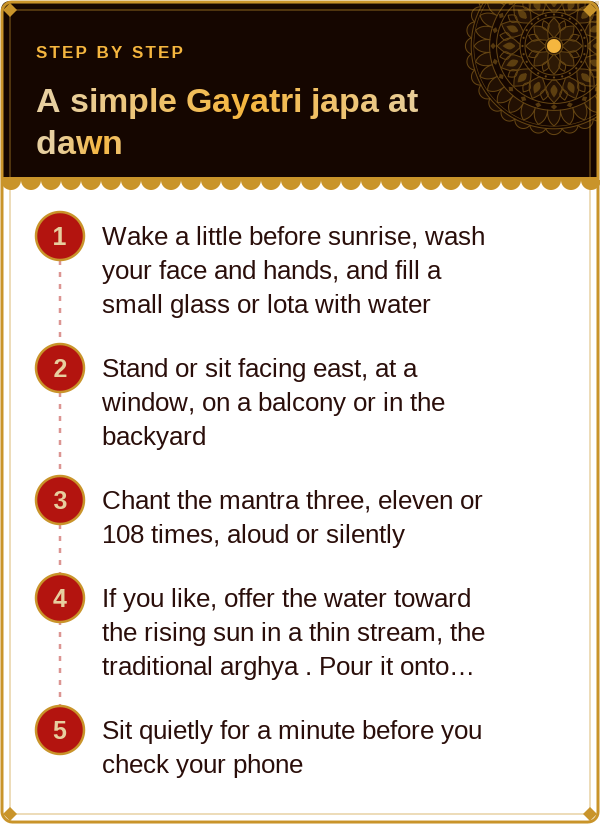
A simple Gayatri japa at dawn
- Wake a little before sunrise, wash your face and hands, and fill a small glass or lota with water.
- Stand or sit facing east, at a window, on a balcony or in the backyard.
- Chant the mantra three, eleven or 108 times, aloud or silently.
- If you like, offer the water toward the rising sun in a thin stream, the traditional arghya. Pour it onto soil or a plant rather than a hard floor.
- Sit quietly for a minute before you check your phone.
In a Texas summer, this sunrise habit has a practical bonus: you are finished before the heat arrives.
Gayatri mantra benefits, honestly
The tradition says the Gayatri clears and brightens the mind. In everyday terms, people who keep it describe a steadier start to the day and a moment of stillness before the rush. Those are real benefits, and modest ones. The mantra is not medicine and makes no health promise. If you want to pair it with breath work, Astrologer and Psychic Vijayram teaches both through energy healing with breath and mantra, by phone, WhatsApp or video.
Who may chant it?
Historically, some communities restricted the Gayatri to those who had received the sacred thread in the upanayana ceremony. Many modern teachers and organizations now teach it to everyone. Families hold different views, and both deserve respect. If your family has a custom, follow it; if not, chant with care and sincerity.
When sunrise is not possible
Night-shift workers, new parents and anyone with an early commute may not see the dawn. Chant at your own waking time, or at the midday or evening sandhya. The post on rest for Medical District night-shift workers discusses keeping prayer times when your day runs upside down. For help choosing a personal mantra alongside the Gayatri, see mantra and meditation guidance.
Common questions
How many times should Gayatri japa be done?
Common counts are three, eleven, twenty-seven or a full round of 108. Start with a number you can keep every day, even if it is only three. Regularity matters more than size.
Can I chant the Gayatri mantra silently?
Yes. Many teachers regard silent, mental repetition as the deepest form of japa. Silent chanting also suits shared homes, early mornings and apartments with thin walls.
Is it fine to chant it at night?
Traditions differ. Some keep the Gayatri to the three junctions of the day, dawn, noon and dusk; others chant it at any hour. Follow your family's custom or your teacher's advice.
Does daylight saving time change when I should chant?
The sun does not change, only the clock. Follow the actual sunrise. That is why your alarm needs adjusting in March and November.
Related service

Keep reading

Breath Before Belief: Alternate-Nostril Breathing Step by Step
Pranayama for calm, taught slowly: alternate-nostril breathing with counts, cautions for heart or breathing conditions, and a version for before a meeting.
Read article →
One Planet a Day: Navagraha Mantras Matched to the Weekdays
A simple navagraha mantra rotation matched to the weekdays, from Surya on Sunday to Shani on Saturday, with small counts, Rahu and Ketu notes and no promises.
Read article →
Fasting Through a Fort Worth Summer: Ekadashi With Heat Safety
Hindu fasting rules for Ekadashi in Texas heat: why dry fasts are risky, the gentler options the tradition allows, and who should check with a doctor first.
Read article →Quick answers
Can I have spiritual healing while pregnant?
Yes, gentle spiritual healing while pregnant is possible: prayer and mantra only, nothing physical. Keep your obstetrician informed. A Fort Worth answer.
Read answer →Do I need to believe in chakras for a session to help?
You do not need to believe in chakras for a chakra balancing session to help you relax. What a Fort Worth session asks of a skeptic and what it never claims.
Read answer →Talk to Astrologer and Psychic Vijayram
Tell us what you are facing. If a reading is unlikely to help, you will be told that plainly.