
Rahu Kaal Shifts Daily in Fort Worth: Reading It From Local Sunrise
Rahu Kaal in Fort Worth is one eighth of the daylight between local sunrise and sunset, taken from a fixed slot for each weekday. Because the length of the day changes through the year and the clocks shift for daylight saving, its clock time moves daily. On Mondays it is the second eighth of daylight; on Sundays, the last.
Key takeaways
- Take the daylight from sunrise to sunset, divide it into eight equal parts, and pick the part assigned to the weekday.
- The biggest single change comes when the clocks move.
- Changing an Indian Rahu Kaal into Central Time does not help, because it was built from Indian sunrise.
- In the tradition, Rahu Kaal is a period to avoid for beginning something new and optional: signing a contract, starting a long drive, opening a shop, launching a website.
- Astrologer and Psychic Vijayram works by phone, WhatsApp or video, in Central Time.
A common Monday mistake goes like this: someone in Fort Worth checks a Rahu Kaal chart forwarded from India, sees 7:30 to 9:00 am, and confidently signs a lease at 9:15. But that chart was for an Indian city. Rahu Kaal in Fort Worth that morning may well have run until nearly ten. The period is built from local sunrise and sunset, so it has to be calculated where you are, and in Central Time it shifts every day.
The rule in one line
Take the daylight from sunrise to sunset, divide it into eight equal parts, and pick the part assigned to the weekday. The traditional assignment of Rahu Kaal is:
| Weekday | Which eighth of daylight |
|---|---|
| Monday | 2nd |
| Saturday | 3rd |
| Friday | 4th |
| Wednesday | 5th |
| Thursday | 6th |
| Tuesday | 7th |
| Sunday | 8th, ending at sunset |
Many people remember the order with a sentence such as "Mother Saw Father Wearing The Turban Suddenly": Monday, Saturday, Friday, Wednesday, Thursday, Tuesday, Sunday.
Working it out for Fort Worth, step by step
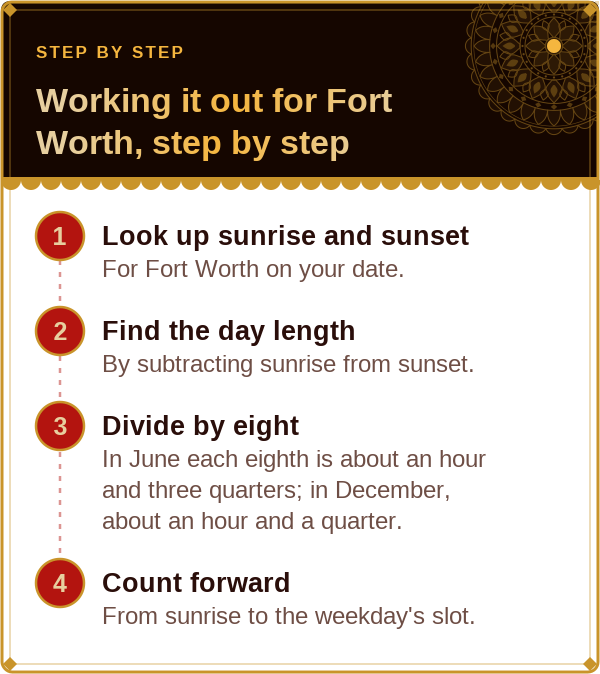
- Look up sunrise and sunset for Fort Worth on your date. The US Naval Observatory's one-day Sun and Moon data gives them for any place.
- Find the day length by subtracting sunrise from sunset.
- Divide by eight. In June each eighth is about an hour and three quarters; in December, about an hour and a quarter.
- Count forward from sunrise to the weekday's slot.
Here is what that gives for a summer and a winter week in 2027, worked out for central Fort Worth:
| Date | Sunrise | Sunset | Rahu Kaal |
|---|---|---|---|
| Sunday 20 June | 6:21 am | 8:40 pm | 6:52 to 8:40 pm CDT |
| Monday 21 June | 6:21 am | 8:40 pm | 8:09 to 9:56 am CDT |
| Sunday 19 December | 7:26 am | 5:26 pm | 4:11 to 5:26 pm CST |
| Monday 20 December | 7:27 am | 5:26 pm | 8:42 to 9:56 am CST |
Notice how a Sunday Rahu Kaal in June runs well into the evening, while in December it is over before most people leave work.
The daylight saving jump
The biggest single change comes when the clocks move. In 2027, daylight saving time begins on Sunday 14 March. On Monday 8 March, Rahu Kaal in Fort Worth runs from about 8:16 to 9:44 am Central Standard Time. One week later, on Monday 15 March, it runs from about 9:09 to 10:39 am Central Daylight Time. The Sun barely changed; the clock jumped an hour. Any chart printed once for "Texas" and reused all year will be wrong for half of it.
Why India's times do not convert
Changing an Indian Rahu Kaal into Central Time does not help, because it was built from Indian sunrise. Fort Worth's daylight has a different length on the same date and begins at a different moment. The only reliable method is to start from Fort Worth's own sunrise. A city setting of Dallas is close enough, since sunrise there is only about two minutes earlier; a setting of New Delhi or Hyderabad is not. Our guide to setting up a panchang app for Fort Worth shows where these settings hide.
Small differences between almanacs come from how sunrise is defined. The Naval Observatory explains the standard definitions of sunrise and sunset, which count the moment the Sun's upper edge appears, allowing for atmospheric refraction.
What Rahu Kaal is used for
In the tradition, Rahu Kaal is a period to avoid for beginning something new and optional: signing a contract, starting a long drive, opening a shop, launching a website. It does not mean stopping work already underway, and it is not a dangerous hour. Rahu itself is a shadow point in the chart, explained in our post on Rahu in the Vedic birth chart. Almanacs also list two other daily periods, Yamaganda and Gulika, worked out in the same way from local daylight.
When an important start cannot avoid it, such as a closing time set by a title company, many families say a short prayer to Ganesha first and carry on calmly. For major events, a muhurta chosen for Fort Worth looks at far more than Rahu Kaal and offers a few workable options.
Getting help with the calculation
If you would like local Rahu Kaal times explained alongside your own chart, a session with a Vedic astrologer serving Fort Worth can cover it. Astrologer and Psychic Vijayram works by phone, WhatsApp or video, in Central Time.
A plain limit to finish: Rahu Kaal is a cautious custom, not a cause. Nothing bad happens because something began inside it, and nothing good is assured by avoiding it.
Common questions
Is Rahu Kaal at the same time every day?
No. Each weekday uses a different eighth of the day, and the length of the day itself changes with the seasons. In Fort Worth a Monday Rahu Kaal starts around 8:10 am in June and around 8:40 am in December, and it lasts longer in summer than in winter.
Is there a Rahu Kaal at night?
Some almanacs calculate a night version by dividing the hours from sunset to sunrise in the same way, but most families use only the daytime period. If your elders follow the night version too, ask for both when a date is being chosen.
Should I move a doctor's appointment or a flight that falls in Rahu Kaal?
No. Health, safety, work and travel commitments come first. Rahu Kaal is a traditional caution about beginning optional new undertakings, not a reason to miss care or a connection.
Why does my app differ from my temple's calendar by a few minutes?
Almanacs define sunrise slightly differently, for example the first edge of the Sun versus its center, and some ignore the bending of light by the atmosphere. Those choices move sunrise by a few minutes, and Rahu Kaal moves with it.
Related service

Keep reading

Setting Up a Panchang App for Fort Worth: Location, Time Zone and DST
A panchang for Fort Worth only works with the right city, time zone and daylight saving setting. How to set up an app and read the day's tithi and nakshatra.
Read article →
Born in Texas Before 1967? Checking War Time in Your Chart
Daylight saving time can move a birth chart by an hour. How War Time, the unregulated 1946 to 1966 years and later rule changes affect a Texas birth record.
Read article →
Finding a Texas Birth Time: Hospital Records and Vital Statistics
Where to find a birth time in Texas when your certificate lacks one: family papers, the long-form record from Vital Statistics, hospital files, and a fallback.
Read article →Quick answers
Must I stop reading Western horoscopes to see a Vedic astrologer?
No, you do not need to stop reading your Western horoscope to see a Vedic astrologer in Fort Worth. How the two zodiacs differ and why your sign may shift.
Read answer →Do I need my birth certificate for a Vedic reading?
You do not need your birth certificate for a Vedic reading in Fort Worth: date, time and place of birth matter, and a certificate simply confirms the time.
Read answer →Talk to Astrologer and Psychic Vijayram
Tell us what you are facing. If a reading is unlikely to help, you will be told that plainly.