
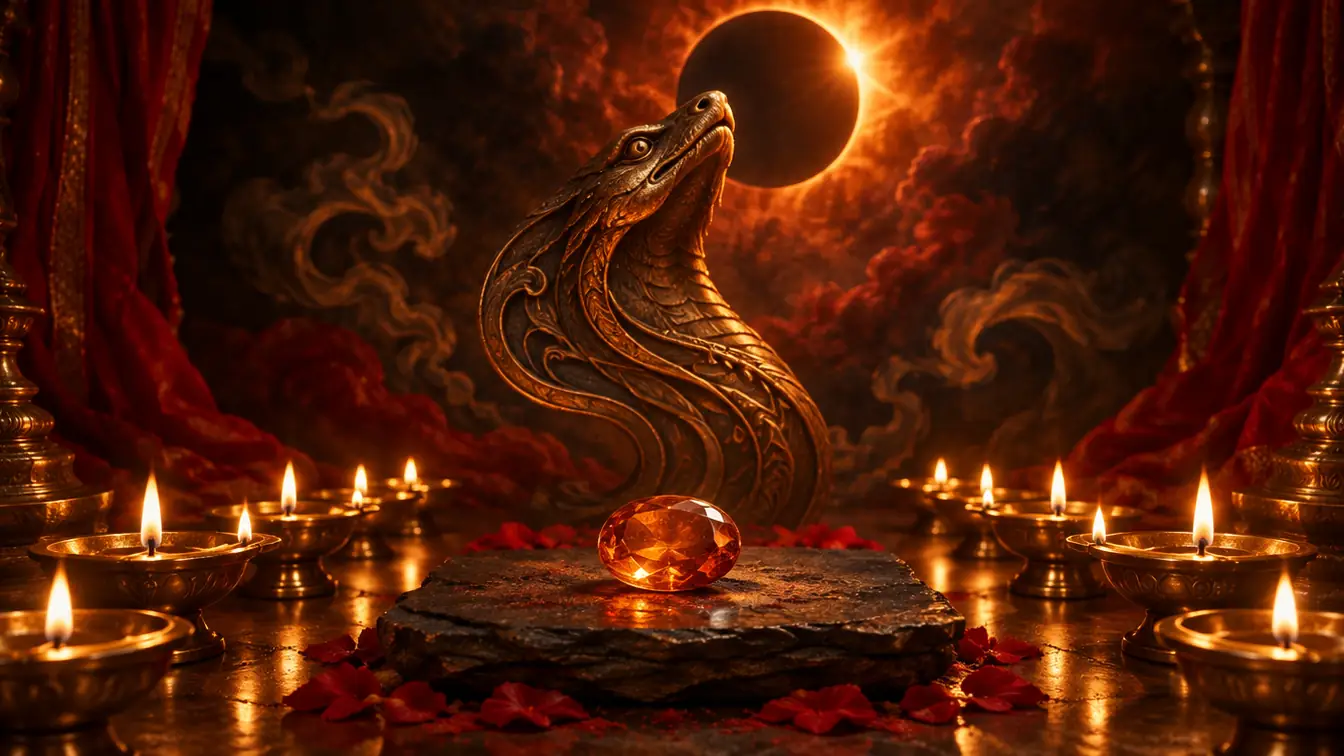
Rahu (the north node) in the Vedic Birth Chart
In Vedic astrology Rahu, the Moon's north node, signifies ambition, desire, the foreign and unfamiliar, technology and restlessness. It has no body, so it is judged through the sign and house it occupies, its sign ruler, the planets it joins and its dasha. Rahu shows where you hunger for more, not a curse or a fixed outcome.
Key takeaways
- The Moon's orbit is tilted slightly against the Sun's apparent path, and the two cross at two points called nodes.
- The myth behind Rahu comes from the churning of the ocean, when gods and demons worked together to draw out the nectar of immortality.
- Because tradition ties Rahu to foreign lands, a move across the world to Texas for work or study is exactly the kind of story a reader looks for Rahu in.
- Rahu and Ketu always sit in opposite houses, so they are read as a pair.
- Rahu's major period lasts eighteen years.
On the afternoon of 8 April 2024, Fort Worth lay in the path of a total solar eclipse. For a few minutes the afternoon turned to dusk. In Jyotish, that moment belongs to Rahu. The post on eclipse customs Fort Worth families kept that day describes how local households marked it. This post is about the shadowy point behind the eclipse: Rahu in Vedic astrology, the north node of the Moon, and what it signifies in a birth chart.
A point, not a planet
Rahu is not a physical body. The Moon's orbit is tilted slightly against the Sun's apparent path, and the two cross at two points called nodes. Rahu is the north node, where the Moon crosses heading north; Ketu, the south node, lies exactly opposite. Eclipses happen only when a new or full Moon falls near one of these points. NASA's eclipse pages explain that the nodes slide slowly backward around the zodiac, completing a full circuit in about 18.6 years. That is why Rahu is treated as always moving in reverse and spends about eighteen months in each sign.
The severed head
The myth behind Rahu comes from the churning of the ocean, when gods and demons worked together to draw out the nectar of immortality. The account of Rahu tells how the demon Svarbhanu slipped into the line of gods to drink it. The Sun and Moon saw him and raised the alarm, and Vishnu cut off his head with his discus, but not before the nectar reached his throat. The immortal head became Rahu, the body Ketu, and the head still chases the Sun and Moon, swallowing them briefly at every eclipse.
The image explains the planet: a head that hungers and can never be filled, because there is no body to hold what it takes in.
What Rahu signifies
- Ambition and desire. The drive to have more, go further, break in.
- The foreign and unfamiliar. Other countries, other cultures, outsiders, people who cross boundaries.
- Technology and innovation. New tools, media, unconventional methods.
- Restlessness and confusion. Smoke, illusion, the feeling that the ground is not quite solid.
- Sudden change. Rapid rises and rapid reversals.
Because tradition ties Rahu to foreign lands, a move across the world to Texas for work or study is exactly the kind of story a reader looks for Rahu in.
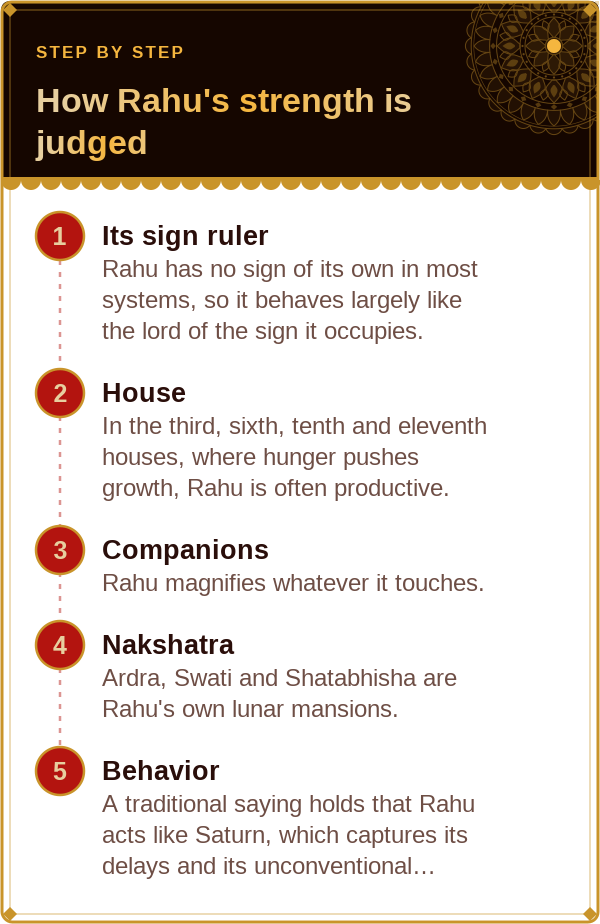
How Rahu's strength is judged
- Its sign ruler. Rahu has no sign of its own in most systems, so it behaves largely like the lord of the sign it occupies. A Rahu in a sign whose ruler is strong tends to deliver; a Rahu whose ruler is weak tends to scatter.
- House. In the third, sixth, tenth and eleventh houses, where hunger pushes growth, Rahu is often productive. Elsewhere it can unsettle what the house governs.
- Companions. Rahu magnifies whatever it touches. With the Moon it can stir anxiety; with the Sun it can pressure confidence; with Jupiter it challenges inherited beliefs.
- Nakshatra. Ardra, Swati and Shatabhisha are Rahu's own lunar mansions.
- Behavior. A traditional saying holds that Rahu acts like Saturn, which captures its delays and its unconventional rewards.
None of these makes Rahu a curse. It shows where you want something badly, and how that wanting may play out.
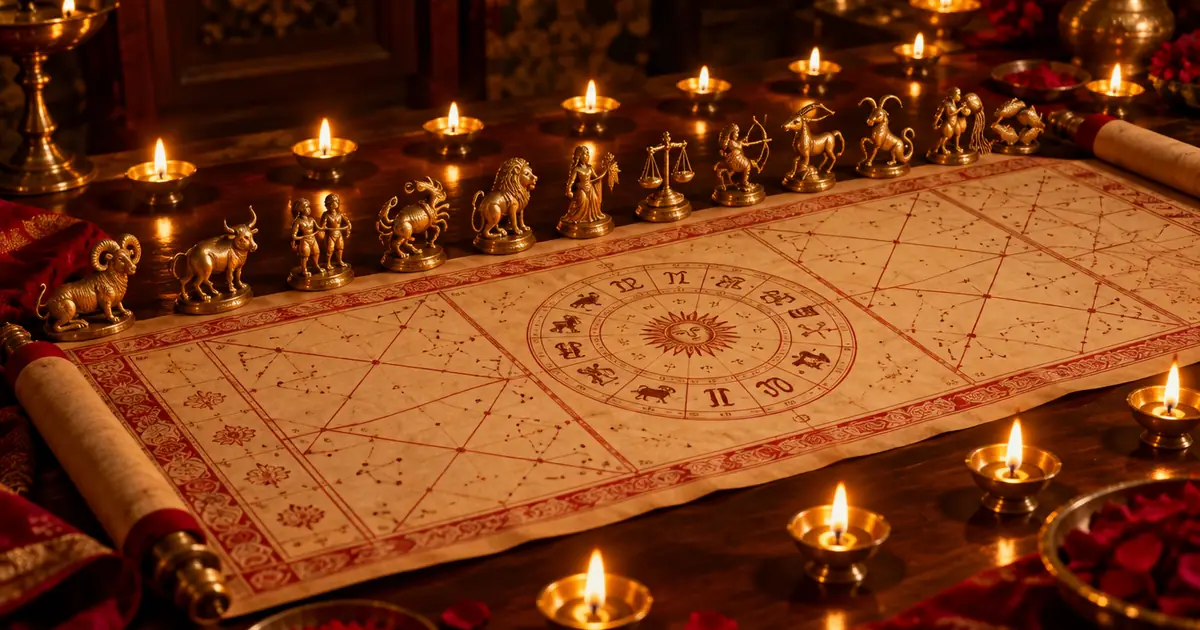
Rahu in kundli: the axis with Ketu
Rahu and Ketu always sit in opposite houses, so they are read as a pair. Rahu marks where you reach, the unfamiliar ground you feel drawn to; Ketu marks what already comes naturally, sometimes so easily that you undervalue it. With Rahu in the tenth and Ketu in the fourth, for example, the pull is toward career and public life, with a certain detachment from home. The companion post on Ketu, the south node looks at the other end of the axis.
Rahu mahadasha: eighteen years of wanting more
Rahu's major period lasts eighteen years. It often brings big ambitions, foreign travel or relocation, unconventional careers, sudden opportunities and stretches of confusion. People sometimes describe it as a time when they wanted everything at once. Practical habits help: check facts twice, be wary of get-rich-quick offers, and keep one grounding routine that does not change. The heavy, cloudy feeling some people report during Rahu and Ketu periods is discussed in Rahu, Ketu and feeling under a cloud.
Rahu Kaal is something else
Rahu Kaal, the daily stretch many families avoid for new beginnings, shares the name but is not read from your chart. It is worked out from local sunrise and sunset, so it shifts every day and differs between Fort Worth and India; see why Rahu Kaal times differ in Fort Worth.
What Rahu cannot do
Rahu describes desire, restlessness and the pull of the unfamiliar as the tradition understands them. It cannot predict scandal, sudden loss or windfall, and it never replaces medical, legal or financial advice. No one needs an expensive ritual to "fix" Rahu. To see it in the context of your whole chart, book a birth chart reading with Astrologer and Psychic Vijayram, held by phone, WhatsApp or video in Central Time.
Common questions
Is Rahu always a malefic?
Rahu is counted as a natural malefic because it brings hunger, restlessness and confusion. In the third, sixth, tenth and eleventh houses, where drive helps, it is often read as a source of growth and worldly success. Its results depend on its sign ruler and the rest of the chart.
Why do books give Rahu different exaltation signs?
Because the classical authorities disagree. Some place Rahu's exaltation in Taurus, others in Gemini, with debilitation opposite. Since Rahu is a point rather than a body, many readers lean instead on the strength of the planet that rules the sign Rahu occupies.
Which gemstone is linked with Rahu?
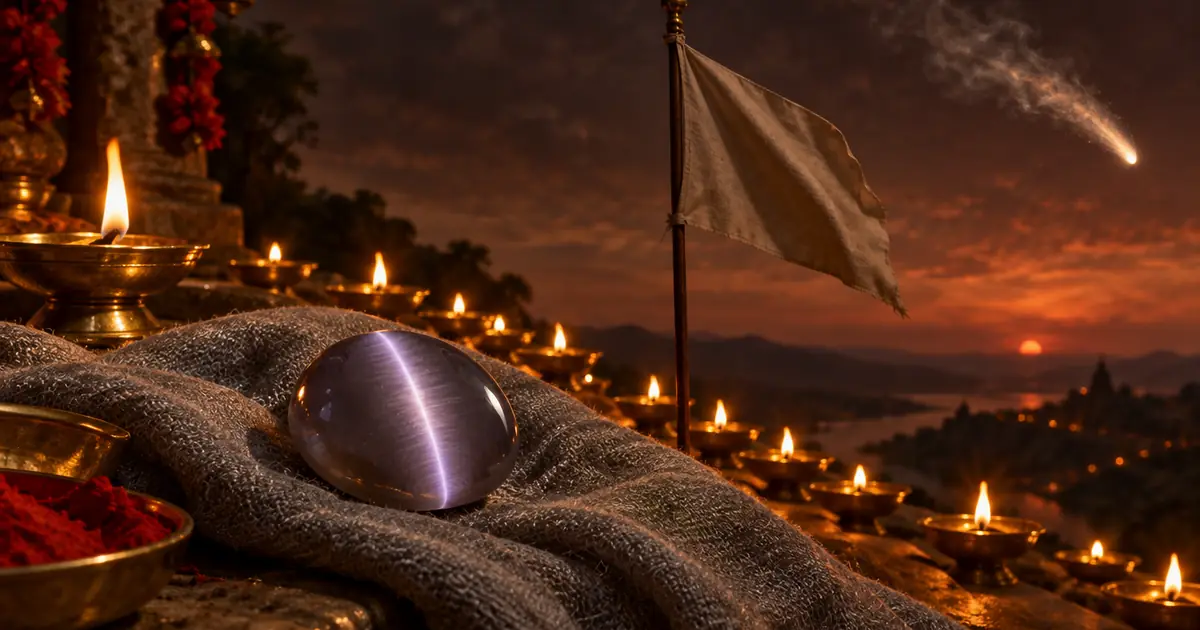
Hessonite garnet, called gomed, is the traditional stone for Rahu. It is never required and does not suit every chart. If it comes up, a gemstone suitability reading checks Rahu's role in your chart first and explains the choice without pressure.
Related service
Keep reading
Ketu (the south node) in the Vedic Birth Chart
Ketu in Vedic astrology: what the south node signifies for detachment, intuition and letting go, how its strength is judged, and the Ketu mahadasha.
Read article →
The First House in Vedic Astrology
The first house in Vedic astrology: what the lagna shows about self, body and outlook, how its lord and planets are read, and honest answers about Jyotish.
Read article →
The Second House in Vedic Astrology
The second house in Vedic astrology: what the 2nd bhava shows about family, speech and savings, how its lord and planets are read, and what it cannot promise.
Read article →Quick answers
Do I need my birth certificate for a Vedic reading?
You do not need your birth certificate for a Vedic reading in Fort Worth: date, time and place of birth matter, and a certificate simply confirms the time.
Read answer →Can my birth time be worked out from past events?
Birth time unknown? Astrology can estimate it from dated past events through rectification. How it works for Fort Worth clients, and why it stays an estimate.
Read answer →Talk to Astrologer and Psychic Vijayram
Tell us what you are facing. If a reading is unlikely to help, you will be told that plainly.