

The Second House in Vedic Astrology
The second house in Vedic astrology, called dhana or kutumba bhava, describes family, speech, food, values and accumulated savings. A reader looks at its sign, at where its lord sits and how strong that planet is, and at planets in or aspecting the second house. It shows tendencies around money and words, not a bank balance.
Key takeaways
- Brihat Parashara Hora Shastra gives each house a set of names, and the verse listing the twelve bhavas calls the second dhana, wealth.
- Whether someone speaks gently or bluntly, sparingly or at length, truthfully or with flourish, is read partly from here.
- A common mix-up is to read income from the second house.
- The second house describes the household you were born into and the one you keep: its values, traditions, food and finances.
- The planet ruling the second house carries its themes wherever it sits:
Picture a family dinner table: the food on it, the voices around it, the savings that paid for it, the recipes and habits passed down to the people sitting there. That one scene holds nearly everything the second house in Vedic astrology describes. It is the house of what you hold onto, in your hands, in your household and in your mouth.
Dhana and kutumba: two names, one house
Brihat Parashara Hora Shastra gives each house a set of names, and the verse listing the twelve bhavas calls the second dhana, wealth. It is also widely known as kutumba bhava, the house of the family or household. The two names belong together. In the traditional picture, wealth is not a number in an account but the stored grain, gold and goodwill that keep a household going from one generation to the next.
Speech: the house of the mouth
The second house also governs the face and mouth, and through them food, voice and speech. Whether someone speaks gently or bluntly, sparingly or at length, truthfully or with flourish, is read partly from here. A useful way to see it is to look at planets placed in the second:
| Planet in the second | Speech often described as | Money habits often described as |
|---|---|---|
| Mercury | Articulate, witty, persuasive | Good with accounts and trade |
| Jupiter | Measured, wise, a good counselor | Generous; savings that grow slowly |
| Venus | Pleasant, sometimes musical | Spends on beauty and comfort |
| Moon | Soothing, emotional | Savings that rise and fall |
| Sun | Authoritative, proud | Money tied to status or family name |
| Mars | Sharp, quick, argumentative | Earns and spends with force |
| Saturn | Few words, serious, careful | Slow, steady accumulation |
| Rahu | Bold, exaggerated, drawn to other languages | Unusual or foreign sources of money |
| Ketu | Blunt or sparing | Detached from possessions |
These are tendencies only. Sign, aspects and the second lord's condition can change any line of the table.
Savings, not income
A common mix-up is to read income from the second house. Jyotish separates the two: the eleventh house shows gains and income, the second shows what is kept and accumulated. When the lords of the second and eleventh are connected, by sitting together, exchanging signs or aspecting each other, the combination is one of the classic dhana yogas, wealth combinations. Even then, the texts describe potential, not a guaranteed sum.
Kutumba: the family you come from
The second house describes the household you were born into and the one you keep: its values, traditions, food and finances. In many South Asian families in Tarrant County, it is also where questions about supporting relatives back home, sharing a multi-generation house or carrying on family customs in Texas show up. A reader may look here, along with the fourth house, when a family relationship reading turns to money or household harmony.
Where the second lord goes
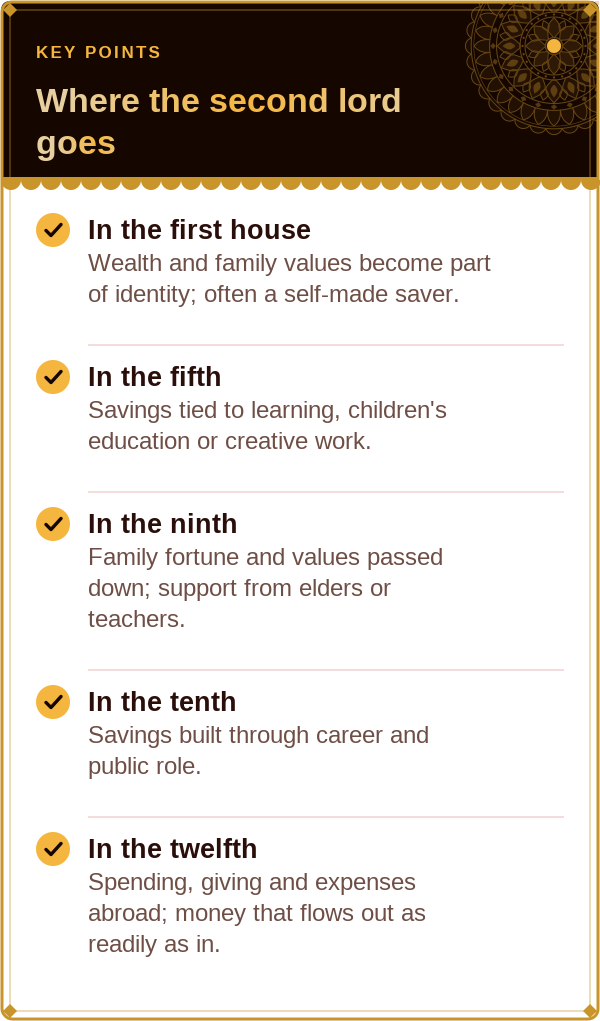
The planet ruling the second house carries its themes wherever it sits:
- In the first house. Wealth and family values become part of identity; often a self-made saver.
- In the fifth. Savings tied to learning, children's education or creative work.
- In the ninth. Family fortune and values passed down; support from elders or teachers.
- In the tenth. Savings built through career and public role.
- In the twelfth. Spending, giving and expenses abroad; money that flows out as readily as in.
The same principle applies to every house, which is why the lord of the first matters so much, as described in the first house in Vedic astrology. The house that follows, the third, turns from holding to effort; see the third house in Vedic astrology.
The second house from the Moon
Readers also count houses from the Moon. The second from the Moon is where Saturn sits during the last phase of Sade Sati, which is why that phase is linked with family finances and careful speech. The post on the three phases of Sade Sati explains how that stage tends to be read.
Money questions belong with a professional
A chart can describe habits around money: whether you save or spend, what you value, how family shapes your choices. It cannot tell you what to invest in, when to buy a house or how to handle debt. For those decisions, the SEC's investor education site explains how to choose and check an investment professional, including how to look up registration and disciplinary history. That is advice worth following before any purchase, astrological or otherwise.
What the second house cannot promise
The second house describes tendencies around family, speech and savings as tradition understands them. It cannot promise wealth, predict an inheritance or settle a family dispute. To see your second house in the context of your whole chart, book a session with a Vedic astrologer; Astrologer and Psychic Vijayram reads by phone, WhatsApp or video at a confirmed Central Time slot.

Common questions
What is the second house meaning in plain English?
It is the part of the chart that describes what you hold onto: the family you come from, the food and values of your household, the way you speak, and the money you manage to keep. Income itself is read more from the eleventh house.
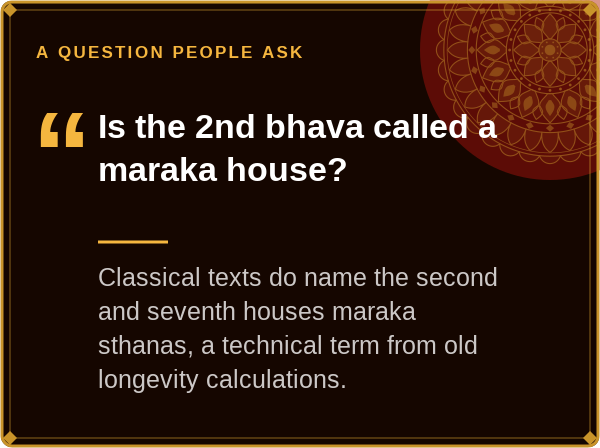
Is the 2nd bhava called a maraka house?
Classical texts do name the second and seventh houses maraka sthanas, a technical term from old longevity calculations. No responsible reader uses it to predict anyone's death, and no reading can. In ordinary practice the second house is read for family, speech and savings.
Does a strong second house mean I will be wealthy?
No. A strong second house is read as a tendency to save, value family and speak with weight. Whether that becomes wealth depends on work, choices, circumstances and luck that no chart can promise. For real money decisions, a licensed professional is the right adviser.
Related service

Keep reading

The Third House in Vedic Astrology
The third house in Vedic astrology covers siblings, courage, effort and short trips. What its sign, its lord and the planets placed there are read for.
Read article →
The Fourth House in Vedic Astrology
What the fourth house in Vedic astrology says about home, mother, property and peace of mind, with its lord, the Moon and the planets placed there.
Read article →
The Fifth House in Vedic Astrology: Intelligence and Past Merit
The fifth house in Vedic astrology: buddhi, mantra, purva punya, children and creative work, and how its lord and planets placed there are read.
Read article →Quick answers
Must I stop reading Western horoscopes to see a Vedic astrologer?
No, you do not need to stop reading your Western horoscope to see a Vedic astrologer in Fort Worth. How the two zodiacs differ and why your sign may shift.
Read answer →Do I need my birth certificate for a Vedic reading?
You do not need your birth certificate for a Vedic reading in Fort Worth: date, time and place of birth matter, and a certificate simply confirms the time.
Read answer →Talk to Astrologer and Psychic Vijayram
Tell us what you are facing. If a reading is unlikely to help, you will be told that plainly.