

Ketu (the south node) in the Vedic Birth Chart
In Vedic astrology Ketu, the Moon's south node, signifies detachment, intuition, spiritual search, letting go and skills that come without effort. Having no body, it is judged through its house, its sign ruler, the planets it joins and its dasha. Ketu shows where you already hold enough and may loosen your grip, not a fixed misfortune.
Key takeaways
- In Sanskrit, ketu is an old word for a banner or flag, and also for a bright sign in the sky such as a comet.
- The account of Ketu describes the headless half as a shadow planet linked with karma, spirituality and liberation.
- Ketu's themes are quieter than Rahu's, and easier to miss:
- Like Rahu, Ketu has no body and no sign that all authorities agree it rules, so it is judged mostly by context.
- Because Ketu and Rahu always face each other across the chart, Ketu's house is best read as the place you come from rather than the place you are going.
If Rahu is a head without a body, always hungry, Ketu is the body without a head: it has taken in what it needed and no longer feels the craving. That single image from Indian myth explains most of what Ketu in Vedic astrology means. The south node of the Moon stands for detachment, intuition and letting go, and it marks the part of a chart where you may already have more than you realize.
What the word Ketu means
In Sanskrit, ketu is an old word for a banner or flag, and also for a bright sign in the sky such as a comet. The Sanskrit and Jyotisha definitions of Ketu collect these meanings, from the flag carried at the head of an army to the luminous apparitions early sky-watchers recorded. In the chart, Ketu is drawn as a flag for the same reason: it signals rather than speaks. Its insights tend to arrive whole, without the reasoning that led to them.
The body that remained
Both nodes come from the same story of the churning of the ocean, in which a demon who drank the nectar of immortality was cut in two. The account of Ketu describes the headless half as a shadow planet linked with karma, spirituality and liberation. The post on Rahu, the north node tells the story in full and explains the astronomy: the two nodes are the points where the Moon's path crosses the Sun's, always opposite each other, always drifting backward.
What Ketu signifies
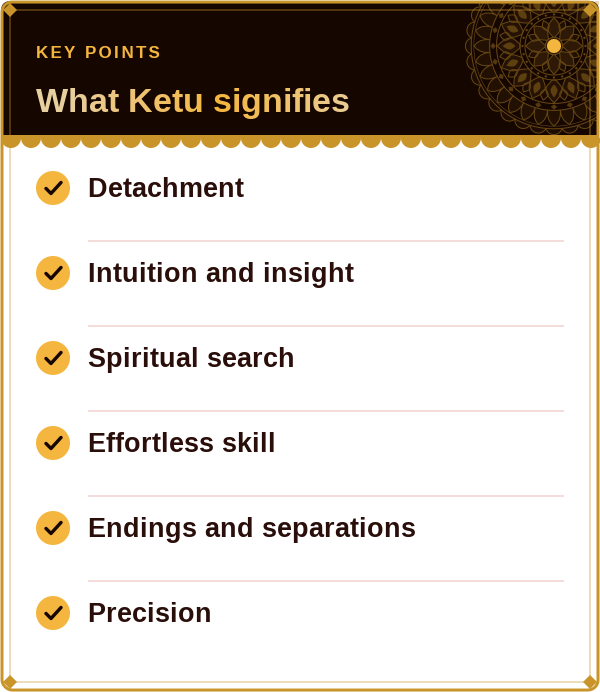
Ketu's themes are quieter than Rahu's, and easier to miss:
- Detachment. Indifference to what others chase; the ability to walk away.
- Intuition and insight. Knowing without being able to say how.
- Spiritual search. Ketu is called the moksha karaka, the significator of liberation.
- Effortless skill. Talents that seem to come from nowhere, which tradition frames as abilities carried from earlier lives.
- Endings and separations. Sudden closures that clear the way for something else.
- Precision. A narrow, cutting focus that suits specialized work.
Judging Ketu: house, ruler and companions
Like Rahu, Ketu has no body and no sign that all authorities agree it rules, so it is judged mostly by context.
House
Where Ketu sits, you may feel oddly detached or unusually competent, often both. It is considered helpful in the third, sixth and eleventh houses, and in the twelfth it is valued for spiritual life.
Sign ruler
Ketu acts through the planet that rules its sign. A traditional saying likens it to Mars, which captures its sharp, sudden quality.
Companions
A planet sitting with Ketu often expresses itself in a detached or unusual way. With Venus, taste may be refined but conventional romance may feel less compelling. With the Moon, strong intuition can come with emotional unease. With Mercury, a precise, specialist mind. With Jupiter, wisdom of a contemplative kind.
Nakshatras
Ashwini, Magha and Mula belong to Ketu. The classical texts disagree on its sign of exaltation, Scorpio or Sagittarius, so many readers place little weight on that label.
Ketu in kundli: what you already know
Because Ketu and Rahu always face each other across the chart, Ketu's house is best read as the place you come from rather than the place you are going. With Ketu in the first house and Rahu in the seventh, a person may be self-sufficient to a fault and learning to lean on a partner. With Ketu in the seventh, the reverse: easy with others, but needing freedom inside commitment. With Ketu in the tenth and Rahu in the fourth, work may come easily while the heart pulls toward home and roots. In each case Ketu points to ground that is familiar, and the lesson is to use it without clinging to it.
Ketu mahadasha: seven years of simplifying
Ketu's period lasts seven years and stands first in the Vimshottari sequence, so people whose Moon sits in Ashwini, Magha or Mula begin life in Ketu's period; the post on finding your birth nakshatra shows how to check. In adulthood, a Ketu period is often described as a time of paring back: endings, a turn toward spiritual interests, loss of appetite for old ambitions, sometimes a sense of drifting. Two pieces of practical advice recur. Keep a simple daily structure, because Ketu loosens structure on its own. And avoid sweeping renunciations made in a hurry; let things fall away at their own pace.
Intuition, or something else?
Ketu's intuition is real in the tradition's terms, but a strong hunch is not always insight. The post on how a reader checks an intuitive impression against the chart shows one way of testing impressions. A sense of emptiness or detachment that deepens over weeks, or that comes with low mood, is a reason to talk to a doctor or counselor rather than to blame a node.
What Ketu cannot tell you
Ketu describes detachment, intuition and letting go as the tradition understands them. It cannot predict losses, separations or spiritual awakening, and it never replaces medical or psychological care. Nobody needs a costly ritual to calm Ketu; quiet practices such as meditation or a short daily mantra are optional ways to work with it. To see Ketu within your whole chart, book a birth chart reading with Astrologer and Psychic Vijayram, by phone, WhatsApp or video at a confirmed Central Time slot.
Common questions
Is Ketu bad in a birth chart?
Ketu is counted as a natural malefic because it brings separation and detachment, but those are not the same as misfortune. In the third, sixth and eleventh houses it is often read as helpful, and for spiritual life it is valued highly. Its effect depends on its house, sign ruler and companions.
What does Ketu in the twelfth house mean?
The twelfth is the house of retreat, sleep, faraway places and liberation, and Ketu there is traditionally linked with spiritual inclination and an easy relationship with solitude. Some readers mention restless sleep or unplanned spending. It is a tendency to reflect on, not a prediction.
Which gemstone is linked with Ketu?
Cat's eye chrysoberyl is the traditional stone for Ketu, and it is one of the more cautioned gems. It is never required. A gemstone suitability reading would examine Ketu's role in your chart first and explain the options without pressure.
Related service
Keep reading

The First House in Vedic Astrology
The first house in Vedic astrology: what the lagna shows about self, body and outlook, how its lord and planets are read, and honest answers about Jyotish.
Read article →
The Second House in Vedic Astrology
The second house in Vedic astrology: what the 2nd bhava shows about family, speech and savings, how its lord and planets are read, and what it cannot promise.
Read article →
The Third House in Vedic Astrology
The third house in Vedic astrology covers siblings, courage, effort and short trips. What its sign, its lord and the planets placed there are read for.
Read article →Quick answers
Do I need my birth certificate for a Vedic reading?
You do not need your birth certificate for a Vedic reading in Fort Worth: date, time and place of birth matter, and a certificate simply confirms the time.
Read answer →Can my birth time be worked out from past events?
Birth time unknown? Astrology can estimate it from dated past events through rectification. How it works for Fort Worth clients, and why it stays an estimate.
Read answer →Talk to Astrologer and Psychic Vijayram
Tell us what you are facing. If a reading is unlikely to help, you will be told that plainly.