

How a Reader Checks an Intuitive Impression Against the Chart
How psychic impressions work, in this practice: an image or feeling arises during the session, the reader notes it without announcing it, checks it against your birth chart and what you have actually said, and only then offers it as a question you can accept or reject. Anything that fails those checks is quietly dropped.
Key takeaways
- Traditions call the experience intuition, inner sight or grace.
- A birth chart is calculated before the session from your date, time and place of birth.
- Some clients add a short face reading or palm reading to a chart session.
- A careful reader welcomes these questions.
- An intuitive reading with Astrologer and Psychic Vijayram is faith-based reflection, held by phone, WhatsApp or video.
People often ask how psychic impressions work, and whether the reader simply "sees" things. In this practice, an intuitive image is where checking begins, not where it ends. An impression might be a picture, a phrase, a physical sense or a mood that surfaces while you are talking. Before it is ever said aloud, it is tested against two things: your Vedic birth chart and what you have actually told the reader. If it does not hold up, you never hear it.
A made-up example, step by step
Here is an invented session, simplified, to show the process.
1. The impression arrives
A client asks about work. Partway through, the reader has a sudden image of packing boxes and an empty room.
2. It is noted, not announced
The reader jots "boxes, empty room" in the margin and keeps listening. Saying "I see you moving!" at this point would be a guess dressed up as insight.
3. It meets the chart
The chart is consulted. Is the fourth house, which tradition links with home, under strong transit? Is the client in a dasha period involving the fourth or twelfth house lord, which classical texts associate with changes of residence or distant places? If none of this is present, the image loses most of its weight.
4. It meets the client's own words
The reader asks a quiet internal question: did the client already hint at this? Perhaps they mentioned a long commute, a lease ending or a partner offered a job in another state. If so, the image may simply be the reader's own mind joining dots from the conversation, which is inference, not intuition.
5. It is offered as a question
If the image survives, it is put gently: "The chart has some emphasis on home and change of place over the next year. Is a move anywhere on your mind?" The client can say yes, no or not yet.
6. The client's answer decides
A "no" ends it. The reader does not push, reframe or insist that the move "will come". A "yes" opens a conversation about the client's own options, with the chart's timing as one consideration.
Where impressions come from: the honest version
Nobody fully knows. Traditions call the experience intuition, inner sight or grace. The overview of clairvoyance notes that claims of perceiving information beyond the senses have not held up under controlled testing. Psychology offers other ingredients that certainly play a part: pattern recognition built from many past conversations, attention to tone of voice and pauses, and empathy, which the American Psychological Association defines as understanding a person from their frame of reference rather than your own.
This practice does not need to settle that debate. It treats every impression as a hypothesis, and the checks above exist precisely because intuition can be wrong, and because a confident wrong statement can upset someone for weeks.
Why the chart works as a brake
A birth chart is calculated before the session from your date, time and place of birth. It cannot be nudged by how you sound on the phone or what the reader hopes to find. That makes it useful as an outside reference. If an intuitive image and the chart agree, it is worth raising. If they disagree, the image is the one that gets dropped.
The chart also adds timing, which intuition rarely provides. The planetary periods described in a dasha and transit reading show which themes tradition sees as active now and which belong to later years. The post on what a birth chart adds to a psychic reading looks at that pairing more broadly, and the fourth house in Vedic astrology post explains the house used in the example above.
Face and palm as a third check
Some clients add a short face reading or palm reading to a chart session. These traditional arts offer another, independent sketch of temperament. If the chart suggests a strong Mercury and your face reading points to quick, expressive features, they support each other. If an intuitive impression says "shy and withdrawn" while the chart, face and your own account all say otherwise, the impression is plainly the weak link.
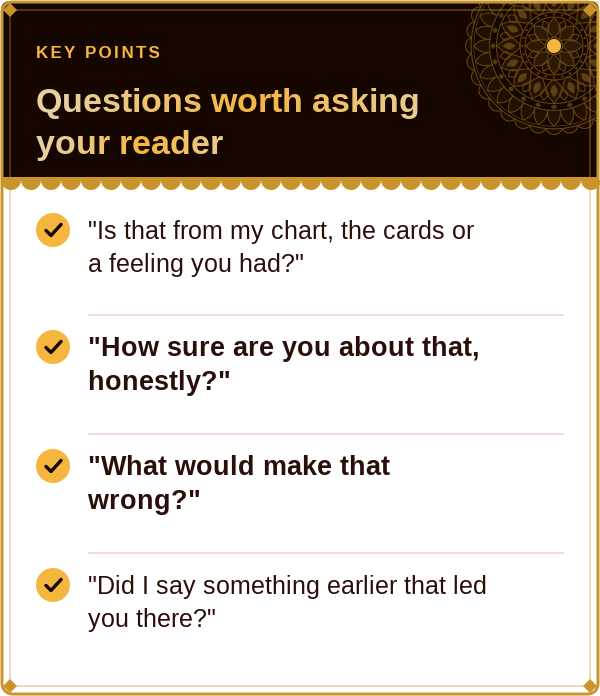
Questions worth asking your reader
- "Is that from my chart, the cards or a feeling you had?"
- "How sure are you about that, honestly?"
- "What would make that wrong?"
- "Did I say something earlier that led you there?"
A careful reader welcomes these questions. One who becomes defensive, or keeps fishing for details and handing them back as revelations, is closer to the methods described in telling insight from cold reading.
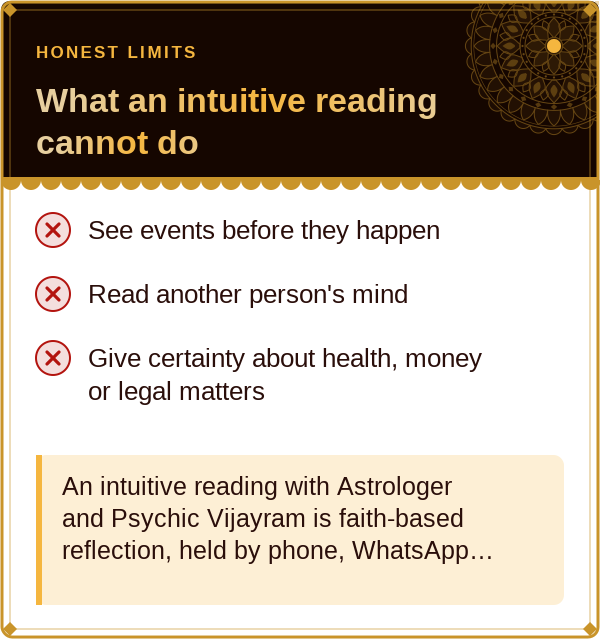
What an intuitive reading cannot do
An intuitive reading with Astrologer and Psychic Vijayram is faith-based reflection, held by phone, WhatsApp or video. It cannot see events before they happen, read another person's mind, or give certainty about health, money or legal matters. Impressions are offered as questions for you to weigh, and your own judgment, the facts and qualified professionals always come first.
Common questions
Is clairvoyance real?
Clairvoyance, the claimed ability to perceive things beyond the ordinary senses, has not been shown to exist in controlled tests. Many people still experience strong intuitive images. This practice treats them as prompts to check, not as information.
What happens when an impression contradicts the chart?
It is usually set aside, or mentioned only as an open question with the contradiction stated. The chart, your own account and the facts you know all outrank a passing image.
Will the reader share every impression that comes up?
No. Many are vague, some are clearly the reader's own associations, and a few would only cause worry without helping. Only impressions that survive the checks, and that might be useful to you, are offered.
Can I ask how the reader reached a point?
Yes, and you should. A careful reader can tell you whether a remark came from the chart, the cards, your palm, something you said or an intuitive impression, and how confident to be in each.
Related service

Keep reading

One Question, One Reading: Why We Suggest Waiting Before Asking Again
How often to book a psychic reading: why asking the same question again tends to add worry, and a simple rule of thumb for when a follow-up is worth it.
Read article →
Before You Book: Tarrant County Mental Health and Crisis Resources
When not to see a psychic, and who to call instead: emergency services, the Suicide and Crisis Lifeline, Tarrant County's MHMR crisis line, your doctor and other help, before or alongside any reading.
Read article →
Samudrika Shastra: What a Face Reader Looks At, Feature by Feature
Indian face reading explained feature by feature: what samudrika shastra says about forehead, eyes, nose, lips and chin, and why it never judges character.
Read article →Quick answers
Is the price agreed before a reading begins?
Yes. For a psychic reading in Fort Worth, the fee and session length are agreed in writing before the reading begins, with nothing added during the call.
Read answer →Can I bring a friend to my first psychic reading?
Yes, a friend can join your first psychic reading in Fort Worth, sitting beside you at home or on the video call, with your consent and a few privacy points.
Read answer →Talk to Astrologer and Psychic Vijayram
Tell us what you are facing. If a reading is unlikely to help, you will be told that plainly.