

Fishing for Clues: Five Cold-Reading Tactics and How to Respond
Cold reading is a set of techniques for appearing to know things about a stranger without any special insight: statements that fit almost anyone, scattered guesses, fishing questions and close attention to your reactions. Knowing the five common tactics lets you test what a reader tells you and keep control of your own session.
Key takeaways
- What it sounds like: "You have a lot of potential you haven't used yet." "You can be outgoing, but sometimes you need time alone." "You've had a loss that still affects you."
- What it sounds like: "I'm seeing a J, or maybe a G... a grandmother or an older woman... something about a kitchen, or a garden, or a ring."
- What it sounds like: "Who is the person with the M name?" "Does the month of March mean something to you?" "Why am I getting a feeling about a move?"
- What it sounds like: A statement trails off, then shifts direction.
- What it sounds like: "You're a generous person, but you've learned to protect yourself." "You're confident, though inside you sometimes doubt yourself."
If a reader has named someone close to you as working against you, or frightened you with a disaster that is coming unless you pay at once, end the contact now. Keep any messages and receipts. If you feel threatened, call emergency services. If you have lost money, report it to local police and the Federal Trade Commission. The rest of this post can wait until you are safe.
For everyone else: what is cold reading, and how can you tell it from genuine, careful work? Cold reading is the art of appearing to know a stranger. It has been studied for decades, and the overview of cold reading describes its methods in detail. You do not need to memorize them. Five tactics cover most of what you will meet.
Tactic 1: Statements that fit almost anyone
What it sounds like: "You have a lot of potential you haven't used yet." "You can be outgoing, but sometimes you need time alone." "You've had a loss that still affects you."
Psychologists call this the Barnum effect: people rate vague, flattering descriptions as highly accurate for themselves, even when everyone receives the same text. These statements feel personal because they are true of nearly everyone.
How to respond: Ask yourself whether your best friend, your cousin and your coworker would also say yes. If they would, the statement tells you nothing. You can ask the reader, kindly, "What makes that specific to me?"
Tactic 2: Shotgunning
What it sounds like: "I'm seeing a J, or maybe a G... a grandmother or an older woman... something about a kitchen, or a garden, or a ring."
The reader offers many guesses quickly. You remember the one that hits and forget the four that missed.
How to respond: Keep a quiet tally. Write down each guess, hit or miss. Most people are surprised by how many misses there were once they see them on paper.
Tactic 3: Fishing questions
What it sounds like: "Who is the person with the M name?" "Does the month of March mean something to you?" "Why am I getting a feeling about a move?"
These sound like insights but are questions. Whatever you answer becomes the next "insight." Ten minutes later, the reader tells you things you told them, and it feels uncanny.
How to respond: Answer yes or no without adding detail. "Yes, my aunt's name is Maria" gives the reader a name, a relationship and a story to build on. "Yes" alone gives very little.
Tactic 4: Reading your reactions
What it sounds like: A statement trails off, then shifts direction. "There's tension with someone... a man... no, it's more about work..."
The reader watches your face, your posture and your voice, and follows whatever makes you lean in. On video this still works; on a phone call there is less to read, though tone of voice carries a lot.
How to respond: Notice when the reader changes direction mid-sentence. If you want to test it, keep your face neutral for a few minutes and see whether the statements become vaguer.
Tactic 5: Covering both sides
What it sounds like: "You're a generous person, but you've learned to protect yourself." "You're confident, though inside you sometimes doubt yourself."
Each statement includes a trait and its opposite, so it cannot be wrong. Some call this the rainbow ruse.
How to respond: Split the sentence in half. If both halves are true of nearly everyone, it is not an insight.
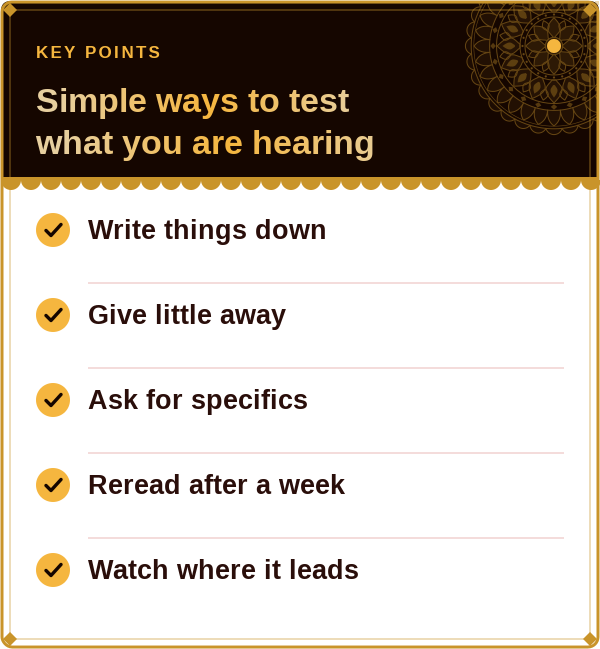
Simple ways to test what you are hearing
- Write things down during or straight after the session, including misses.
- Give little away. Brief answers make it easier to see what the reader actually brought.
- Ask for specifics. "What would that look like in my life?" is a fair question.
- Reread after a week. With distance, vague statements look vague.
- Watch where it leads. A session that builds trust and then turns to fear or a sales pitch is the clearest warning sign of all.
The post on signs a reading went well gives the other side of the picture.
What a careful reader does instead
A careful reader offers impressions tentatively, welcomes "that doesn't fit," says "unclear" out loud and never uses a reading to frighten you. The post on the language a careful reader uses explains why words like "likely" and "possible" matter. A psychic reading in Fort Worth with Astrologer and Psychic Vijayram is run this way, with the fee agreed in writing before the session. For more checks to run before booking anyone, see vetting a psychic in Fort Worth, and if you have already paid someone who keeps asking for more, follow the steps in fees that keep growing and the steps to take.
What knowing these tactics cannot do
Spotting cold reading protects you from being misled, but it cannot tell you whether intuition has any value for you personally. That is a matter of your own experience and beliefs. What a reading can honestly offer is reflection and a fresh way to look at a question, not proof of hidden knowledge.
Common questions
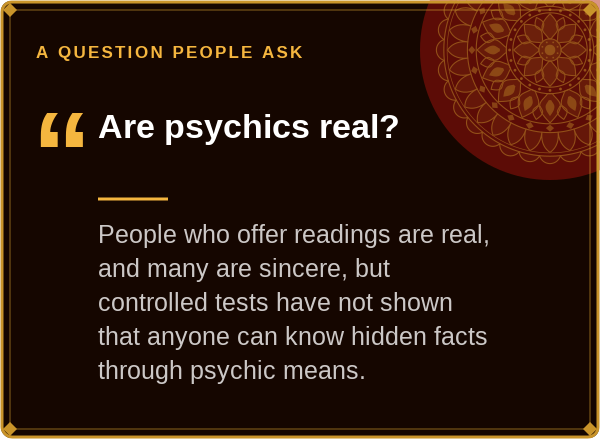
Are psychics real?
People who offer readings are real, and many are sincere, but controlled tests have not shown that anyone can know hidden facts through psychic means. A careful reader treats intuition as impression, says when something is unclear and leaves the conclusions to you.
Is every reader who uses cold reading a fraud?
Not always. Some readers use these habits without realizing it, the way anyone reads a friend's mood. It becomes a problem when the tactics are used to build false trust and then to sell fear, rituals or repeat sessions.
Should I give the reader feedback during a session?
Yes, but keep it honest and brief. Say whether something fits; there is no need to fill in details. A good reader works with your corrections instead of steering you toward agreement.
What is hot reading?
Hot reading means learning about a client in advance, for example from social media, and presenting it as insight. If a reader knows things you have posted publicly, that is not evidence of a gift.
Related service

Keep reading

Likely, Possible, Unclear: The Language a Careful Reader Uses
Are psychic readings accurate? What testing shows, why a careful reader says "likely", "possible" and "unclear" out loud, and what it means for your decisions.
Read article →
Breaks, Islands and Forks: Reading Changes Along the Major Palm Lines
Palm lines meaning for the markings palmists notice: breaks, islands, forks, crosses and squares on the heart, head, life and fate lines, read in context.
Read article →
Thumbs and Fingers in Indian Palmistry: Length and Phalanges
Fingers in palmistry, the Indian way: how hasta samudrika reads the thumb, finger lengths, the three phalanges and flexibility, and how they fit with the lines.
Read article →Quick answers
Is the price agreed before a reading begins?
Yes. For a psychic reading in Fort Worth, the fee and session length are agreed in writing before the reading begins, with nothing added during the call.
Read answer →Can I bring a friend to my first psychic reading?
Yes, a friend can join your first psychic reading in Fort Worth, sitting beside you at home or on the video call, with your consent and a few privacy points.
Read answer →Talk to Astrologer and Psychic Vijayram
Tell us what you are facing. If a reading is unlikely to help, you will be told that plainly.