
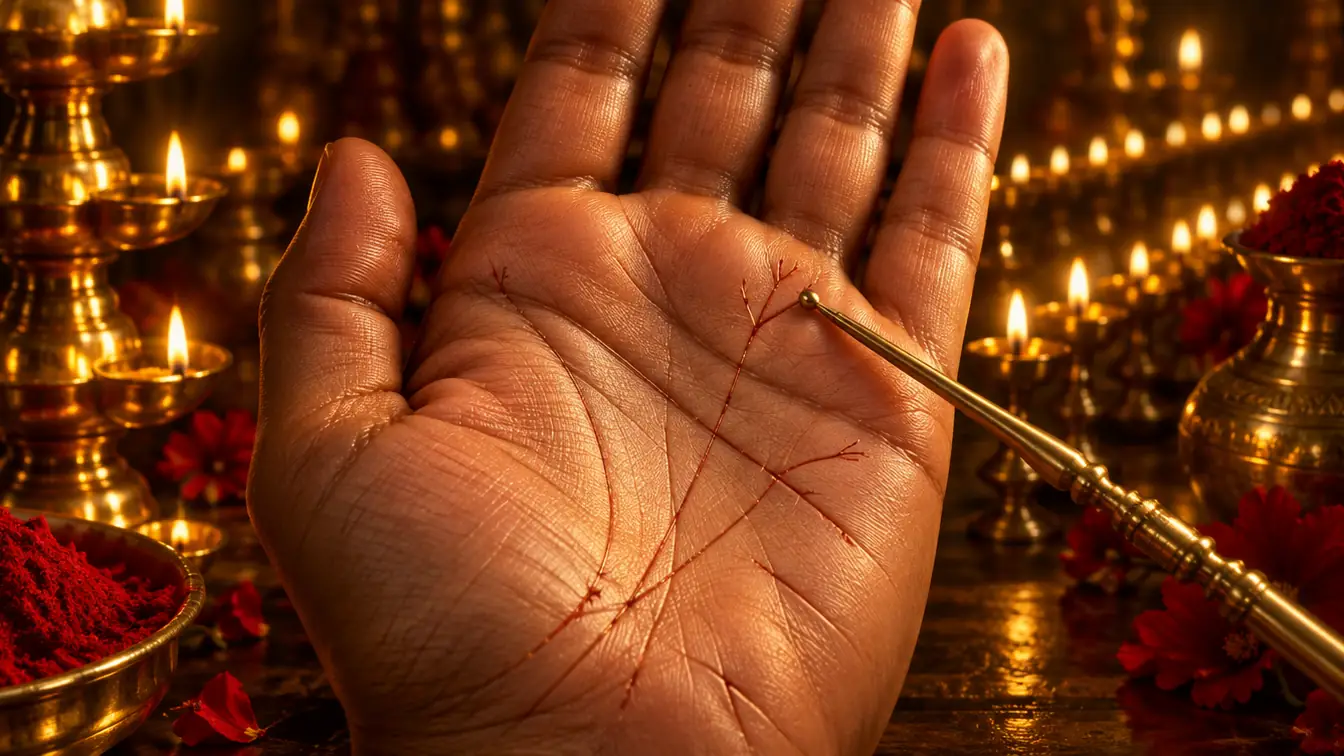
Breaks, Islands and Forks: Reading Changes Along the Major Palm Lines
In palmistry, palm lines meaning depends as much on the markings along a line as on the line itself. Breaks are read as changes of direction, islands as periods of strain, forks as versatility, and squares as steadiness around a difficult patch. Tradition never reads one mark on its own: the whole hand and both hands always matter.
Key takeaways
- You read palm lines by following each one from start to finish in good light and noting its depth, length, course and any markings along the way, then comparing both hands.
- The heart line is read for emotional style.
- The head line is read for thinking style.
- The life line is read for vitality and the rhythm of change.
- Not everyone has a clear fate line, and that is no cause for concern.
Once you can find the four major lines on your hand, the next thing you notice is that none of them is a clean, unbroken stroke. They fork, fade, overlap, sprout tiny branches and loop into small ovals. Palmists have a name and a traditional reading for each of these markings. This post goes through them one by one, line by line, and explains why a careful reader never pulls one mark out of context.
How do you read palm lines?
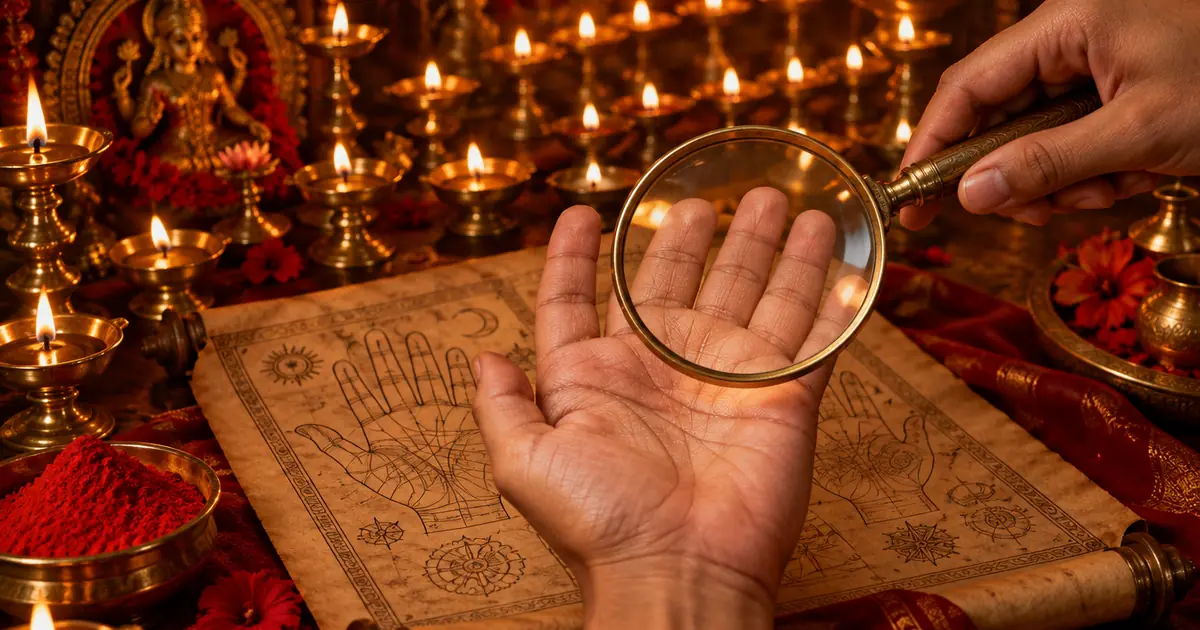
You read palm lines by following each one from start to finish in good light and noting its depth, length, course and any markings along the way, then comparing both hands. Practically:
- Sit by a window in daylight. Cup your hand slightly to deepen the creases.
- Trace the heart line first (the highest horizontal crease), then the head line below it, then the life line curving round the thumb, then the fate line if you have one, running up the center of the palm.
- Along each line, note anything that interrupts or changes it.
- Repeat with the other hand, and photograph both so you can enlarge the images.
The markings, and what tradition says about each
| Marking | What it looks like | Traditional reading |
|---|---|---|
| Break | A gap in the line | A change of direction or a pause |
| Overlapping break | One segment begins before the other ends | A change that is prepared for, a smoother transition |
| Island | A small oval loop | A period of strain or divided energy |
| Fork | The line splits into two | Versatility, two strands of a trait |
| Chain | A run of small linked loops | Sensitivity, energy spread thin |
| Cross | Two short lines crossing on or near a line | A decision point or an obstacle |
| Square | Four short lines forming a box | Steadiness or protection around a hard patch |
| Bars | Short lines cutting across | Interruptions, distractions |
| Sister line | A fine line running alongside | Support, reinforcement |
Markings on the heart line
The heart line is read for emotional style. A chained heart line is often read as deep sensitivity. An island is traditionally linked with a stretch of emotional strain. A fork at the end, especially one branch rising toward the index finger, is commonly read as balance between head and heart. Older writers could be dramatic: in Palmistry for All, Cheiro treated breaks in the heart line as signs of disappointment in love. A careful reader today would call a break a change in how someone handles closeness, nothing more.
Markings on the head line
The head line is read for thinking style. A fork at the end, sometimes nicknamed the writer's fork, is read as the ability to see two sides of a question. Islands are traditionally linked with periods of worry or scattered focus, and a chained stretch with restlessness of mind. A break may be read as a change in outlook, such as a new field of study or a different way of working.
Markings on the life line
The life line is read for vitality and the rhythm of change. Breaks and overlapping breaks are read as relocations, career shifts or new ways of living. A sister line running inside the life line, sometimes called the line of Mars, is traditionally read as extra resilience. A fork at the base is often read as a life that spreads between two places, which many people who have moved to Fort Worth from another country or state recognize.
What the life line does not measure is lifespan. A study by Flinders University researchers, testing whether the line of life predicts longevity, found no reliable link. Any reading that frightens you about the length of your life line is not a responsible one.
Markings on the fate line
Not everyone has a clear fate line, and that is no cause for concern. Where it exists, it is read for the sense of direction in work and life. Breaks are read as career changes; an overlapping break as a change made by choice. A fate line that starts late, high on the palm, is often read as finding direction later in life. A square on the fate line is traditionally read as steadiness through a hard period at work.
Why one mark is never read alone
A careful palmist reads every marking against several other things:
- The rest of the hand. Hand shape, thumb, fingers and mounts change the meaning of any line.
- The other hand. A mark on one hand only may be read very differently from one on both.
- Depth and clarity. A faint island on a deep line means less than a clear one on a faint line.
- Everyday wear. Some small marks are simply creases from work, sport or age.
- Your own life. A reader asks what fits rather than telling you what happened.
The posts on thumbs and fingers in Indian palmistry and palm mounts beside the Vedic chart cover the features that sit around the lines.
A note on health
Palm creases are not a medical test. Some, such as the single palmar crease, can be noted by doctors as part of a wider examination, but they are common in healthy people too. Changes in your hands such as swelling, color changes, numbness or pain are reasons to see a doctor.
Having your lines read
A palm reading with Astrologer and Psychic Vijayram looks at every line and marking from clear photos and a live video call. Couples who want to compare hands can read about comparing two hands side by side, and parents can check the short answer on reading children's palms.
What palm lines cannot tell you
No marking on a palm predicts an event, a date, an illness or a lifespan. Palmistry is a traditional, reflective practice that describes tendencies in temperament. It can start a good conversation about your life; it cannot write the next chapter of it.
Common questions
Does a break in my life line mean something bad will happen?
No. Palmists traditionally read a break as a change of direction, such as a move or a new way of living, not as illness or danger. Research has found no link between the life line and lifespan, so a break is not a warning.
Why do my two hands have different markings?
Almost everyone's do. Many readers treat the dominant hand as the present and the other as underlying temperament, so differences between them are part of the reading rather than a contradiction.
Can markings on the palm change?
Fine lines and small marks can deepen, fade or appear over the years, especially with age and how you use your hands. The major creases keep their basic course, which is why readers focus on them first.
I have a single crease instead of separate heart and head lines. Is that a problem?
A single crease across the palm is common in people with no health condition at all. Palmists read it as intense focus. If a doctor has mentioned it in a medical context, follow their advice, not a palm reading.
Related service
Keep reading
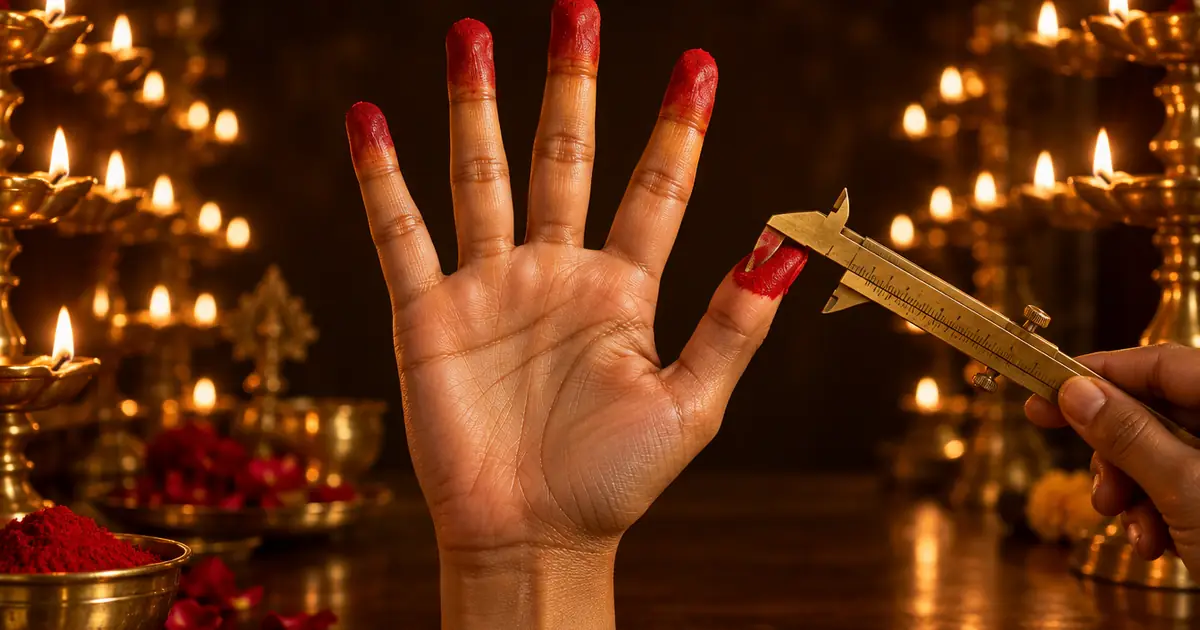
Thumbs and Fingers in Indian Palmistry: Length and Phalanges
Fingers in palmistry, the Indian way: how hasta samudrika reads the thumb, finger lengths, the three phalanges and flexibility, and how they fit with the lines.
Read article →
Mount of Venus, Mount of Saturn: Palm Mounts Beside the Vedic Chart
Mounts of the palm meaning in Indian palmistry: Venus, Jupiter, Saturn and more, compared with the same planets in your kundli, and what to do if they differ.
Read article →
Moolank and Bhagyank: Indian Numerology's Two Core Numbers
Your numerology birth number in the Indian system: how moolank and bhagyank are worked out, what each is read for, and how both relate to the name number.
Read article →Quick answers
Do you read children's palms?
Yes, children's palms are read in Fort Worth, gently and with a parent present on video, looking at temperament and strengths, never at predictions.
Read answer →Is the price agreed before a reading begins?
Yes. For a psychic reading in Fort Worth, the fee and session length are agreed in writing before the reading begins, with nothing added during the call.
Read answer →Talk to Astrologer and Psychic Vijayram
Tell us what you are facing. If a reading is unlikely to help, you will be told that plainly.