

Moolank and Bhagyank: Indian Numerology's Two Core Numbers
Indian numerology gives your birth number two forms. The moolank, or root number, is the day you were born reduced to one digit. The bhagyank, or destiny number, is your full date of birth reduced the same way. Moolank is read for everyday temperament, bhagyank for the broad direction of life, with the name number weighed against both.
Key takeaways
- The moolank, also called the root or psychic number, comes from the day of the month alone.
- The bhagyank, or destiny number, uses the whole date of birth.
- Indian numerology links each digit with one of the navagraha: 1 with the Sun, 2 the Moon, 3 Jupiter, 4 Rahu, 5 Mercury, 6 Venus, 7 Ketu, 8 Saturn and 9 Mars.
- A reader looks at how the moolank and bhagyank relate:
- The name number is the single digit you get by adding the values of the letters in your name.
Two numbers sit at the heart of Indian numerology, and both come straight from your date of birth. The moolank describes the person you are day to day; the bhagyank describes the road you are on. Your name adds a third number that families have weighed for generations. This post shows how to work out each one, what tradition reads into it, and how they fit together.
The moolank: your root number
The moolank, also called the root or psychic number, comes from the day of the month alone. Add the digits of the day and keep adding until one digit is left.
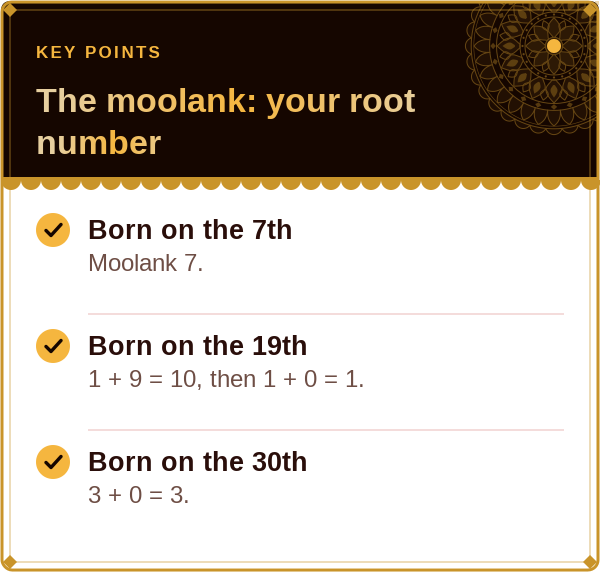
- Born on the 7th: moolank 7.
- Born on the 19th: 1 + 9 = 10, then 1 + 0 = 1. Moolank 1.
- Born on the 30th: 3 + 0 = 3. Moolank 3.
Repeated adding like this produces what mathematicians call a digital root. In numerology, the moolank is read for instinct and everyday temperament: how you react, what comes easily, how others first experience you.
The bhagyank: your destiny number
The bhagyank, or destiny number, uses the whole date of birth. Add every digit of the day, month and year, then reduce.
- 7 March 1988: 0 + 7 + 0 + 3 + 1 + 9 + 8 + 8 = 36, then 3 + 6 = 9. Bhagyank 9, with moolank 7.
- 30 November 2001: 3 + 0 + 1 + 1 + 2 + 0 + 0 + 1 = 8. Bhagyank 8, with moolank 3.
The bhagyank is read for the broad direction of a life as tradition sees it: the themes that tend to come back, the kind of work and relationships that feel meaningful over time. Where the moolank is the person, the bhagyank is the path.
Numbers and planets
Indian numerology links each digit with one of the navagraha: 1 with the Sun, 2 the Moon, 3 Jupiter, 4 Rahu, 5 Mercury, 6 Venus, 7 Ketu, 8 Saturn and 9 Mars. So the person born on 7 March 1988 carries a Ketu moolank and a Mars bhagyank, which a reader might describe as an inward, reflective nature on a path that asks for action and courage. The planetary link is what makes Indian numerology feel close to astrology, and why many astrologers use both.
Reading the two together
A reader looks at how the moolank and bhagyank relate:
- The same number suggests a person whose temperament and path pull in one direction, often with focus and sometimes with too little balance.
- Numbers whose planets are traditionally friendly suggest a fairly comfortable fit between who you are and what life asks.
- Numbers whose planets are traditionally at odds suggest a life where temperament and direction need to be reconciled, which is often where the most growth happens.
The moolank tends to matter most in the first half of life, many readers say, and the bhagyank more as the years go by.
What is name number in astrology?
The name number is the single digit you get by adding the values of the letters in your name. It belongs to numerology rather than astrology proper, but because each number is tied to a planet, people often hear it described as part of astrology. In Vedic astrology itself, the link between name and chart is different: the first syllable of a baby's name is traditionally chosen from the Moon's nakshatra at birth.
Indian numerologists mostly use the Chaldean letter table, popularized in English by Cheiro's Book of Numbers:
| Value | Letters |
|---|---|
| 1 | A, I, J, Q, Y |
| 2 | B, K, R |
| 3 | C, G, L, S |
| 4 | D, M, T |
| 5 | E, H, N, X |
| 6 | U, V, W |
| 7 | O, Z |
| 8 | F, P |
No letter is given 9 in this system. As a worked example, take the city's own name. FORT: 8 + 7 + 2 + 4 = 21. WORTH: 6 + 7 + 2 + 4 + 5 = 24. Together 45, and 4 + 5 = 9. Fort Worth, by this reckoning, is a 9, the number of Mars, which a numerologist might enjoy linking with a city that began as an army outpost.
How the name number relates to the birth numbers
Birth numbers cannot change; names can. That is why, in Indian families, the name number is the one people think about adjusting. Traditional practice looks for a name number that sits comfortably with the moolank and bhagyank, and some families add or double a letter to shift it. A name numerology check looks at this for a baby, a business or an adult name change, and the post on taking a spouse's surname after a Texas wedding covers one common moment.
Numbers turn up elsewhere too. The post on repeating 11s, 22s and 33s in a birth date explains how Western master numbers differ from the Indian approach, and personalized Texas license plates shows a lighter use.
Going further
A numerology reading with Astrologer and Psychic Vijayram works out all three numbers, explains how they interact and, if you wish, sets them beside your birth chart. Sessions are held by phone, WhatsApp or video, and all you need is your date of birth and your name as you use it. The history of numerology is a useful read if you want to see how the Indian and Western systems grew apart.
What these numbers cannot do
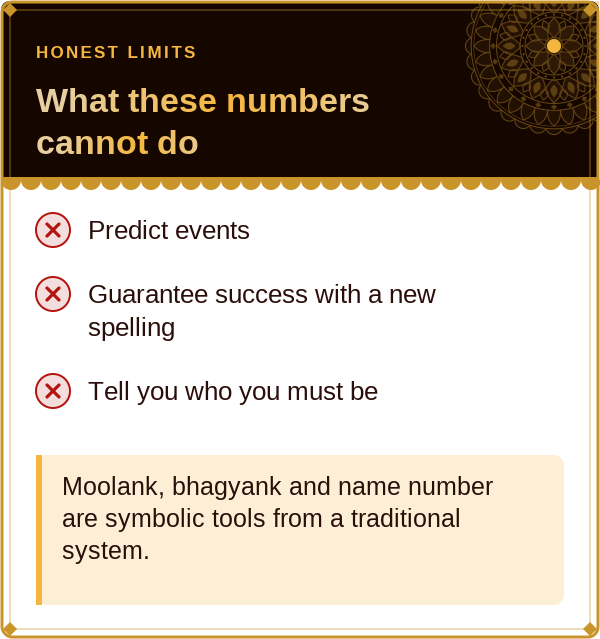
Moolank, bhagyank and name number are symbolic tools from a traditional system. They cannot predict events, guarantee success with a new spelling or tell you who you must be. They offer a way to reflect on temperament and direction, and the arithmetic, at least, you can check yourself.
Common questions
I was born just after midnight. Which date do I use?
Most numerologists use the date on your birth certificate. A few follow the Vedic day, which begins at sunrise, and use the previous date for births between midnight and dawn. A reader should tell you which convention they use before working anything out.
I was born in India but live in Fort Worth. Does the time zone change my numbers?
No. Use the date where you were born, as recorded there. The local date in Texas at that moment does not matter for numerology, though it does matter for some astrology calculations.
Why does an app give me a different name number?
Usually because it uses the Pythagorean letter table, which assigns values from 1 to 9 in alphabetical order, while Indian practice mostly follows the Chaldean table. Different tables give different numbers from the same name.
Are 11 and 22 reduced in Indian numerology?
Usually yes. Indian practice generally reduces every total to a single digit, while some Western systems keep 11, 22 and 33 as master numbers.
Related service

Keep reading

Gut Feeling or Worry Loop? A Journal Test Before You Book
Intuition vs anxiety: a two-week journal test to tell a calm gut feeling from a worry loop, and the signs that a doctor or counselor is the better next step.
Read article →
Visitation Dreams: Keeping a Record After a Loss
Dreams of deceased loved ones are common in grief. How to write them down, what different traditions say about them, and where to find grief support.
Read article →
How to Prepare for a Medium Sitting
How to prepare for a medium reading by phone or video: rest beforehand, hold expectations loosely, set up a quiet room and plan gentle time afterward.
Read article →Quick answers
Is the price agreed before a reading begins?
Yes. For a psychic reading in Fort Worth, the fee and session length are agreed in writing before the reading begins, with nothing added during the call.
Read answer →Can I bring a friend to my first psychic reading?
Yes, a friend can join your first psychic reading in Fort Worth, sitting beside you at home or on the video call, with your consent and a few privacy points.
Read answer →Talk to Astrologer and Psychic Vijayram
Tell us what you are facing. If a reading is unlikely to help, you will be told that plainly.