

How to Prepare for a Medium Sitting
To prepare for a medium reading, arrive rested, hold any hope of a specific message loosely, and set up a quiet, private room with water and tissues. Write down who you are remembering but do not script the sitting. Plan calm time afterward, and keep your grief support in place, because a sitting never replaces it.
Key takeaways
- A medium reading is a session in which a person who describes themselves as a medium shares impressions they believe relate to someone who has died.
- Alcohol, a late night or hours spent looking through old messages can leave you raw before you begin.
- A sitting works just as well by phone, and some people find it easier: there is no screen to watch, only a voice to listen to.
- The hardest part of preparing is managing expectation.
- A sitting often stirs up more feeling than people expect, even when it goes gently.
Knowing how to prepare for a medium reading takes some of the nerves out of it. Most people who book a sitting are grieving, and the best preparation is less about the session than about looking after yourself around it. Before anything else: if you are finding grief hard to carry, a grief counselor, a hospice bereavement program or your doctor can help, and the Suicide & Crisis Lifeline answers calls and texts at any hour. In an emergency, call emergency services.
What is a medium reading?
A medium reading is a session in which a person who describes themselves as a medium shares impressions they believe relate to someone who has died. It is a faith-based practice found in many cultures, and the overview of mediumship explains its history and the scientific skepticism around it. A remembrance sitting with a psychic medium here is held by phone, WhatsApp or video, offered gently, and never presented as proof of anything.
A week or so before
- Check in with yourself. Are you sleeping and eating? If the honest answer is "barely", it may be better to postpone and talk to your doctor first.
- Think about who you are remembering. Write their name and your relationship on a card. You do not need dates, causes of death or private details.
- Decide whether anyone will join you. A sibling or partner on the same call can be a comfort, or a distraction. The post on bringing family to a medium sitting helps you weigh it.
- Confirm the practical side in writing: the date, the time in Central Time, the length and the fee.
The day before
Keep the evening ordinary. Alcohol, a late night or hours spent looking through old messages can leave you raw before you begin. If you have a keepsake you would like nearby, such as a watch, a photo or a prayer book, set it out. Whether to show it on camera is up to you; the short answer on bringing a photo or keepsake covers that.
An hour before
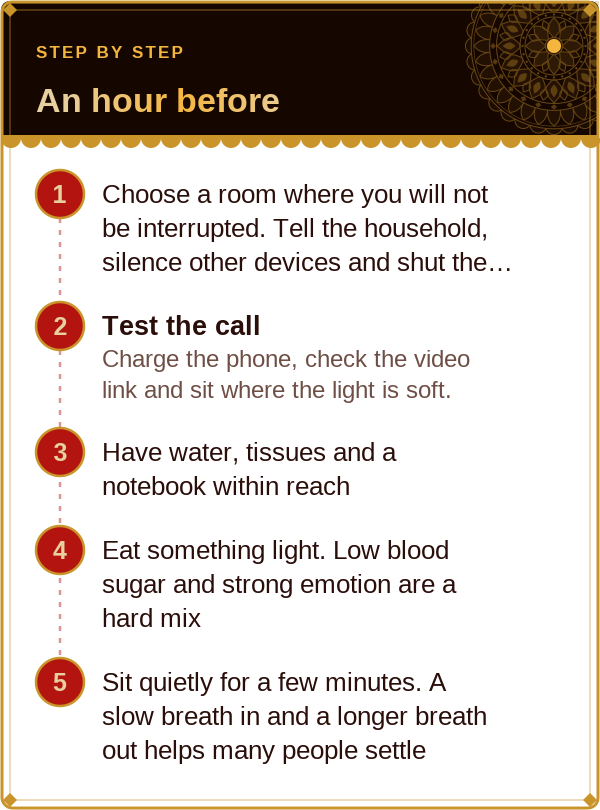
- Choose a room where you will not be interrupted. Tell the household, silence other devices and shut the door.
- Test the call: charge the phone, check the video link and sit where the light is soft.
- Have water, tissues and a notebook within reach.
- Eat something light. Low blood sugar and strong emotion are a hard mix.
- Sit quietly for a few minutes. A slow breath in and a longer breath out helps many people settle.
If you are joining by phone rather than video
A sitting works just as well by phone, and some people find it easier: there is no screen to watch, only a voice to listen to. A few small adjustments help. Use earphones so both hands are available for taking notes. Sit somewhere you will not be tempted to pace or tidy. Close your eyes during quieter moments if that helps you concentrate. And because you cannot see each other, say "can we pause?" out loud whenever you need a moment; silence on a phone line is easy to misread.
Bring hope, not a script
The hardest part of preparing is managing expectation. Many people arrive hoping to hear one particular word, nickname or apology. Holding that hope tightly can make the whole sitting feel like a test the medium has to pass. It helps to go in open to whatever comes, including nothing at all.
It also helps to know what careful practice sounds like. A thoughtful medium offers impressions tentatively, asks whether they mean anything to you and accepts "no" without pushing. A medium who asks a stream of leading questions and then hands your answers back as messages is doing something else; the post on telling insight from guesswork explains what to listen for.
During the sitting
- Answer honestly and briefly. "That doesn't fit" is a perfectly good reply.
- Take notes of anything that moves you, in your own words.
- Pause or stop whenever you need to. The answer on stopping a sitting that becomes too much is simple: yes, always.
- Do not agree to anything extra on the spot, such as further sessions, rituals or payments. Decide later, calmly.
Afterward: plan the quiet
A sitting often stirs up more feeling than people expect, even when it goes gently. Leave the next hour or two empty if you can. A walk, a cup of tea, a call with a friend who knew the person, or simply sitting outside can help the experience settle. Many people find it useful to write a short summary that evening, then put the notebook away for a few days.
The Hospice Foundation of America's guide to grief is a good reminder that grief has no fixed timetable, and a sitting does not close it. If you would like ongoing faith-based companionship, spiritual support in grief offers that alongside, never instead of, counseling.
What a medium sitting cannot do
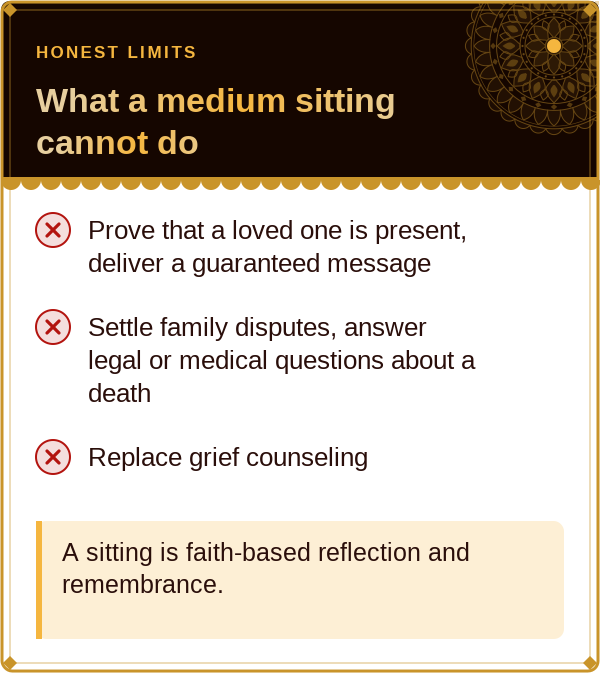
A sitting is faith-based reflection and remembrance. It cannot prove that a loved one is present, deliver a guaranteed message, settle family disputes, answer legal or medical questions about a death, or replace grief counseling. Astrologer and Psychic Vijayram will say so plainly if you ask, and will suggest professional help if grief is overwhelming you.
Common questions
What if nothing comes through in the sitting?
That can happen, and it says nothing about your love for the person or theirs for you. A careful medium will tell you honestly when nothing clear is coming rather than fill the silence with guesses. The time can still be used to talk about the person and what you are carrying.
Should I tell the medium who I hope to hear from?
You can, and many people find it eases the pressure. Some prefer to say only that they are remembering a family member. Either way, a good medium should not fish for details and then repeat them back as messages.
How soon after a death should I book a sitting?
There is no fixed rule, but many people find it helps to wait until the first rush of arrangements and shock has passed, often a few months. If you are struggling to function, a grief counselor or doctor is the better first call.
Can I record a phone or video sitting?
Ask before the session starts. Many people prefer to take their own notes or write a summary straight afterward, which captures what mattered to them without replaying every word.
Related service

Keep reading
Psychic Readings by WhatsApp: Privacy and Etiquette
A WhatsApp psychic reading made simple: what to share, what never to send, how to photograph your palms, and the warning signs of a scam to report.
Read article →
Can a Psychic Find a Lost Item or Pet?
Can a psychic find lost things or a missing pet? An honest look at the limits, the practical search steps that work in Fort Worth, and where a reading fits.
Read article →
How a Reader Checks an Intuitive Impression Against the Chart
How psychic impressions work in a session: where an intuitive image comes from, and how it is checked against the Vedic chart and your own words before sharing.
Read article →Quick answers
Can I stop a medium sitting if it becomes too much?
Yes, you can stop a medium sitting at any point. How a Fort Worth sitting is paused or ended gently, and where to turn for grief support if it feels heavy.
Read answer →Should I bring a photo or keepsake to a medium sitting?
A photo or keepsake is optional at a medium sitting in Fort Worth. What it can help with, what it is never used for, and how to hold one on a video call.
Read answer →Talk to Astrologer and Psychic Vijayram
Tell us what you are facing. If a reading is unlikely to help, you will be told that plainly.