

Repeating 11s, 22s and 33s in a Birth Date: What Numerologists Say
Master numbers in numerology are 11, 22 and 33, which the Western school leaves unreduced instead of adding down to 2, 4 or 6. They are found by adding the digits of a birth date, though methods differ. Numerologists read them as heightened potential that asks for effort, not as special status. Indian practice usually reduces them.
Key takeaways
- Most numerology reduces any total to a single digit: 29 becomes 11, which becomes 2.
- Master numbers belong to modern Western numerology, which took shape in the United States in the late nineteenth and early twentieth centuries.
- In the Western school, 11 is described as the intuitive, idealistic number: sensitive, inspired, quick to pick up on atmosphere, and prone to nervous tension and self-doubt.
- Twenty-two is called the "master builder": practical vision on a large scale, the ability to turn ideas into lasting structures, and a heavy sense of responsibility.
- Thirty-three is described as the teacher or caregiver: compassion, service and a pull toward looking after others.
Master numbers in numerology catch people's attention the moment they notice them. Someone born on the 29th adds 2 + 9, gets 11 and wonders whether it means something. Someone else adds up their whole birth date and lands on 22 or 33. This post explains what numerologists mean by these numbers, how they are found, why different methods give different answers, and why the honest reading is "potential", not "chosen one".
What numerologists mean by master numbers
Most numerology reduces any total to a single digit: 29 becomes 11, which becomes 2. The Western school makes an exception for 11, 22 and 33, which it leaves as they are and calls master numbers. Each is said to carry the qualities of its single digit (2, 4 and 6) in a stronger, more demanding form. Numerologists who use them tend to describe both a gift and a strain: more sensitivity, more ambition, more responsibility, and more pressure to go with it.
Where the idea comes from
Master numbers belong to modern Western numerology, which took shape in the United States in the late nineteenth and early twentieth centuries. That school is often traced to writers such as L. Dow Balliett, who taught a letter system based on the ancient Pythagorean idea that numbers underlie everything. Indian numerology developed along other lines. Most Indian practitioners reduce every total to a single digit linked with a planet, and many follow the Chaldean tradition popularized by Cheiro, which gives meanings to two-digit compound numbers instead of setting aside three special ones.
How to find master numbers in a birth date
There are three common methods, and they do not always agree. Here are three invented birth dates worked each way.
| Birth date | Add every digit | Month + day + year, reduced separately | Day of birth |
|---|---|---|---|
| 29 December 1990 | 1+2+2+9+1+9+9+0 = 33 | 3 + 11 + 1 = 15, then 6 | 29, then 11 |
| 11 October 1990 | 1+0+1+1+1+9+9+0 = 22 | 1 + 11 + 1 = 13, then 4 | 11 |
| 29 November 1992 | 1+1+2+9+1+9+9+2 = 34, then 7 | 11 + 11 + 3 = 25, then 7 | 29, then 11 |
Look at the first row: the same person has a 33 by one method and a 6 by another. The third person has repeating 11s in the month and day, yet the total reaches 7 either way. That is why it matters to know which method a reader uses, and why nobody should hang an identity on one calculation.
Master number 11
In the Western school, 11 is described as the intuitive, idealistic number: sensitive, inspired, quick to pick up on atmosphere, and prone to nervous tension and self-doubt. Its everyday form is 2, the cooperative peacemaker. Numerologists often say an 11 does best with steady routines that calm an active mind.
Numerology 22
Twenty-two is called the "master builder": practical vision on a large scale, the ability to turn ideas into lasting structures, and a heavy sense of responsibility. Its everyday form is 4, the patient, methodical worker. The strain described here is perfectionism and carrying too much alone.
Master number 33
Thirty-three is described as the teacher or caregiver: compassion, service and a pull toward looking after others. Its everyday form is 6, the nurturer. The caution is the obvious one: caring for everyone except yourself. Many numerologists only use 33 when it appears through the add-every-digit method.
Potential, not special status
Popular numerology content sometimes treats master numbers as a badge of spiritual rank. That reading does people no favors. It can make an adult feel they are failing a cosmic assignment, or a child feel pressure from a label they never asked for. Even within the tradition, master numbers describe possibilities that ask for effort, not results that arrive on their own.
It is also fair to say that numerology has no scientific support. The entry on numerology in The Skeptic's Dictionary sets out the case against it plainly. Many people still enjoy numbers as a way to reflect, and that is how they are offered here.
Reading the same date the Indian way
In Indian practice, a person born on 29 December 1990 has a moolank (birth number) of 2, from 29 to 11 to 2, linked with the Moon, and a bhagyank (destiny number) of 6, linked with Venus. There is no master number, but the reader might note that the day's compound number is 11 and the full date's digits total 33, as a point of interest. The post on moolank and bhagyank explains both numbers, and an Indian numerology reading puts them together with your name number. Names have their own calculation, covered in the name numerology check.
Astrologer and Psychic Vijayram can show you both the Western and the Indian reading of your date, side by side, and say plainly where they differ.
What master numbers cannot do
A master number cannot make you more gifted, more spiritual or more important than anyone else, and it cannot predict what you will achieve. Numerology is a traditional practice for reflection. Your choices and effort, not a sum of digits, shape your life.
Common questions
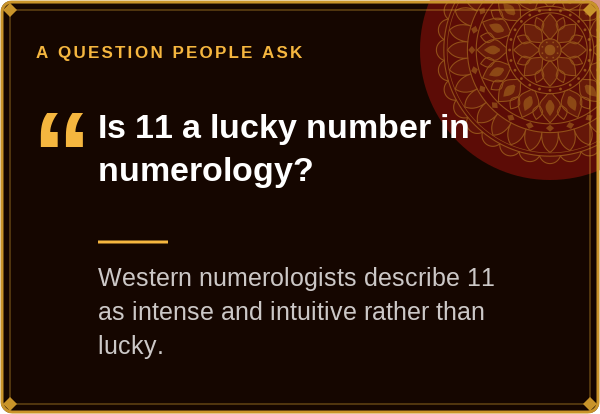
Is 11 a lucky number in numerology?
Western numerologists describe 11 as intense and intuitive rather than lucky. It is said to bring sensitivity along with nervous energy. Indian numerology reduces it to 2, linked with the Moon. Neither tradition promises good fortune from it.
Why does one calculator say 11 and another say 2?
They use different methods. Some keep master numbers, some reduce everything, and some add the month, day and year separately before combining them. Ask any reader which method they use, and stick with one.
Are master numbers better than other numbers?
No. Even the numerologists who use them describe master numbers as demanding, with their own strains. Every number has strengths and challenges in the tradition, and none makes a person more important.
Can master numbers appear in a name?
In Western numerology, yes: a name whose letters total 11, 22 or 33 is read as a master number. In the Chaldean method most Indian numerologists use, the compound total is read and then reduced to a single digit.
Related service
Keep reading
Vetting a Psychic in Fort Worth: Written Prices and Walk-Away Signs
How to choose a psychic in Fort Worth: seven checks before you book, from written prices and real reviews to the walk-away signs that mean leave now.
Read article →
Fortune Telling Under Texas Law and Fort Worth City Rules
Is fortune telling legal in Texas? What state law and city codes cover, how to check Fort Worth's current rules, and where to report a deceptive reader.
Read article →
Package Deals and Add-Ons: Reading the Fine Print on Psychic Pricing
What shapes psychic reading cost in Fort Worth: session length, preparation, bundles, follow-up fees and add-on rituals, and the fine print to read first.
Read article →Quick answers
Is the price agreed before a reading begins?
Yes. For a psychic reading in Fort Worth, the fee and session length are agreed in writing before the reading begins, with nothing added during the call.
Read answer →Can I bring a friend to my first psychic reading?
Yes, a friend can join your first psychic reading in Fort Worth, sitting beside you at home or on the video call, with your consent and a few privacy points.
Read answer →Talk to Astrologer and Psychic Vijayram
Tell us what you are facing. If a reading is unlikely to help, you will be told that plainly.