

Visitation Dreams: Keeping a Record After a Loss
Dreams of deceased loved ones are a very common part of grief. Many people find comfort in them, some find them unsettling, and traditions read them in different ways. Writing each dream down soon after waking, without rushing to interpret it, helps you hold it gently. Ongoing distress or lost sleep deserves a doctor or grief counselor.
Key takeaways
- The mind spends the day holding a loss it cannot fix, and at night it returns to familiar faces, rooms and routines.
- Every family brings its own background, and many Fort Worth households hold more than one.
- A written record lets you return to the dream later without the details fading or shifting each time you retell it.
- Big decisions after a death are better made slowly, with family and, where money or property is involved, a qualified professional.
- Some dreams after a death are frightening, especially if the death was sudden, violent or involved a long illness you witnessed.
Dreams of deceased loved ones are one of the most common things people mention in the months after a death. A mother appears in her kitchen, a grandfather sits on the porch as if nothing had happened, a friend says one sentence and is gone. If you are grieving, please put support first. Your doctor, a grief counselor or the bereavement program of the hospice that cared for your loved one can help. If grief ever feels unbearable or you think about ending your life, contact the Suicide and Crisis Lifeline at any hour, and call emergency services in an emergency.
Why so many people dream of someone they have lost
Grief reaches into sleep. The mind spends the day holding a loss it cannot fix, and at night it returns to familiar faces, rooms and routines. The MedlinePlus pages on bereavement describe trouble sleeping and vivid memories as part of ordinary grief. Dreams of the person who died fit right into that picture.
Some dreams feel unlike others. People often describe a "visitation dream" as unusually clear and calm, with the person looking well, saying little and leaving a sense of peace. Others are tangled, sad or anxious. Both kinds are normal.
What traditions say about visitation dreams
Every family brings its own background, and many Fort Worth households hold more than one.
- Hindu families often connect dreams of parents and grandparents with the ancestors (pitru) and may respond with a prayer, an offering of food or by keeping the annual shraddha. The post on Pitru Paksha and remembering ancestors explains that season.
- Ayurvedic texts took dreams seriously too. A chapter of the Charaka Samhita on dreams sorts them into kinds, many drawn from things seen, heard or longed for in waking life, with only some treated as meaningful signs.
- Mexican and Catholic families, including many on Fort Worth's Northside, keep the dead close through prayer, Masses and Día de los Muertos altars, and dreams are often spoken about warmly at those times.
- Christian, Muslim, Sikh and Jewish traditions each have their own teachings on dreams; your pastor, imam, granthi or rabbi is the right person to ask.

How to keep a record of the dream
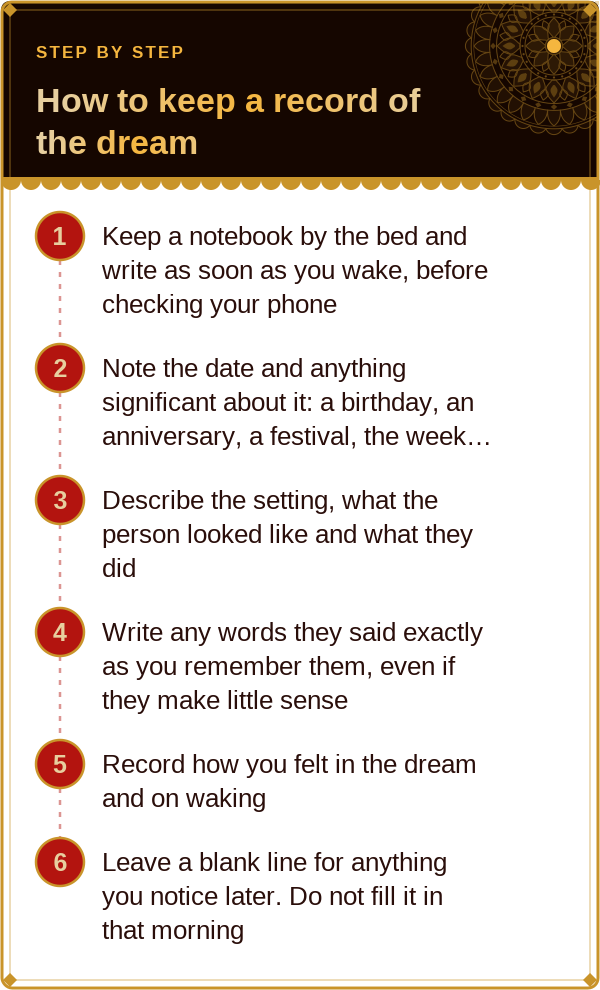
A written record lets you return to the dream later without the details fading or shifting each time you retell it.
- Keep a notebook by the bed and write as soon as you wake, before checking your phone.
- Note the date and anything significant about it: a birthday, an anniversary, a festival, the week after a hard conversation.
- Describe the setting, what the person looked like and what they did.
- Write any words they said exactly as you remember them, even if they make little sense.
- Record how you felt in the dream and on waking.
- Leave a blank line for anything you notice later. Do not fill it in that morning.
Over months, the notebook often shows a change. Many people find the dreams become less frequent and more peaceful as grief softens, and the record lets you see that rather than guess.
Holding the dream gently
A dream is not an instruction. If your late father seems to say "sell the house", that is not a reason to put it on the market next week. Big decisions after a death are better made slowly, with family and, where money or property is involved, a qualified professional.
If a dream leaves you wanting to do something, choose something small and kind: visit the grave or the place where the ashes were scattered, cook their favorite dish, call the sibling you have not spoken to, or give a meal to someone who needs one.
When dreams become distressing
Some dreams after a death are frightening, especially if the death was sudden, violent or involved a long illness you witnessed. Repeated nightmares, fear of going to sleep, or dreams that replay the death itself are worth raising with your doctor or a counselor who works with grief and trauma. Help for this exists, and it is not a spiritual failing to need it.
Honoring someone by name
A dream of a grandparent sometimes arrives while a family is expecting a baby, and the conversation turns to naming the child after them. Many families do this with a middle name or a shared first syllable. If you want to compare spellings, a name numerology check can show how each version adds up in the Indian tradition, as one gentle consideration alongside meaning, sound and the family's wishes.
What a reader can and cannot do
Some people want to talk a dream through with someone who takes spiritual experience seriously. A remembrance sitting with a psychic medium, or spiritual support in grief with Astrologer and Psychic Vijayram, can offer a calm space to do that by phone, WhatsApp or video. Neither can tell you for certain what the dream meant, who sent it, or anything that only the person who died could know. They are faith-based reflection, never a replacement for grief counseling, medical care or the people who loved them with you.
Common questions
Are visitation dreams real visits?
Nobody can prove what a dream is. Many faiths see some dreams of the dead as meaningful, and many people experience them as a real meeting. Others understand them as the grieving mind replaying love and memory. You do not have to settle the question to be comforted by the dream.
Is it bad luck to keep dreaming of dead relatives?
No. Dreaming of a parent, grandparent or friend who has died is a normal part of missing them, and it is not a sign of bad luck or a warning. If the dreams are frightening or stop you sleeping, mention them to your doctor.
Should I do something after dreaming of a parent who has died?
Only if it feels right. Some families light a lamp, say a prayer, give food to someone in need or share a memory at dinner. Nothing is required, and no ritual needs to be bought.
Can a medium tell me what my dream meant?
A medium or reader can listen and offer a faith-based reflection, but cannot confirm what a dream meant or who sent it. Your own sense of the dream, and the people who knew the person, matter more.
Related service

Keep reading

How to Prepare for a Medium Sitting
How to prepare for a medium reading by phone or video: rest beforehand, hold expectations loosely, set up a quiet room and plan gentle time afterward.
Read article →
Psychic Readings by WhatsApp: Privacy and Etiquette
A WhatsApp psychic reading made simple: what to share, what never to send, how to photograph your palms, and the warning signs of a scam to report.
Read article →
Can a Psychic Find a Lost Item or Pet?
Can a psychic find lost things or a missing pet? An honest look at the limits, the practical search steps that work in Fort Worth, and where a reading fits.
Read article →Quick answers
Is the price agreed before a reading begins?
Yes. For a psychic reading in Fort Worth, the fee and session length are agreed in writing before the reading begins, with nothing added during the call.
Read answer →Can I bring a friend to my first psychic reading?
Yes, a friend can join your first psychic reading in Fort Worth, sitting beside you at home or on the video call, with your consent and a few privacy points.
Read answer →Talk to Astrologer and Psychic Vijayram
Tell us what you are facing. If a reading is unlikely to help, you will be told that plainly.