

Gut Feeling or Worry Loop? A Journal Test Before You Book
Intuition vs anxiety often comes down to tone and repetition. A gut feeling tends to arrive once, quietly, and point to something you can check. Anxiety loops, grows louder with each pass and asks for reassurance. Writing both down for two weeks usually shows which is which, and constant worry deserves a doctor's attention.
Key takeaways
- You need a small notebook or a notes app, and about five minutes a day.
- Feelings that cluster late at night, after little sleep or after an argument lean toward worry.
- Book a medical or counseling appointment if any of these apply:
- Some people ask for a short add-on like a traditional face reading hoping it will settle whether a fear is real.
The question of intuition vs anxiety usually turns up at 2 a.m. You have a strong feeling that something is wrong with a job, a relationship or a family member, and you cannot tell whether it is wisdom or worry talking. Before you book anyone, try the simple notebook test below. And if the worry has been loud for weeks, is stopping you from sleeping or eating, or comes with chest pain or panic, start with your doctor or a licensed counselor rather than a reader. If you ever feel unsafe or think about harming yourself, contact the Suicide and Crisis Lifeline any hour, or emergency services in an emergency.
How a gut feeling and a worry loop tend to feel
Neither one is a fault. Both are your mind trying to protect you. They simply behave differently, and noticing the difference is a skill you can practice.
| Feature | Gut feeling | Worry loop |
|---|---|---|
| Arrival | Quiet, often once, sometimes in a calm moment | Loud, repeated, often when tired or alone |
| Content | One plain point ("check that contract again") | A chain of what-ifs that keeps branching |
| Body | A small pull or pause, then settled | Tight chest, racing thoughts, restlessness |
| Response to facts | Eases when checked | Finds a new angle as soon as one is answered |
| What it asks for | An action | Reassurance, again and again |
The National Institute of Mental Health overview of anxiety disorders describes worry that is hard to control and lasts for months, with restlessness, poor sleep and trouble concentrating. If that list sounds like your last few weeks, the notebook test is still worth doing, but the doctor's appointment comes first.
The two-week journal test
You need a small notebook or a notes app, and about five minutes a day. Writing feelings down is a recognized self-help habit; the University of Rochester Medical Center's page on journaling for emotional wellness notes that it can help people spot patterns and triggers. Here it is used for one narrow purpose.
Week one: catch and record
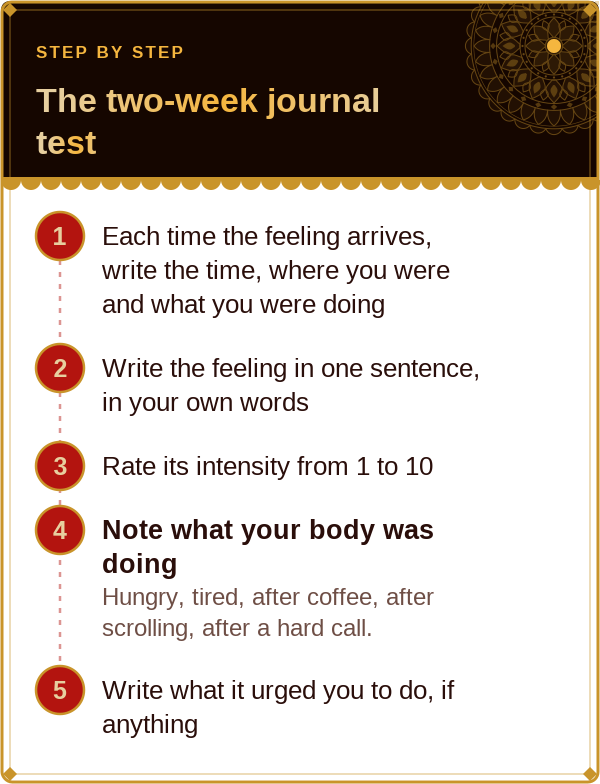
- Each time the feeling arrives, write the time, where you were and what you were doing.
- Write the feeling in one sentence, in your own words.
- Rate its intensity from 1 to 10.
- Note what your body was doing: hungry, tired, after coffee, after scrolling, after a hard call.
- Write what it urged you to do, if anything.
Do not argue with the entries yet. Just collect them.
Week two: sort and test
- Count how many entries are about the same subject.
- Mark each entry as "one clear point" or "chain of what-ifs".
- For any clear point, take one small, safe step to check it: reread the email, ask the question, look at the bank statement.
- Write down what happened after the check. Did the feeling ease, or move on to a new worry?
Reading your notes at the end
Patterns usually jump out. Feelings that cluster late at night, after little sleep or after an argument lean toward worry. Feelings that appeared once, said one thing and calmed down after you checked lean toward intuition. A feeling about a person that only surfaces after you have been scrolling their social media is almost always worry.
Sometimes the notebook shows both at once: a fair point buried under a pile of what-ifs. That is common. Keep the fair point, act on it sensibly, and let the rest go as best you can.
How to trust intuition without feeding worry
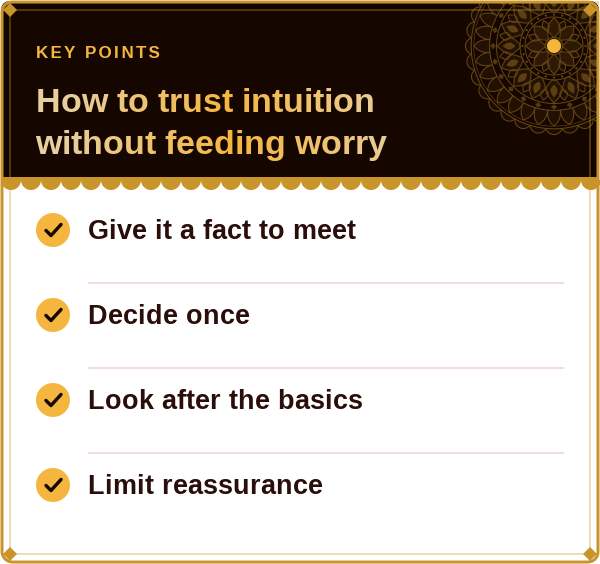
- Give it a fact to meet. Intuition is a prompt to look, not a verdict. Look, then decide.
- Decide once. If you have checked and chosen, write the decision down and stop reopening it.
- Look after the basics. Sleep, food and movement change how loud worry sounds. Slow breathing helps many people; the post on simple pranayama for calm has a short practice.
- Limit reassurance. Asking five friends, three apps and two readers the same question trains the loop to ask again.
When a doctor or counselor is the better next step
Book a medical or counseling appointment if any of these apply:
- The worry has lasted most days for several weeks.
- You are losing sleep, skipping meals or avoiding work, school or people.
- You have panic attacks, chest pain or a racing heart. Chest pain needs urgent medical care.
- You are using alcohol or other substances to quiet your thoughts.
- You have thoughts of harming yourself. Contact the Suicide and Crisis Lifeline now.
Never stop or change a prescribed medicine because of a feeling, a journal entry or anything a reader says. Talk to the prescriber. The post on Tarrant County crisis and mental health resources lists local and national contacts.
Where a reading fits, if it fits at all
Some people ask for a short add-on like a traditional face reading hoping it will settle whether a fear is real. It cannot. A face, palm or chart reading describes traditional signs of temperament for reflection; it does not confirm a hunch about a partner or predict whether a worry will come true. What a calm session with Astrologer and Psychic Vijayram can offer, once the sharpest anxiety has eased, is a different angle on a decision you are already weighing.
If you do book, bring your notebook. A clear question that survived the two weeks makes a far better starting point than a midnight panic. And keep the follow-up modest: the post on why it helps to wait before asking again explains why repeat readings on the same worry tend to make it louder.
Common questions
How do I know if it's a gut feeling or anxiety when it keeps coming back?
Repetition on its own points toward anxiety. A gut feeling usually makes its point and then rests, while a worry loop returns with new what-ifs each time. If the same fear has visited dozens of times this week, treat it as worry first and talk it over with someone you trust or a counselor.
Can a psychic tell me whether my intuition is right?
No reader can confirm that a feeling is accurate. A careful reader can help you look at a situation from another angle, but checking the facts, asking the person involved or seeing a professional will tell you far more than any reading.
Should I book a reading while I feel very anxious?
It is usually better to wait until the sharpest anxiety has eased, and to see a doctor if it has gone on for weeks. A reading booked in the middle of panic tends to become one more thing to worry about rather than a source of calm.
Does a worry journal replace therapy?
No. Journaling is a useful self-help habit, but it is not treatment. If anxiety is affecting sleep, work or relationships, a doctor or licensed counselor can offer options that a notebook cannot.
Related service

Keep reading

Visitation Dreams: Keeping a Record After a Loss
Dreams of deceased loved ones are common in grief. How to write them down, what different traditions say about them, and where to find grief support.
Read article →
How to Prepare for a Medium Sitting
How to prepare for a medium reading by phone or video: rest beforehand, hold expectations loosely, set up a quiet room and plan gentle time afterward.
Read article →
Psychic Readings by WhatsApp: Privacy and Etiquette
A WhatsApp psychic reading made simple: what to share, what never to send, how to photograph your palms, and the warning signs of a scam to report.
Read article →Quick answers
Is the price agreed before a reading begins?
Yes. For a psychic reading in Fort Worth, the fee and session length are agreed in writing before the reading begins, with nothing added during the call.
Read answer →Can I bring a friend to my first psychic reading?
Yes, a friend can join your first psychic reading in Fort Worth, sitting beside you at home or on the video call, with your consent and a few privacy points.
Read answer →Talk to Astrologer and Psychic Vijayram
Tell us what you are facing. If a reading is unlikely to help, you will be told that plainly.