
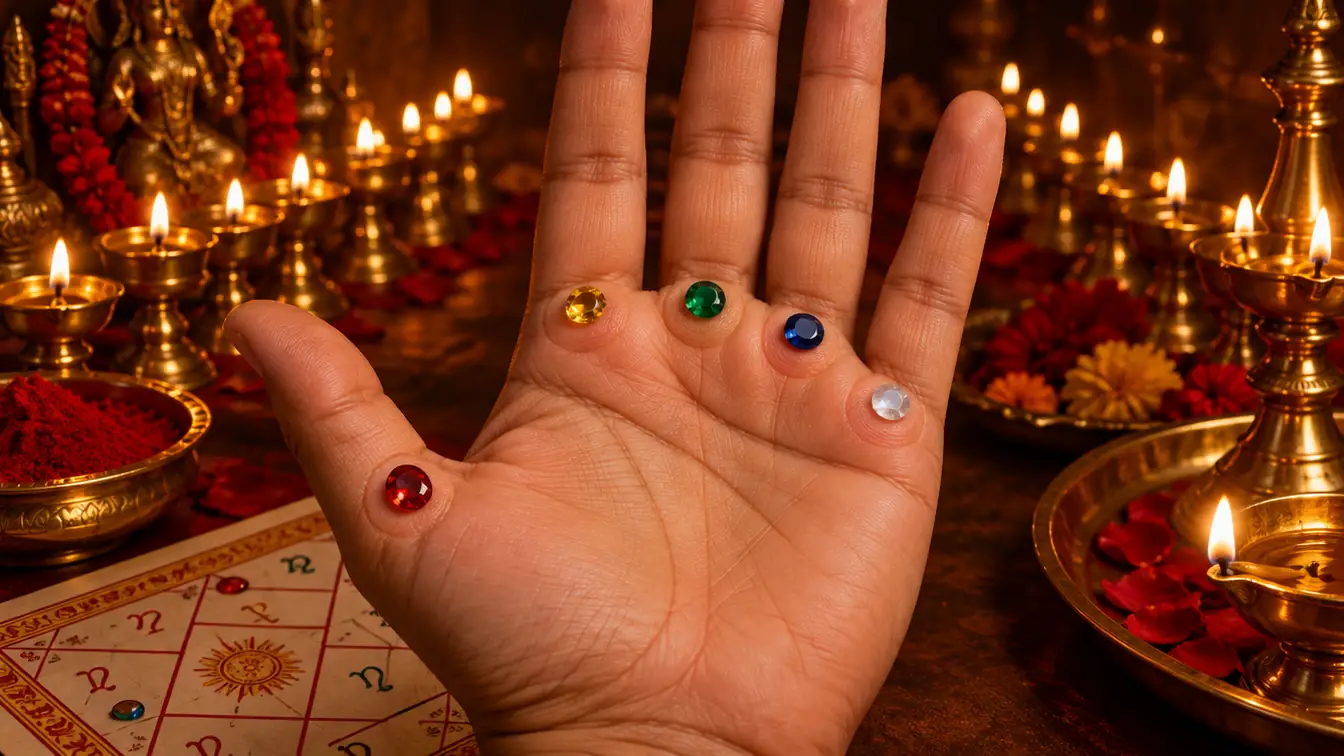
Mount of Venus, Mount of Saturn: Palm Mounts Beside the Vedic Chart
The mounts of the palm are raised pads under the fingers and at the base of the hand, each named after a planet. Their meaning depends on fullness: a full Mount of Jupiter is read as confidence, a full Mount of Venus as warmth. Indian readers compare each mount with the same planet in the kundli.
Key takeaways
- The mounts follow the same planetary scheme that runs through the wider palmistry tradition , matched in India with the navagraha , the nine planetary influences of Vedic astrology.
- A full Mount of Venus is read as warmth, generosity and a strong appetite for life: food, music, friendship, love.
- For clients who know their birth details, Indian readers often compare each mount with the same planet in the chart.
- Say your Mount of Saturn is full and firm, suggesting discipline and seriousness, but Saturn in your chart is weak by the classical rules.
- People sometimes hear that a weak mount means they need a gemstone.
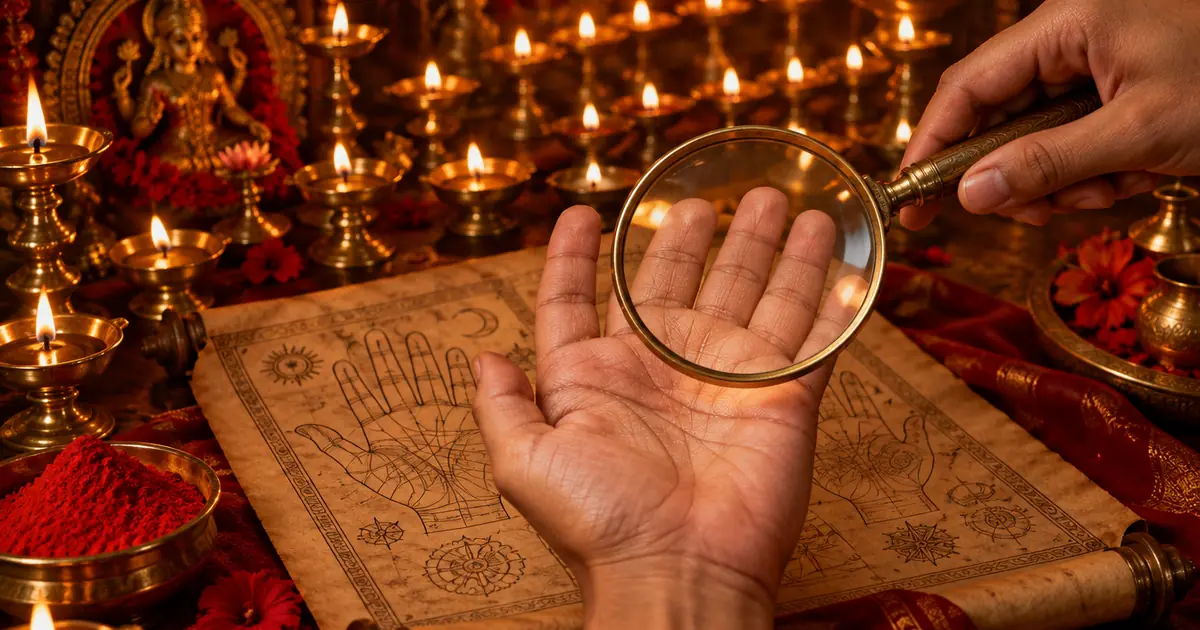
Hold your palm up to a lamp, tilt it a little, and the surface stops looking flat. Under each finger there is a small pad of flesh, and at the base of the thumb there is a broad, rounded one. Palmists call these the mounts and give each one the name of a planet. In Indian palmistry, which grew up beside Vedic astrology, that naming invites an obvious question: does the Mount of Venus on your hand agree with Venus in your birth chart? This post explains the mounts and what to make of it when hand and chart disagree.
The mounts and their planets
The mounts follow the same planetary scheme that runs through the wider palmistry tradition, matched in India with the navagraha, the nine planetary influences of Vedic astrology.
| Mount | Where it sits | Read for, when full |
|---|---|---|
| Jupiter (Guru) | Under the index finger | Confidence, ambition, faith, the wish to guide others |
| Saturn (Shani) | Under the middle finger | Seriousness, responsibility, a liking for solitude |
| Sun (Surya) | Under the ring finger | Creativity, warmth, the wish to be seen |
| Mercury (Budha) | Under the little finger | Communication, trade, quick wit |
| Venus (Shukra) | Base of the thumb | Affection, vitality, enjoyment of beauty and comfort |
| Moon (Chandra) | Outer heel of the hand, opposite the thumb | Imagination, feeling, love of travel |
| Mars (Mangal) | Two areas: inside, above Venus, and on the outer edge below Mercury | Drive and physical courage; endurance and moral courage |
Some Indian systems also mark areas for Rahu and Ketu, usually in the center of the palm and near the wrist, though readers differ on exactly where.
How a mount is judged
A palmist looks at four things:
- Fullness. Is the mount raised, flat or hollow compared with the others?
- Firmness. Firm and springy is read as active energy; soft as a more passive form of the same quality.
- Position. A mount that leans toward its neighbor is read as blending the two planets. A Mount of Jupiter drifting toward Saturn might suggest ambition tempered by caution.
- Markings. Small crosses, stars or grilles on a mount add traditional nuances, always read lightly.
The Mount of Venus is usually the largest on any hand, so readers judge it against what is typical, not against the small finger mounts.
Mount of Venus and Mount of Jupiter: the two most asked about
A full Mount of Venus is read as warmth, generosity and a strong appetite for life: food, music, friendship, love. A narrow, flat one is read as reserve or a more private emotional life. It says nothing about how many relationships you will have.
A full Mount of Jupiter is read as healthy confidence and an interest in leading, teaching or advising. Very prominent, it may be read as pride or a need to be in charge. A flat Mount of Jupiter often belongs to people who do excellent work quietly and prefer not to be the boss.
Setting the mounts beside the kundli
For clients who know their birth details, Indian readers often compare each mount with the same planet in the chart. The kundli shows a planet's sign, house and strength, and the periods when it is most active. The hand shows how that planet's qualities look in your temperament now.
When the two agree, for example a full Mount of Jupiter alongside a well-placed Jupiter in the chart, a reader may treat that quality as a clear theme in your life. When they disagree, the reading becomes more interesting.
What to make of it when hand and chart disagree
Say your Mount of Saturn is full and firm, suggesting discipline and seriousness, but Saturn in your chart is weak by the classical rules. Several sensible readings are possible:
- Different time frames. The chart is fixed at birth; hands reflect a life lived. You may have built discipline through work and circumstance that the chart did not make easy.
- Different scope. The chart describes timing as well as temperament. A quality may show strongly in your hands now and still have its active period in the chart later.
- A useful tension. Disagreement can point to an area of your life where effort has changed the picture. That is worth talking about.
- Uncertain data. If your birth time is approximate, the chart side of the comparison is less reliable, and the reader should say so.
What a careful reader does not do is let one method silently overrule the other, or treat a disagreement as a problem to be fixed with a purchase or a ritual. The post on checking intuitive impressions against the chart explains the same principle for other methods.
Gemstones and remedies
People sometimes hear that a weak mount means they need a gemstone. In Vedic practice, gemstones are judged from the birth chart, and only after careful thought; a gemstone suitability reading looks at whether any stone is appropriate, and often concludes that none is needed. A mount alone is never a reason to buy anything.
Reading your mounts with a reader
A palm reading with Astrologer and Psychic Vijayram looks at the mounts alongside the thumb, fingers and lines, from photos and a short video call. If you would like the comparison with your chart, add your birth details and ask for the palm to be read beside a kundli and birth chart reading. The posts on thumbs and fingers in Indian palmistry and the major palm lines cover the rest of the hand.
What the mounts cannot tell you
Mounts describe tendencies in temperament, as tradition reads them. They cannot predict events, wealth, marriage or health, and a full or flat mount is never a verdict on who you are. Palmistry and astrology are traditional practices for reflection, and they work best when they leave room for your own experience.
Common questions
What does a large Mount of Venus mean?
A full, firm Mount of Venus at the base of the thumb is traditionally read as warmth, affection, energy and enjoyment of life. Very large and soft, some readers say it can lean toward indulgence. It describes temperament, not your future relationships.
What does a flat mount mean?
A flat mount is read as that planet's qualities being quieter in your temperament, not missing. A flat Mount of Jupiter might suggest someone who leads only when asked. Nothing about a flat mount is a bad sign.
Should I wear a gemstone if a mount is weak?
Not on the strength of a palm alone. In Vedic practice, gemstones are judged from the birth chart, carefully, and many people need none at all. A weak-looking mount is never a reason to buy anything.
Can I see my mounts in a photo?
Partly. Mounts are about fullness and firmness, so a side view of the hand and a slightly cupped palm show them best. On a video call, the reader may ask you to press a mount gently to see how firm it is.
Related service
Keep reading
Moolank and Bhagyank: Indian Numerology's Two Core Numbers
Your numerology birth number in the Indian system: how moolank and bhagyank are worked out, what each is read for, and how both relate to the name number.
Read article →
Gut Feeling or Worry Loop? A Journal Test Before You Book
Intuition vs anxiety: a two-week journal test to tell a calm gut feeling from a worry loop, and the signs that a doctor or counselor is the better next step.
Read article →
Visitation Dreams: Keeping a Record After a Loss
Dreams of deceased loved ones are common in grief. How to write them down, what different traditions say about them, and where to find grief support.
Read article →Quick answers
Do you read children's palms?
Yes, children's palms are read in Fort Worth, gently and with a parent present on video, looking at temperament and strengths, never at predictions.
Read answer →Is the price agreed before a reading begins?
Yes. For a psychic reading in Fort Worth, the fee and session length are agreed in writing before the reading begins, with nothing added during the call.
Read answer →Talk to Astrologer and Psychic Vijayram
Tell us what you are facing. If a reading is unlikely to help, you will be told that plainly.