
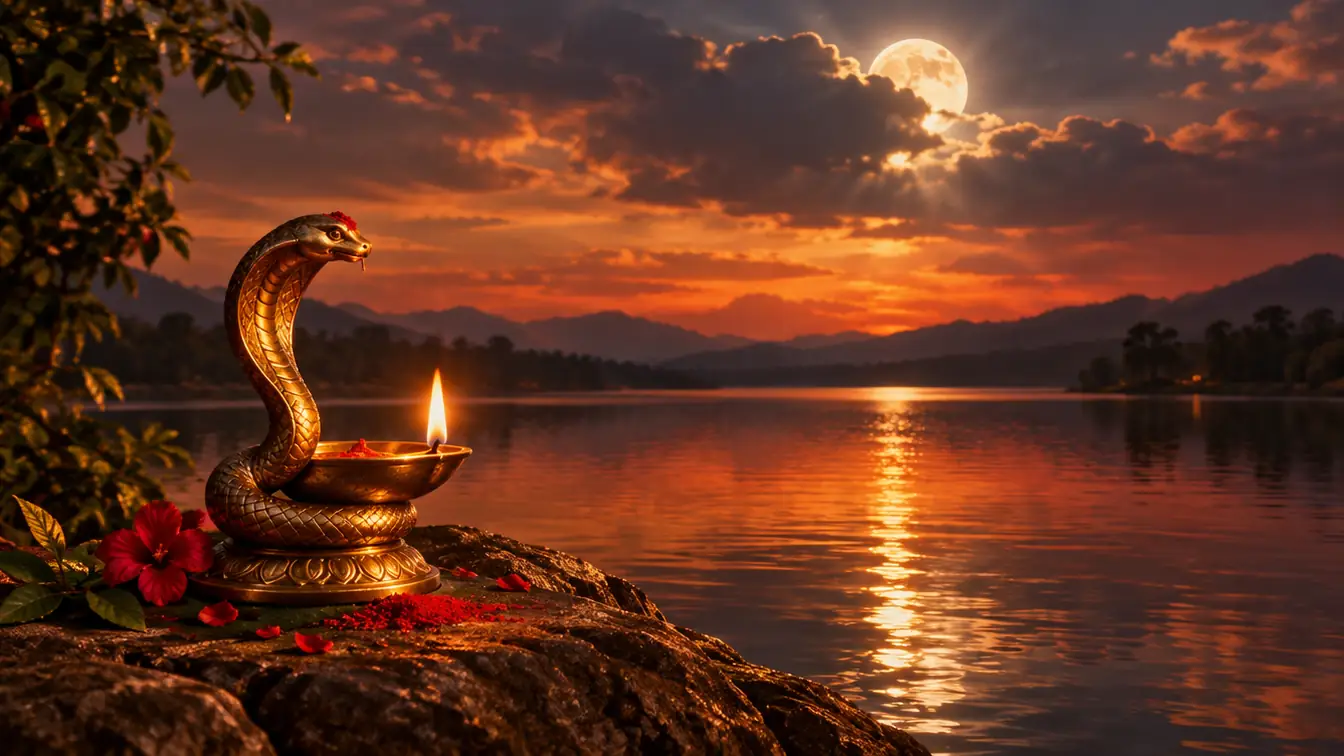
Rahu, Ketu and Feeling Under a Cloud
Rahu and Ketu are the Moon's nodes, not physical planets. The negative effects people link to them, restlessness with Rahu and a foggy, detached mood with Ketu, are read as phases in a chart, never as curses. A careful astrologer looks at dasha and transit timing, then checks ordinary causes like sleep, stress and health first.
Key takeaways
- Rahu and Ketu are not planets you can see.
- Classical and modern astrologers give the two nodes opposite moods:
- In the Vimshottari system, the Rahu mahadasha lasts eighteen years and the Ketu mahadasha seven.
- You may also hear the label Kaal Sarp, used when every planet falls on one side of the nodal axis.
- A fog that settles for weeks has ordinary suspects.
Clients describe it in weather words. A fog. A low ceiling. Days when nothing is exactly wrong but nothing quite lands either. In Vedic astrology, two names come up again and again when people feel this way: Rahu and Ketu. Searches for Rahu Ketu negative effects tend to turn up frightening lists. This post takes a calmer route: what the two nodes are, how an astrologer reads a restless stretch, and why none of it amounts to a curse.
What Rahu and Ketu actually are
Rahu and Ketu are not planets you can see. They are the two points where the Moon's tilted orbit crosses the apparent path of the Sun across the sky. NASA's notes on the Moon's orbit and its nodes explain why eclipses can only happen when the Sun and Moon line up near these points. Indian astronomers tracked them for that reason, and astrology gave them a place among the nine grahas.
The story behind them is older. In the Puranic tale, a demon named Svarbhanu slipped among the gods to drink the nectar of immortality. Vishnu's discus cut him in two before he could swallow, leaving an immortal head, Rahu, and a headless body, Ketu. The traditional accounts of Rahu and of Ketu describe them as shadow grahas that chase the Sun and Moon, which is the old explanation for eclipses.
Why they get blamed for feeling stuck
Classical and modern astrologers give the two nodes opposite moods:
- Rahu is hunger without a full stomach: ambition, obsession, foreign places, sudden change, technology, illusion. A strong Rahu period can feel restless and wired.
- Ketu is the body without a head: detachment, loss of interest, endings, insight, spiritual pull. A Ketu period can feel foggy and far away.
Those descriptions are useful as language for an experience. They become harmful when they are turned into threats.
Rahu dasha effects and the Ketu period, in timing terms
In the Vimshottari system, the Rahu mahadasha lasts eighteen years and the Ketu mahadasha seven. Inside every major period are shorter sub-periods, so a Rahu or Ketu sub-period can surface even when you are in someone else's main period. Our plain-English guide to how Vimshottari dasha works shows how the layers fit together.
The nodes also move through the zodiac, always backward, spending roughly a year and a half in each sign. When that axis crosses your natal Moon or ascendant, many people notice a season of change. A dasha and transit reading sets out your own dates in Central Time, so you know whether a period is starting, peaking or nearly done.
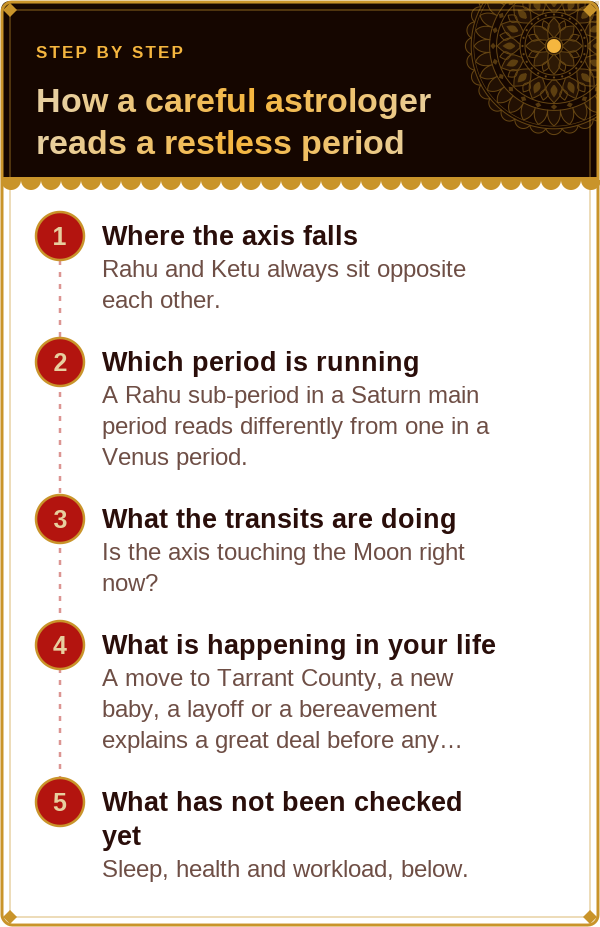
How a careful astrologer reads a restless period
- Where the axis falls. Rahu and Ketu always sit opposite each other. Across the fourth and tenth houses, the pull is between home and career; across the first and seventh, between self and partner.
- Which period is running. A Rahu sub-period in a Saturn main period reads differently from one in a Venus period.
- What the transits are doing. Is the axis touching the Moon right now?
- What is happening in your life. A move to Tarrant County, a new baby, a layoff or a bereavement explains a great deal before any planet does.
- What has not been checked yet. Sleep, health and workload, below.
You may also hear the label Kaal Sarp, used when every planet falls on one side of the nodal axis. It is a relatively recent label in astrological writing and is often used to sell expensive pujas. Treat any alarm built on it with caution.
Feeling under a cloud? Check these before blaming the nodes
A fog that settles for weeks has ordinary suspects. Poor sleep, a thyroid or iron problem, side effects from a new medicine, heavy drinking, grief that has not been spoken about, or the long drain of a Fort Worth August can all feel like a shadow over everything. A check-up with your doctor rules out the physical causes. If low mood, loss of interest or hopelessness last most days for two weeks or more, read when low mood needs more than prayer and talk to a professional. If you ever feel unsafe, contact the Suicide and Crisis Lifeline.
Optional practices people keep in these periods
Some people like to pair practical steps with a small devotion. Tradition links Rahu with the goddess Durga and Ketu with Ganesha, so a short prayer to either, a weekly act of charity, or a node mantra repeated eleven times are common choices. Our post on matching the navagraha mantras to the weekdays gives simple wording. None of this has to be bought, and all of it is optional. If you want prayers offered on your behalf, Astrologer and Psychic Vijayram explains what negative energy removal involves before anything is agreed.
What a chart cannot tell you
A chart cannot diagnose depression or illness and cannot promise the date a heavy period will lift. It can give a restless season a shape and a likely length, which some people find steadying. Use it for that, alongside the people and services who can treat what needs treating.
Common questions
Is Rahu dasha always bad?
No. It lasts eighteen years, and plenty of people marry, move and build careers inside it. The tradition describes Rahu as ambitious and worldly, so the same period can bring drive as well as restlessness, depending on where Rahu sits in your chart.
What does a Ketu period feel like?
People often describe it as quieter: less interest in old goals, more time spent inward, a pull toward study or spiritual practice. If that detachment turns into hopelessness or lasts for weeks, see a doctor rather than waiting for the period to end.
Can Rahu and Ketu be removed from a chart?
No. Both nodes appear in every birth chart, so there is nothing to remove. Anyone offering to take them out of your chart for a fee is selling fear, not tradition.
Did the 2024 eclipse over Fort Worth affect my Rahu or Ketu?
Eclipses always happen near the nodes, which is why the tradition links them. Families kept observances on 8 April 2024, described in eclipse customs Fort Worth families kept, but an eclipse is not a reason for fear.
Related service

Keep reading

After a Cleansing: Keeping the Home Calm
What to do after spiritual cleansing: light, order and a short daily prayer to keep the home calm, with no repeat fees or top-up rituals required.
Read article →
Blessing a Food Truck Before Its First Fort Worth Season
A food truck blessing for Fort Worth owners: propane and generator safety first, then a short vahan puja style prayer and a weekly habit. Faith, not a promise.
Read article →
Welcoming a New Pet Home: A Gentle Blessing for Fort Worth Families
A simple pet blessing for Fort Worth families welcoming a new dog, cat or horse: a short prayer, a clean space, and care with incense, camphor and plants.
Read article →Quick answers
Is nazar the same thing as mal de ojo?
Nazar and mal de ojo are close cousins: both name the evil eye of envy or admiration. How the South Asian and Latin American beliefs differ in Fort Worth.
Read answer →How do I know if I need a spiritual cleansing?
How do you know if you need a spiritual cleansing? Rule out health, sleep and stress first; then a cleansing can be a calm faith practice. A Fort Worth guide.
Read answer →Talk to Astrologer and Psychic Vijayram
Tell us what you are facing. If a reading is unlikely to help, you will be told that plainly.