
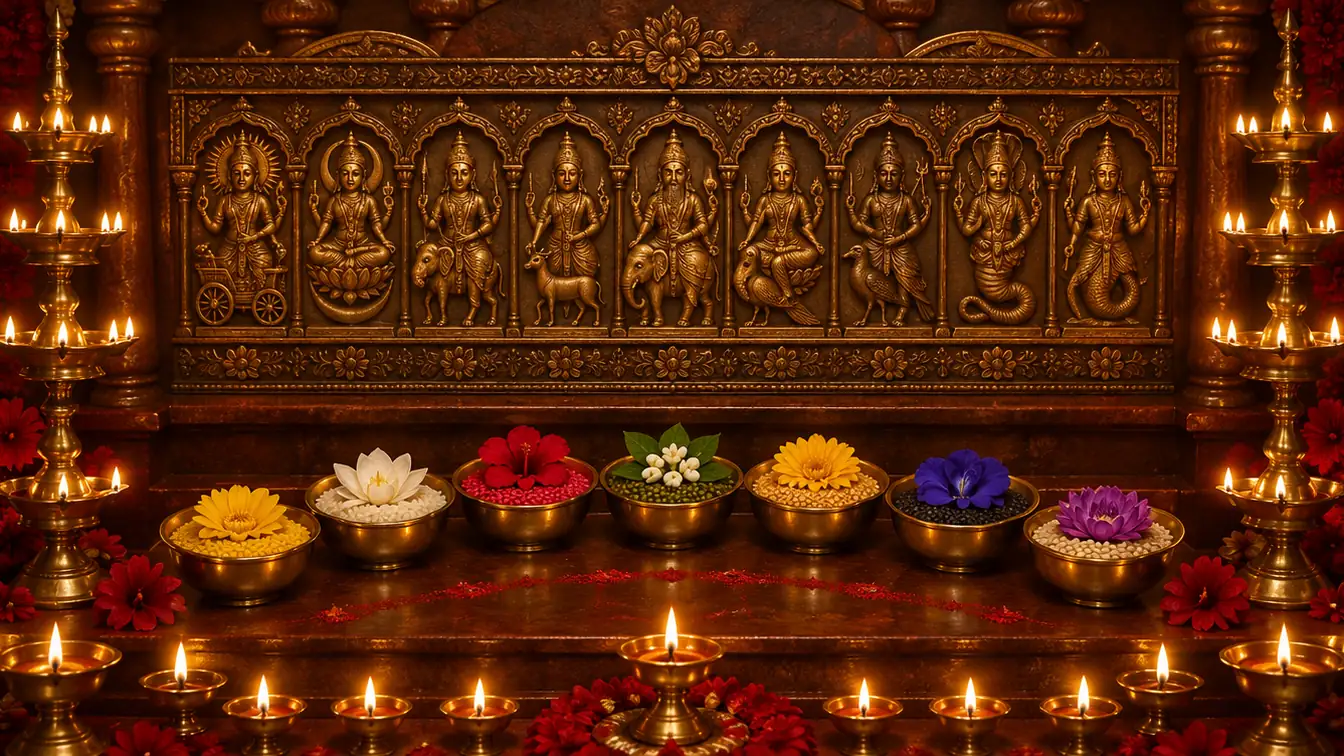
One Planet a Day: Navagraha Mantras Matched to the Weekdays
A navagraha mantra practice can follow the week: Surya on Sunday, Chandra on Monday, Mangala on Tuesday, Budha on Wednesday, Guru on Thursday, Shukra on Friday and Shani on Saturday, with Rahu and Ketu often added on Saturday or Tuesday. Keep counts small, eleven or twenty-seven, and treat it as devotion rather than a fix.
Key takeaways
- Sanskrit weekday names are planet names.
- The lunar nodes have no weekday of their own.
- Three minutes a day, kept for a month, will teach you more about the grahas than an hour of reading.
- Sunday, a parent says the Surya mantra on the back porch at sunrise before the family heads out.
- Saturn has a fearsome reputation, especially during Sade Sati, the seven-and-a-half-year period when it passes over the Moon.
The nine grahas of Vedic astrology, the navagraha, can feel abstract when you first meet them in a chart. A weekly rotation makes them concrete. Each weekday already belongs to a planet, so a navagraha mantra practice can follow the calendar you live by: one short mantra each morning, for the planet of the day, with no long rituals and no promises attached. Here is a simple version that fits a working week in Fort Worth.
Why the weekdays already belong to the planets
Sanskrit weekday names are planet names. Sunday is Ravivara, the Sun's day; Monday is Somavara, the Moon's; Tuesday Mangalavara, Mars; Wednesday Budhavara, Mercury; Thursday Guruvara, Jupiter; Friday Shukravara, Venus; and Saturday Shanivara, Saturn. English keeps traces of the same old planetary week in Sunday, Monday and Saturday. The navagraha tradition gives each of these planets a deity, a color, a grain and a mantra.
The seven-day rotation
| Day | Graha | Simple mantra | Traditional theme |
|---|---|---|---|
| Sunday | Surya (Sun) | Om Suryaya Namah | Vitality, confidence, father |
| Monday | Chandra (Moon) | Om Chandraya Namah | Mind, mood, mother |
| Tuesday | Mangala (Mars) | Om Mangalaya Namah | Courage, energy, siblings |
| Wednesday | Budha (Mercury) | Om Budhaya Namah | Speech, learning, trade |
| Thursday | Guru (Jupiter) | Om Gurave Namah | Wisdom, teachers, children |
| Friday | Shukra (Venus) | Om Shukraya Namah | Love, beauty, comfort |
| Saturday | Shani (Saturn) | Om Shanaishcharaya Namah | Discipline, patience, work |
These are the plainest forms. Longer versions with seed syllables exist for each planet; a teacher can give you those if you want them.
Rahu and Ketu, the two without a day
The lunar nodes have no weekday of their own. Many families add Om Rahave Namah on Saturdays, alongside Saturn, and Om Ketave Namah on Tuesdays, alongside Mars. Others simply say both at the end of the week. If the nodes worry you, read Rahu, Ketu and feeling under a cloud for a calmer view of what they mean.
How to chant, with counts kept small
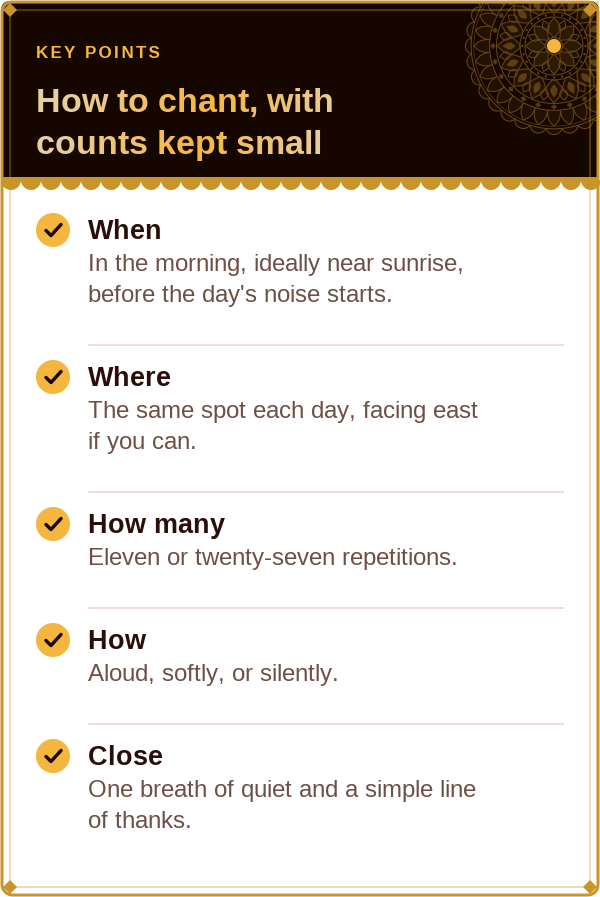
- When: in the morning, ideally near sunrise, before the day's noise starts.
- Where: the same spot each day, facing east if you can. A small shelf or prayer corner works well.
- How many: eleven or twenty-seven repetitions. A full mala of 108 is lovely on a weekend but not required.
- How: aloud, softly, or silently. Count on a mala or on your finger segments.
- Close: one breath of quiet and a simple line of thanks.
Three minutes a day, kept for a month, will teach you more about the grahas than an hour of reading.
A sample week in a Fort Worth household
Here is how the rotation might look in a busy home. Sunday, a parent says the Surya mantra on the back porch at sunrise before the family heads out. Monday, someone chants for Chandra on the drive to work, aloud and with eyes on the road. Tuesday and Wednesday, a teenager does eleven rounds before the school bus, Mars for courage before a game and Mercury before a test. Thursday, a grandmother keeps Guru's day with a full mala. Friday, a couple says the Shukra mantra together after dinner. Saturday, the whole family lights the lamp for Shani. Nobody does all of it perfectly, and nobody needs to. Miss a day and simply pick up with the next planet.
A mantra for Saturn, and why Saturday gets extra attention
Saturn has a fearsome reputation, especially during Sade Sati, the seven-and-a-half-year period when it passes over the Moon. The traditional picture of Shani is stern but fair: a teacher of patience, duty and consequence, not a punisher. Many families keep Saturdays with Om Sham Shanaishcharaya Namah, a Hanuman prayer, or a sesame-oil lamp lit at home with care. If Saturn is on your mind, read Saturn in the Vedic birth chart and the three phases of Sade Sati before you spend money on anything.
Graha mantra or gemstone?
People are often told to wear a stone for a difficult planet. Gemstones are a choice with real cost and real risk of buying a fake, and they suit some charts and not others. A mantra needs nothing but your voice. If you are weighing a stone, a gemstone suitability reading looks at whether one makes sense for you at all, and often the honest answer is that a mantra is enough.
Sound practices that fit together
If you enjoy working with sound, the seed syllables in chakra balancing with mantra follow a similar idea, moving up the body instead of through the week. Astrologer and Psychic Vijayram can show you how to combine the two in one short routine, by phone, WhatsApp or video. To know which planetary periods you are in right now, a dasha and transit reading sets out the dates in Central Time.
What a weekly rotation cannot do
A planet mantra does not change your birth chart, guarantee anything about money, marriage or health, or make a hard period disappear. It is a daily act of devotion and attention. Many people find it steadying, especially in a demanding stretch. Let it keep you company while you deal with life in practical ways too.
Common questions
Do I chant all nine planets every day?
You can. The Navagraha Stotra and similar hymns honor all nine in one sitting. The weekday rotation here is lighter: one planet a day, a few minutes each morning, so the habit is easy to keep.
Which planet mantra should I start with?
Start with today's planet and follow the week. If you know your current dasha, some people add a few extra repetitions for that planet. A dasha and transit reading can tell you which period you are in.
Do I need to fast on a planet's day?
No. Some families fast on Mondays for the Moon or Saturdays for Saturn, but the mantra stands on its own. If you do fast, read up on safe limits first, especially in summer.
Can anyone chant navagraha mantras?
Yes. The short name mantras here are chanted by men and women, young and old, in most households. Families with a particular custom or guru may have their own guidance, which is worth following.
Related service

Keep reading

Fasting Through a Fort Worth Summer: Ekadashi With Heat Safety
Hindu fasting rules for Ekadashi in Texas heat: why dry fasts are risky, the gentler options the tradition allows, and who should check with a doctor first.
Read article →
Ancestors and Remembrance: Pitru Paksha Explained
Pitru Paksha meaning, explained simply: the lunar period of remembrance for ancestors, what shraddha involves, and gentle ways families abroad keep it in Texas.
Read article →
When Low Mood Needs More Than Prayer
Spiritual help for depression can sit beside real care: how to recognize when low mood needs a doctor, a counselor or the Suicide and Crisis Lifeline, with faith as company, not cure.
Read article →Quick answers
Do I need to believe in chakras for a session to help?
You do not need to believe in chakras for a chakra balancing session to help you relax. What a Fort Worth session asks of a skeptic and what it never claims.
Read answer →Can I have spiritual healing while pregnant?
Yes, gentle spiritual healing while pregnant is possible: prayer and mantra only, nothing physical. Keep your obstetrician informed. A Fort Worth answer.
Read answer →Talk to Astrologer and Psychic Vijayram
Tell us what you are facing. If a reading is unlikely to help, you will be told that plainly.