
Setting Up a Panchang App for Fort Worth: Location, Time Zone and DST
A panchang for Fort Worth must be set to Fort Worth or a nearby city, the America/Chicago time zone and automatic daylight saving. With those right, the app shows the tithi and nakshatra running at local sunrise and the clock time each one ends, in Central Time. Most errors come from an app left on an Indian city.
Key takeaways
- In Fort Worth, sunrise never comes earlier than about 6:20 am (in June, on daylight time) and never later than about 7:51 am (in early November, just before the clocks fall back).
- A panchang, literally "five limbs", lists five things for each day.
- A correctly set app for Fort Worth should show something like this:
- India's official almanac, the Rashtriya Panchang published by the India Meteorological Department , and the many regional almanacs are excellent references for India.
- Apps disagree for honest reasons: different ayanamsas, different sunrise definitions, different rules for festival days when a tithi straddles two evenings.
Most panchang mistakes in Fort Worth are not mistakes of astrology. They are settings. An app installed in Hyderabad and never changed, a phone that switched time zones on a flight but left the panchang behind, a printed calendar mailed from home. A panchang for Fort Worth works perfectly well once five settings are right, and then reading the day's entry takes about a minute.
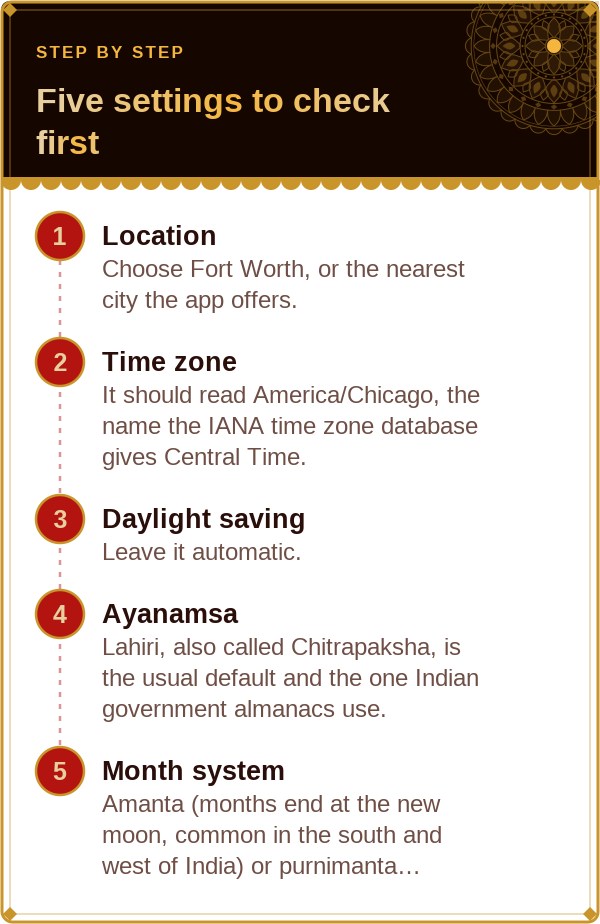
Five settings to check first
- Location. Choose Fort Worth, or the nearest city the app offers. Sunrise is the anchor of the whole Hindu day, so the location decides everything that follows.
- Time zone. It should read America/Chicago, the name the IANA time zone database gives Central Time. A fixed offset such as "UTC minus 6" will be an hour wrong all summer.
- Daylight saving. Leave it automatic. A manual toggle that someone forgot to flip in March or November is the most common cause of puja times that look an hour off.
- Ayanamsa. Lahiri, also called Chitrapaksha, is the usual default and the one Indian government almanacs use. If your family follows another, such as Raman or KP, set that; differences show up mainly in nakshatra ending times.
- Month system. Amanta (months end at the new moon, common in the south and west of India) or purnimanta (months end at the full moon, common in the north). Festival dates stay the same, but the month name for a given half-month changes, which confuses many households.
A quick test that your settings are right
Check the sunrise time the app shows. In Fort Worth, sunrise never comes earlier than about 6:20 am (in June, on daylight time) and never later than about 7:51 am (in early November, just before the clocks fall back). Sunset falls between about 5:22 pm in early December and 8:41 pm around the Fourth of July. If your app shows a December sunrise at 6:10 am, it is not set to North Texas.
Reading the day's entry
A panchang, literally "five limbs", lists five things for each day. The overview of the Hindu calendar explains each in detail; here is what matters on a busy morning:
| Limb | What it is | What to look at |
|---|---|---|
| Tithi | The lunar day, one of 30 in a lunar month | The name running at sunrise and the time it ends |
| Vara | The weekday | It runs sunrise to sunrise, not midnight to midnight |
| Nakshatra | The lunar mansion the Moon is passing through | The name and its ending time |
| Yoga | A combined Sun-Moon measure | Mostly used when choosing dates |
| Karana | Half of a tithi | Mostly used when choosing dates |
The key habit: the time printed beside a tithi or nakshatra is when it ends, not when it begins. If the entry says "Chaturdashi until 10:18 am, then Amavasya", the new moon tithi starts at 10:18 that morning.
A worked example: Thursday 28 October 2027
A correctly set app for Fort Worth should show something like this:
- Sunrise about 7:43 am, sunset about 6:42 pm, Central Daylight Time.
- Tithi: Krishna Chaturdashi until about 10:18 am, then Amavasya.
- Nakshatra: Chitra until about 11:58 pm, then Swati.
Because amavasya is running at sunset, this is Fort Worth's Lakshmi Puja evening, a day earlier than in India. Our post on Diwali puja timing in Central Time works through the rest. If your app puts Diwali on Friday 29 October, check its location first. To understand what the nakshatra line means for your own chart, see finding your birth nakshatra and its pada.
About printed panchangs from India
India's official almanac, the Rashtriya Panchang published by the India Meteorological Department, and the many regional almanacs are excellent references for India. Their times are computed for Indian locations and India Standard Time, so they are not a Fort Worth calendar. Keep them for festival names, fasting customs and family tradition, and take clock times from a properly set local app. Daily periods such as Rahu Kaal in Fort Worth must always come from local sunrise.
When to ask for help
Apps disagree for honest reasons: different ayanamsas, different sunrise definitions, different rules for festival days when a tithi straddles two evenings. If your family is choosing a date for a ceremony and two apps disagree, a consultation with an Indian astrologer serving Fort Worth can explain which rule each is following. Astrologer and Psychic Vijayram works by phone, WhatsApp or video, in Central Time.
What a panchang cannot do is tell you how the day will go. It is a calendar and a guide to traditional timing, read with care, not a forecast.
Common questions
Which city should I choose if Fort Worth is not in the app's list?
Pick the nearest city it offers: Arlington, Dallas or even Denton will be within a few minutes for sunrise. Avoid anything outside North Texas, and never accept a default of New Delhi, Mumbai or Kathmandu.
My parents use a printed panchang from India. Is it wrong?
It is right for the place it was printed for. Its sunrise times and day boundaries belong to India, so dates can differ by a day and clock times will not convert. Use it for meanings and festival names, and a Fort Worth setting for timing.
Why does the app show two tithis on one day?
Because a tithi does not follow the clock. The first one listed is running at sunrise and ends at the time shown; the second takes over after that. Occasionally a tithi begins and ends between two sunrises and is skipped in the day list altogether.
What is tithi today in Texas, and is it the same in Houston?
The tithi changes at the same instant everywhere, so its ending time is identical anywhere on Central Time. What can differ is which tithi was running at sunrise, since sunrise in Houston or Amarillo falls at a different moment from Fort Worth.
Related service
Keep reading
Born in Texas Before 1967? Checking War Time in Your Chart
Daylight saving time can move a birth chart by an hour. How War Time, the unregulated 1946 to 1966 years and later rule changes affect a Texas birth record.
Read article →
Finding a Texas Birth Time: Hospital Records and Vital Statistics
Where to find a birth time in Texas when your certificate lacks one: family papers, the long-form record from Vital Statistics, hospital files, and a fallback.
Read article →
From the West Coast to Cowtown: Reading a Big Move in Your Chart
Relocation astrology for a move to Fort Worth: what a relocation chart is, how the fourth and twelfth houses and the dasha are read, with the job weighed too.
Read article →Quick answers
Can I WhatsApp an Indian astrologer in Fort Worth before booking?
Yes, you can WhatsApp an Indian astrologer in Fort Worth before booking, to check fit, timing and fees. Readings themselves happen in a booked session.
Read answer →Must I stop reading Western horoscopes to see a Vedic astrologer?
No, you do not need to stop reading your Western horoscope to see a Vedic astrologer in Fort Worth. How the two zodiacs differ and why your sign may shift.
Read answer →Talk to Astrologer and Psychic Vijayram
Tell us what you are facing. If a reading is unlikely to help, you will be told that plainly.