
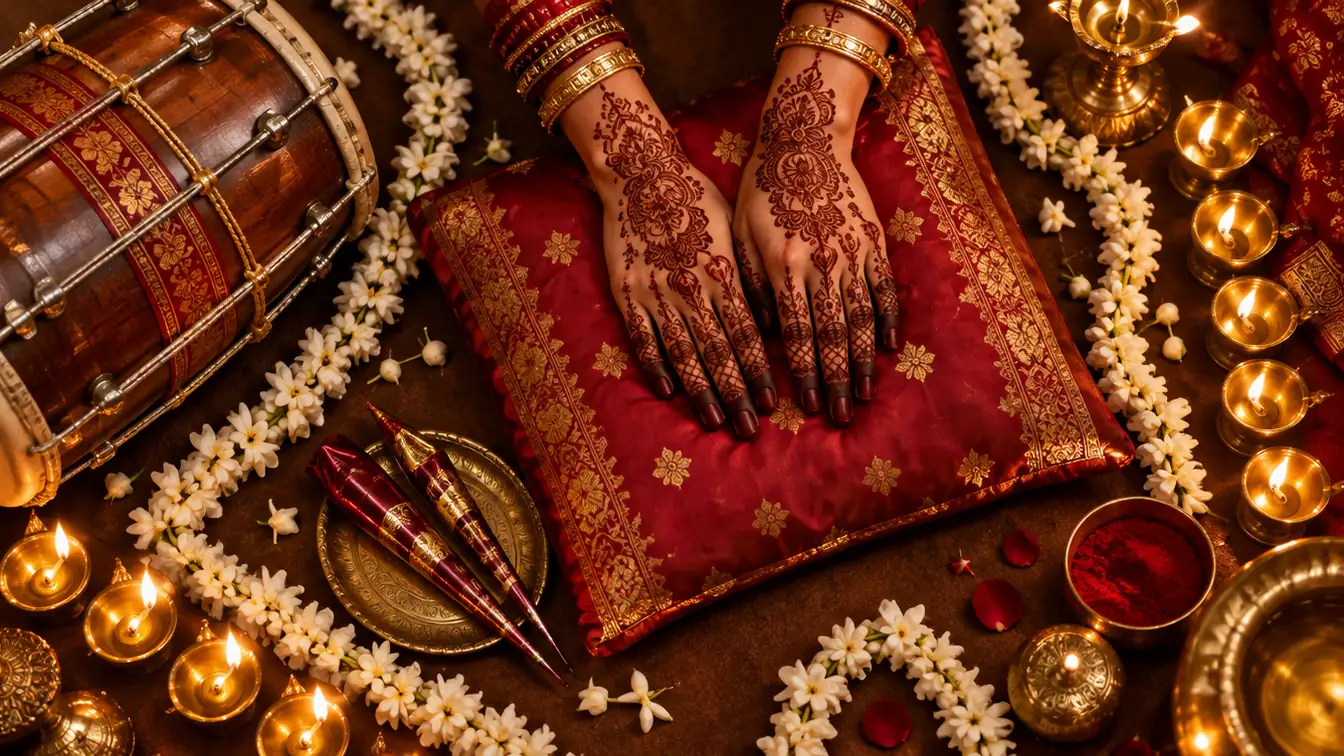
Planning a Sangeet, Mehndi and Wedding Weekend by Muhurta
In Indian wedding weekend planning, only a few events need a true muhurta: the main wedding rites, and in many families the opening puja, the haldi or tilak, and the bride's welcome into her new home. The sangeet, mehndi, cocktail hour and reception only need a convenient time, so build the weekend around the ceremony window first.
Key takeaways
- A muhurta, as the overview of muhurta explains, is an auspicious window chosen from the calendar for an important beginning.
- Some families still prefer to avoid Rahu kaal for the first prayer of the sangeet or the cake cutting.
- In many Tamil weddings the musicians play the loud, fast getti melam at that instant, so no inauspicious word is heard.
- Ask for every timed event at once, not one at a time.
A typical Fort Worth wedding weekend now runs three days. Mehndi on Friday evening in a family home. Sangeet on Saturday night in a hotel ballroom downtown. The ceremony on Sunday morning, a reception that night, and cousins flying home from DFW Airport on Monday. Indian wedding weekend planning goes much more smoothly once you know which of those events actually needs an auspicious time and which simply needs a sensible one. The answer is: fewer than most families assume.
Events that usually need a muhurta
| Event | Needs a muhurta? | Why |
|---|---|---|
| Ganesh puja or opening prayer | Often | Marks the formal start of the wedding rites |
| Haldi, pithi or mangala snanam | In many families | A purifying rite before the wedding; customs vary |
| Tilak or engagement rite, if held the same weekend | Often | A formal commitment between the families |
| Main ceremony: kanyadaan, pheras, saptapadi | Yes | The heart of the wedding |
| Mangalsutra or thali tying | Yes, in many communities the key moment | Often the exact point the muhurta is built around |
| Vidaai and the bride's welcome to her new home | In some families | Griha pravesh customs differ by region |
A muhurta, as the overview of muhurta explains, is an auspicious window chosen from the calendar for an important beginning. That is why it attaches to rites, not to parties.
Events that only need a convenient time
- Mehndi. The henna evening, described in the overview of mehndi, is a social gathering. Choose a time that lets the henna dry before anyone has to sleep in it.
- Sangeet. Music, dance performances and toasts. Evenings work best.
- Welcome dinner, cocktail hour, reception and after-party. Set these by the venue, the guests and the caterer.
Some families still prefer to avoid Rahu kaal for the first prayer of the sangeet or the cake cutting. That is a family preference, not a requirement.
What is muhurtham in a South Indian wedding?
In a South Indian wedding, the muhurtham is the precise auspicious window in which the thali or mangalsutra is tied, usually in the morning, and the whole ceremony is arranged so that moment falls inside it. In many Tamil weddings the musicians play the loud, fast getti melam at that instant, so no inauspicious word is heard. In Telugu weddings, the moment is often marked when the couple place a paste of cumin and jaggery on each other's heads. Either way, the muhurtham is a moment, not a whole day, and guests are often asked to be seated well before it.
Sequencing a Fort Worth wedding weekend
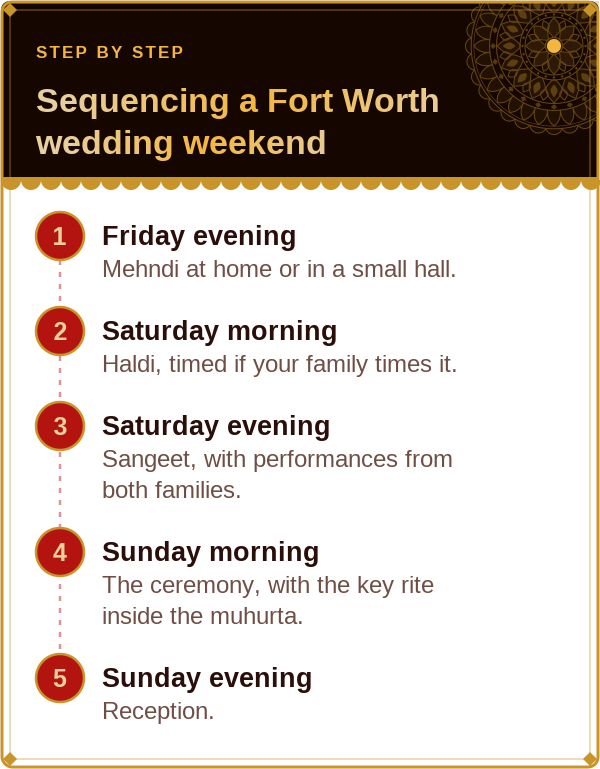
Here is one workable pattern, assuming a Sunday morning muhurta:
- Friday evening: mehndi at home or in a small hall. Relaxed and family-only.
- Saturday morning: haldi, timed if your family times it. Keep it short; outdoor haldis in a Texas summer get hot by ten.
- Saturday evening: sangeet, with performances from both families.
- Sunday morning: the ceremony, with the key rite inside the muhurta.
- Sunday evening: reception.
If the muhurta falls late at night, flip the order and hold the reception first; the short answer on why some wedding muhurtas are late at night explains why that happens. If both families keep different customs, the astrologer can time the rites for each in one plan.
Local logistics that affect timing
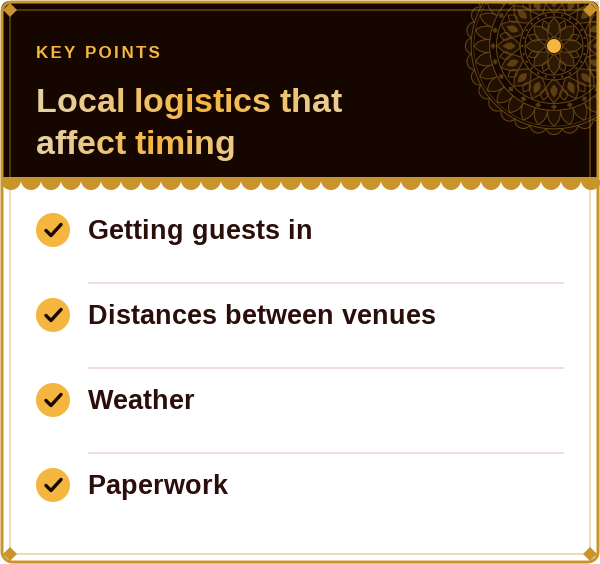
- Getting guests in. Out-of-town guests landing at DFW can ride TEXRail from Terminal B into downtown Fort Worth, which helps if your hotel block is near the T&P or Central stations.
- Distances between venues. A temple on the far west side, a hotel downtown and a banquet hall in Arlington can be forty minutes apart in traffic. Build travel time into the schedule, especially on I-30.
- Weather. Spring storms and summer heat both affect outdoor events. The post on moving a ceremony indoors without losing the muhurta covers backup plans, and Hindu weddings with a Texas touch covers ranch venues and fire rules.
- Paperwork. The legal license has its own timing, explained in the Texas marriage license and your muhurta.
Getting the windows in one plan
Ask for every timed event at once, not one at a time. A wedding muhurta selection with Astrologer and Psychic Vijayram can give you the ceremony window, the haldi or tilak timing if you want it, and fallback dates, all in Central Time, so the venue contracts and the priest's schedule can be settled together. Smaller family events after the wedding, such as a griha pravesh, can be timed through muhurta for other auspicious dates.
What a muhurta cannot do is make a weekend stress-free. Late caterers, rain and a missing cousin are part of every wedding. A well-chosen window simply means the moment that matters most happens at a time the family considers meaningful.
Common questions
Does the sangeet need a muhurta?
No. The sangeet is a celebration, so any convenient evening works. Some families like to avoid Rahu kaal for the opening prayer or first song, but that is optional.
Can the haldi and the wedding be on the same day?
Yes. Many weekend weddings hold the haldi on the morning of the ceremony or the day before. If your family times the haldi, ask the astrologer for both windows together.
What if our venue only has the hall at a time outside the muhurta?
Ask the astrologer for alternative windows on the same day or nearby dates before signing. Moving the reception is usually far easier than moving the ceremony.
How much buffer should we leave around the muhurta?
At least an hour before the window opens, for makeup, photographs, the baraat and late arrivals. Hair and makeup almost always run long, so plan backwards from the start of the rites, not from the guests' arrival time.
Does the mehndi need to be on a particular day?
No. Mehndi is usually held a day or two before the wedding so the henna color has time to deepen, and families pick an evening that suits guests. Some avoid particular days by family custom, but there is no general muhurta rule for it.
Related service
Keep reading
A First-Year Marriage Review for Tarrant County Newlyweds
First year of marriage astrology for Tarrant County newlyweds: a gentle anniversary look at both charts' periods, shared plans and conversations worth having.
Read article →
Explaining Kundli Matching to Your Texan In-Laws
Explaining kundli matching to a non-Indian Texas family: what it is, what it is not, and how to include both families with respect and without pressure.
Read article →
Bikram Sambat Birth Dates: Converting Before Kundli Matching
Nepali cheena matching starts with converting a Bikram Sambat birth date and time correctly. How conversion works, what both traditions check, and pitfalls.
Read article →Quick answers
Why are some Hindu wedding muhurtas late at night?
Some Hindu wedding muhurtas fall late at night because the rising sign and nakshatra decide the time. How Fort Worth venues and families plan around it.
Read answer →Do gunas matter if we are already engaged?
If you are already engaged, guna scores still offer useful talking points, used as guidance rather than a veto. How kundli matching helps Fort Worth couples.
Read answer →Talk to Astrologer and Psychic Vijayram
Tell us what you are facing. If a reading is unlikely to help, you will be told that plainly.