
Moving a Ceremony Indoors Without Losing the Muhurta
For an outdoor puja muhurta in Texas, only the central rite, such as the pheras or the kalash installation, must happen inside the chosen window. Processions, photos and meals can move. Agree an indoor fallback and a decision time in advance, and follow weather warnings: no muhurta is worth standing outside in lightning or dangerous heat.
Key takeaways
- No auspicious window outweighs a guest's safety, and the tradition has never asked anyone to pray in danger.
- A muhurta attaches to a particular act, not to the whole event.
- The baraat, the haldi, photographs, speeches, the meal and the reception are not tied to the window.
- The comfortable months for outdoor ceremonies around Fort Worth are spring and fall, but they are not equal.
- A well-chosen window cannot hold off a storm or cool an August afternoon.
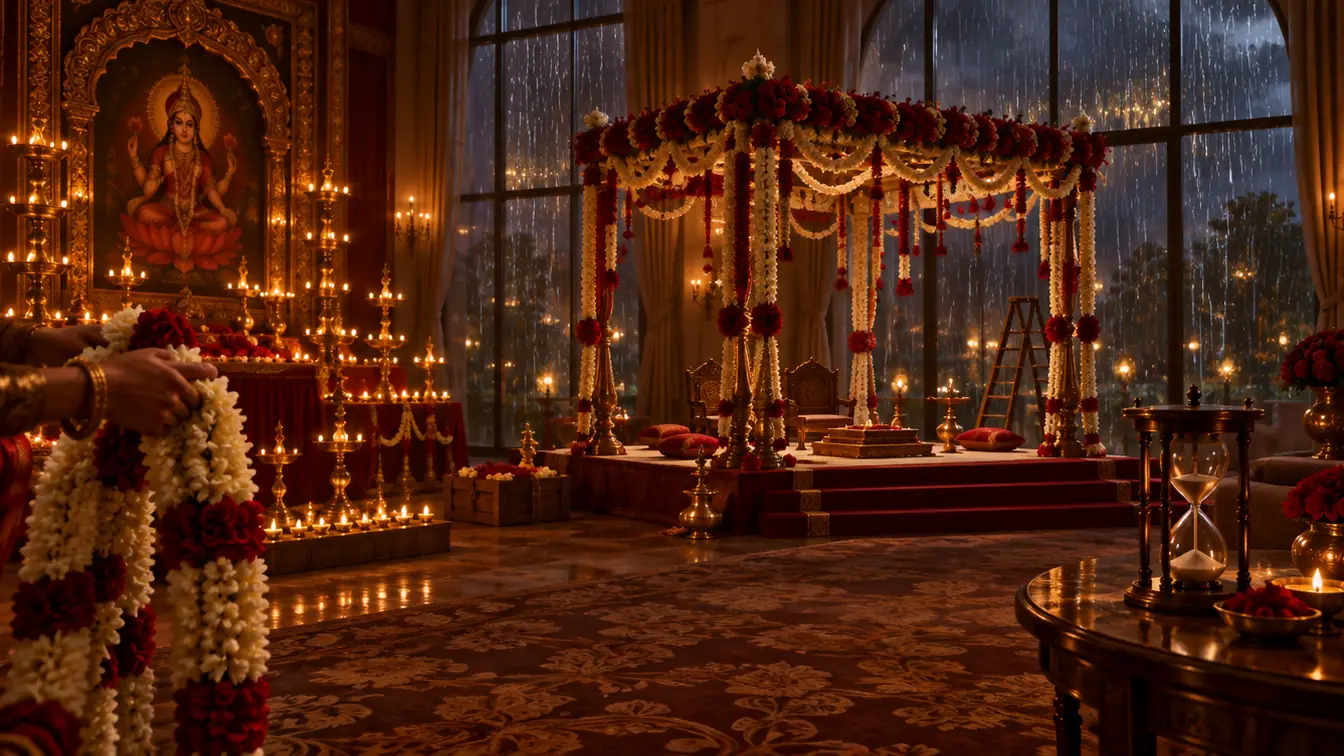
North Texas weather rarely asks permission. A spring wedding on a ranch west of Fort Worth can meet a hailstorm, an outdoor griha pravesh in August can meet a heat index above 105, and an October puja can be interrupted by a line of storms moving across Tarrant County in under an hour. If you have chosen an outdoor puja muhurta in Texas, the most useful thing you can do is decide, before the day, what must happen at that hour and what can bend.
Safety comes before the muhurta
No auspicious window outweighs a guest's safety, and the tradition has never asked anyone to pray in danger. Before anything else:
- Lightning: when thunder can be heard, lightning is close enough to strike. Move everyone into a substantial building and wait 30 minutes after the last thunder before going back out, as the National Weather Service's lightning safety guidance advises. Tents and canopies do not protect.
- Heat: older relatives, small children, pregnant guests and anyone in heavy silk are at real risk on a Texas afternoon. Provide shade, water and a cool room, and learn the warning signs of heat illness from the National Weather Service's heat safety page. A havan fire adds heat for the people closest to it.
- Hail and tornado warnings: move to interior rooms away from windows, and follow local alerts.
- Emergencies: call emergency services without hesitation.
Name one person, not the bride's mother or the priest, whose only job on the day is to watch the forecast and alerts.
What has to happen at the muhurta
A muhurta attaches to a particular act, not to the whole event. The classical approach to choosing auspicious times picks a window for the moment that defines the ceremony. Depending on the family and community, that might be:
- for a wedding, the exchange of garlands, the lowering of the antarpat cloth, the placing of jeelakarra-bellam, the tying of the mangalsutra or the start of the pheras;
- for a griha pravesh, the first entry into the house with the kalash;
- for a puja or a business opening, the sankalpa and the installation of the kalash or murti.
Ask your priest and astrologer to name that act in writing. Everything else is arranged around it.
What can shift
The baraat, the haldi, photographs, speeches, the meal and the reception are not tied to the window. Neither is most of the preparation before the central rite. Windows often span an hour or more, so a sensible plan starts the central act early in the window, leaving room for a delay. Our answer on why some wedding muhurtas fall late at night explains why windows can land at awkward hours, and why night windows still need a storm plan.
Building the indoor fallback
- Confirm an indoor space at the venue big enough for the mandap, the priest, the couple or family, and the elders, even if most guests have to stand.
- Choose a mandap that can move, or a simple indoor alternative such as a decorated frame or a carpet and canopy.
- Agree the fire plan with the venue: a small havan kund, a lamp only, or the havan held later outdoors once it is safe.
- Set a decision time, for example two hours before the central rite, and a single decision-maker.
- Tell guests in advance that an indoor plan exists, and send updates by group text on the day.
- Ask for a second window on the same day or the next as a backup. A muhurta consultation in Central Time can provide a primary and a reserve window together.
Choosing the season in the first place
The comfortable months for outdoor ceremonies around Fort Worth are spring and fall, but they are not equal. Spring is also the severe weather season, while October and early November tend to be calmer. Our post on spring or fall wedding seasons in North Texas compares them, and wedding muhurta selection can look for good windows inside the months that suit the weather. For a household prayer practice during storm season, see a protection prayer routine for Texas storm season.
What a muhurta cannot do
A well-chosen window cannot hold off a storm or cool an August afternoon. It is a traditional way of beginning with care, and moving a ceremony indoors to protect the people in it is entirely in keeping with that care. Astrologer and Psychic Vijayram plans windows by phone, WhatsApp or video with a weather fallback in mind.
Common questions
If a storm delays us, is the muhurta lost?
Not if the window is still open; start the central rite as soon as everyone is safely inside. If it has passed, many priests use a second window given in advance, or the family makes the sankalpa, the formal intention, at the muhurta in a safe room and completes the ceremony afterward.
Is a tent or open-sided canopy safe during lightning?
No. The National Weather Service is clear that tents, gazebos and open shelters do not protect against lightning. Only a substantial building with plumbing and wiring, or a hard-topped vehicle with the windows up, counts as safe.
What are the best months for an outdoor ceremony in Fort Worth?
October and early November are usually the most settled. Spring is pleasant but falls in the severe weather season, with hail and tornado warnings possible. Summer brings many days near or above 100 degrees, and winter can bring ice. Always keep an indoor plan.
Can the havan move indoors?
Only with the venue's permission and within its fire rules. Many families switch to a small havan kund with a little ghee and samagri, or to a lamp in place of the fire, and keep smoke detectors in mind. The rite remains valid.
Related service
Keep reading
Your Birth Nakshatra and Its Pada: Finding Both in Your Kundli
What is a nakshatra? The 27 lunar mansions explained, how to find your birth nakshatra and pada in a kundli, and why the pada matters for names and matching.
Read article →
Antardasha and Pratyantardasha: The Sub-Periods Inside Your Dasha
Vimshottari dasha explained from the inside: how each mahadasha splits into antardashas and pratyantardashas, and how to read a printed dasha table.
Read article →
The Three Phases of Sade Sati: Rising, Peak and Setting
Sade Sati explained phase by phase: what tradition links to Saturn's rising, peak and setting years around your Moon sign, and how to stay steady, not afraid.
Read article →Quick answers
Must I stop reading Western horoscopes to see a Vedic astrologer?
No, you do not need to stop reading your Western horoscope to see a Vedic astrologer in Fort Worth. How the two zodiacs differ and why your sign may shift.
Read answer →Do I need my birth certificate for a Vedic reading?
You do not need your birth certificate for a Vedic reading in Fort Worth: date, time and place of birth matter, and a certificate simply confirms the time.
Read answer →Talk to Astrologer and Psychic Vijayram
Tell us what you are facing. If a reading is unlikely to help, you will be told that plainly.