
Bikram Sambat Birth Dates: Converting Before Kundli Matching
Nepali cheena matching starts by converting the Bikram Sambat birth date to the Gregorian calendar with a published table, and the birth time to the clock Nepal used that year. Once both charts are drawn the same way, the comparison uses the same eight-koota guna milan as an Indian kundli, though record-keeping conventions differ.
Key takeaways
- The birth star is one of the same 27 nakshatras used in India, which is why the two traditions can be compared directly once the calendars agree.
- Bikram Sambat is the official calendar of Nepal.
- As the overview of Nepal Standard Time records, Nepal's clocks have used UTC+5:45 only since 1986.
- Once both charts are drawn correctly, Nepali and North Indian matching look much the same.
- The question of whether a chart made abroad still applies after moving is covered in whether a kundli made in India is still valid in Texas .
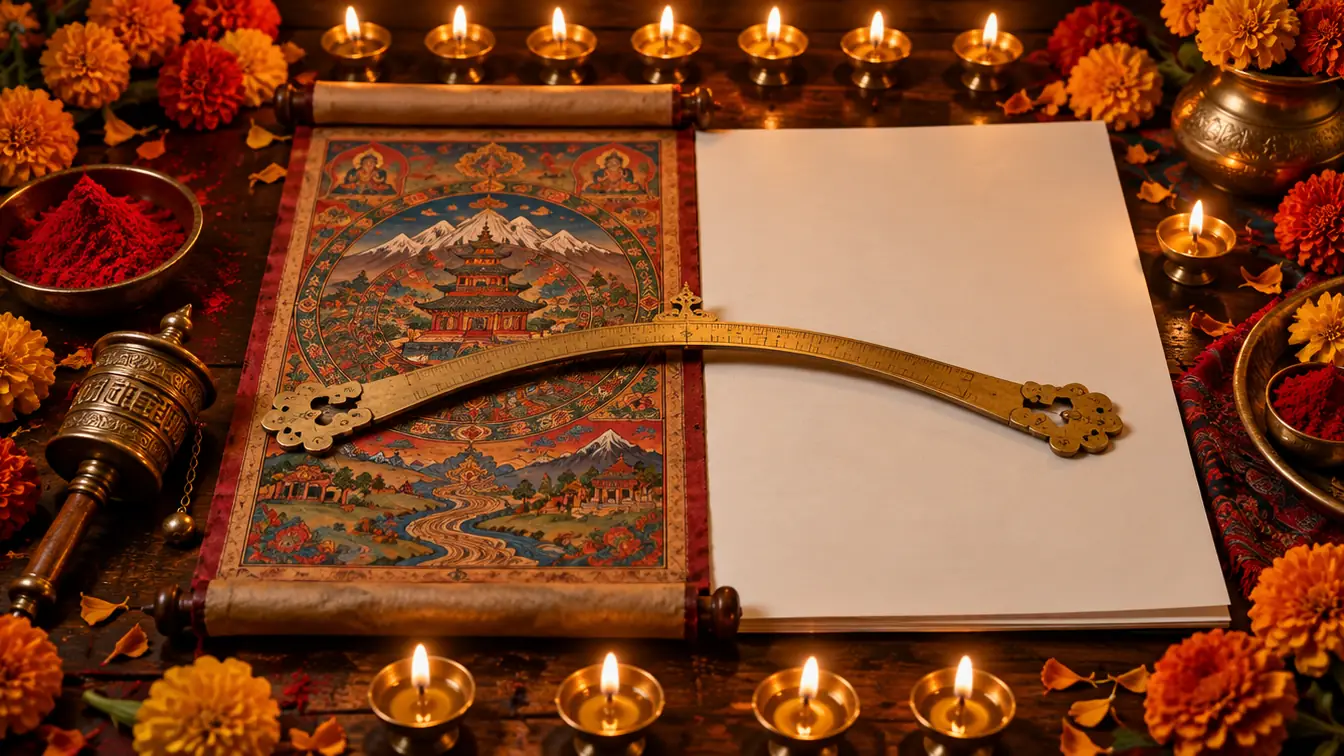
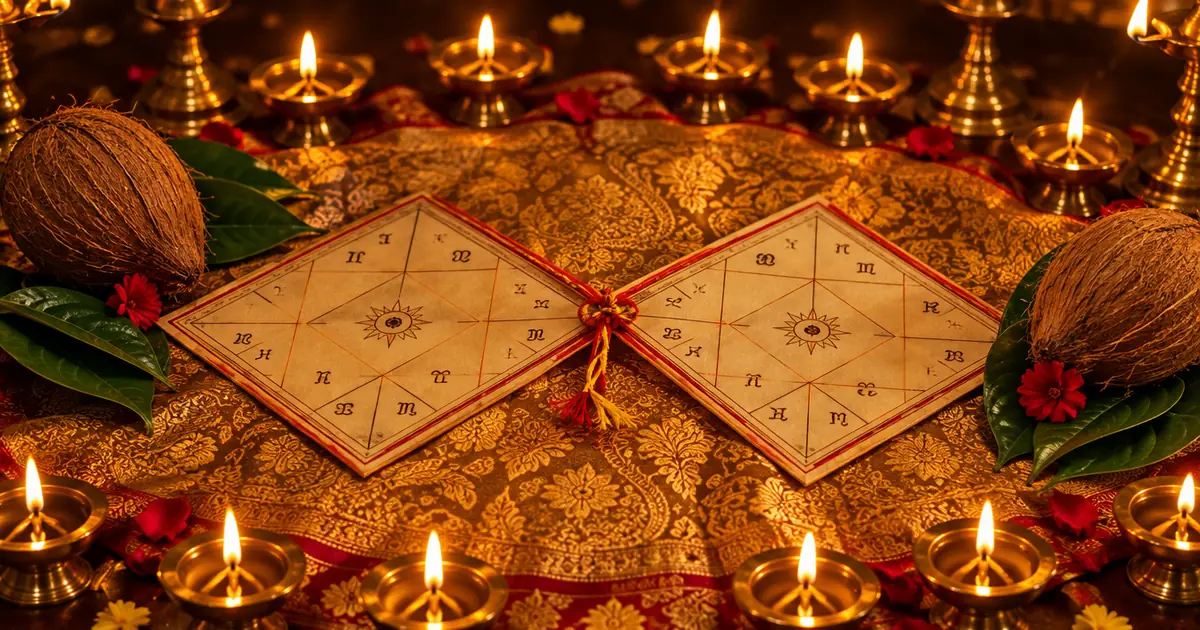
A Nepali cheena is a beautiful object: a long scroll, hand-written in Devanagari by the family priest, rolled and kept safe for decades, often carried from Kathmandu or a camp in eastern Nepal to a new home in Texas. When a proposal arrives and the family wants to compare it with an Indian kundli from another household, everything depends on one unglamorous step: converting the dates and times correctly. Nepali cheena matching is straightforward once that step is done, and surprisingly error-prone when it is rushed.
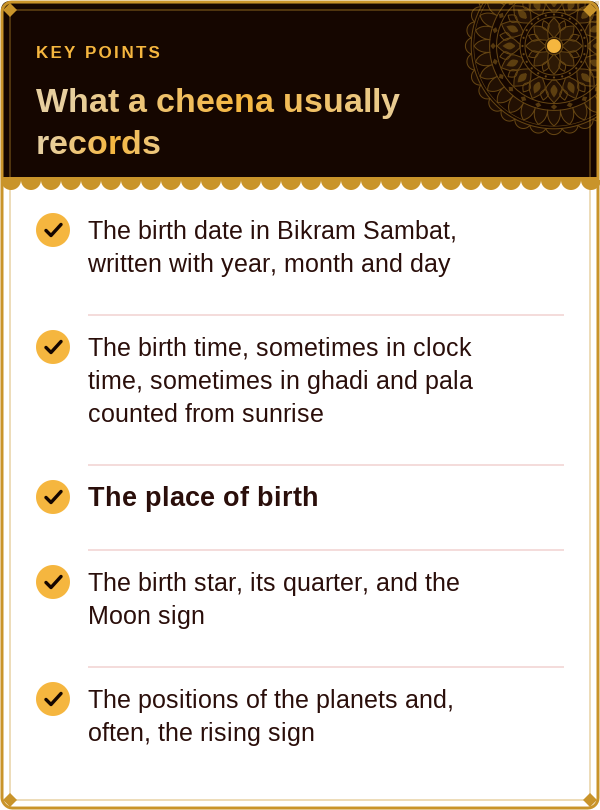
What a cheena usually records
- The birth date in Bikram Sambat, written with year, month and day
- The birth time, sometimes in clock time, sometimes in ghadi and pala counted from sunrise
- The place of birth
- The birth star, its quarter, and the Moon sign
- The positions of the planets and, often, the rising sign
The birth star is one of the same 27 nakshatras used in India, which is why the two traditions can be compared directly once the calendars agree.
Step one: converting the Bikram Sambat date
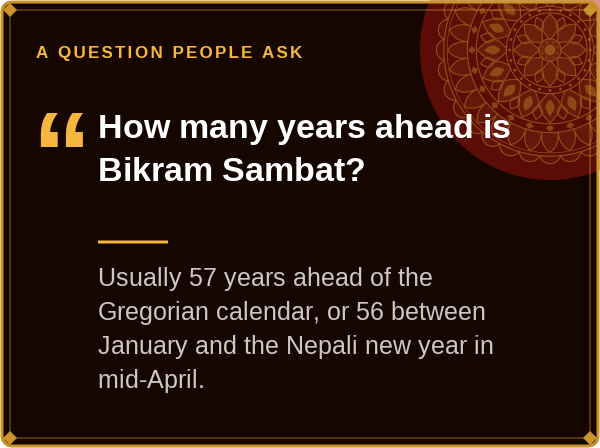
Bikram Sambat is the official calendar of Nepal. According to the overview of Vikram Samvat, Nepal's civil version is solar, its year begins on the first of Baisakh, usually around 13 to 15 April, and its months vary between 29 and 32 days. The year number runs about 57 years ahead of the Gregorian count, or 56 in the months between January and the Nepali new year.
Two examples show how it works. A birth in Asoj 2050 falls in September or October 1993, because Asoj comes after the new year and 2050 minus 57 is 1993. A birth in Magh 2050 falls in January or February 1994, because Magh comes after the Gregorian new year and the gap is 56.
That gets you the month. It does not get you the exact day. Because month lengths change from year to year, a day-by-day conversion needs a published conversion table or a reliable converter. Simple arithmetic, adding a fixed number of days, gives wrong answers. A single day's error changes the Moon's position by about 13 degrees, often enough to change the birth star, and with it the whole match.
Step two: converting the time
This is where many conversions go quietly wrong. As the overview of Nepal Standard Time records, Nepal's clocks have used UTC+5:45 only since 1986. From 1920 until then, Nepal used UTC+5:30, the same offset as India, and before 1920 it used local solar time. A software tool that applies today's offset to a birth in 1980 will be fifteen minutes off. Fifteen minutes rarely changes a birth star, but it can change the rising sign, the navamsa and the house placements.
Older cheenas may give the time as ghadi and pala from sunrise rather than clock time. One ghadi is 24 minutes and one pala is 24 seconds. To convert, the astrologer works out sunrise at the birthplace on that date, adds the count, and arrives at local clock time. Births in Bhutan or elsewhere outside Nepal should be checked against the clock used in that place at that time.
What both traditions check
Once both charts are drawn correctly, Nepali and North Indian matching look much the same. Both use the eight-koota guna milan out of 36. Both pay close attention to nadi and bhakoot. Both check Mars for mangal dosha. A pandit in Euless and one in Arlington, working from the same correct data, should arrive at the same score. The post on chart matching in Nepali families around Euless describes how families there approach the whole process.
Where conventions differ
- The records themselves: calendars, time formats and handwritten Devanagari numerals that need a careful reader.
- Names: the name on the cheena may be a rashi name chosen from the birth star, different from the name the person uses every day. That can be useful, since it often confirms the star.
- Matching across regions: if the other family is South Indian, they may expect a porutham comparison rather than guna milan; porutham and guna milan side by side explains the difference.
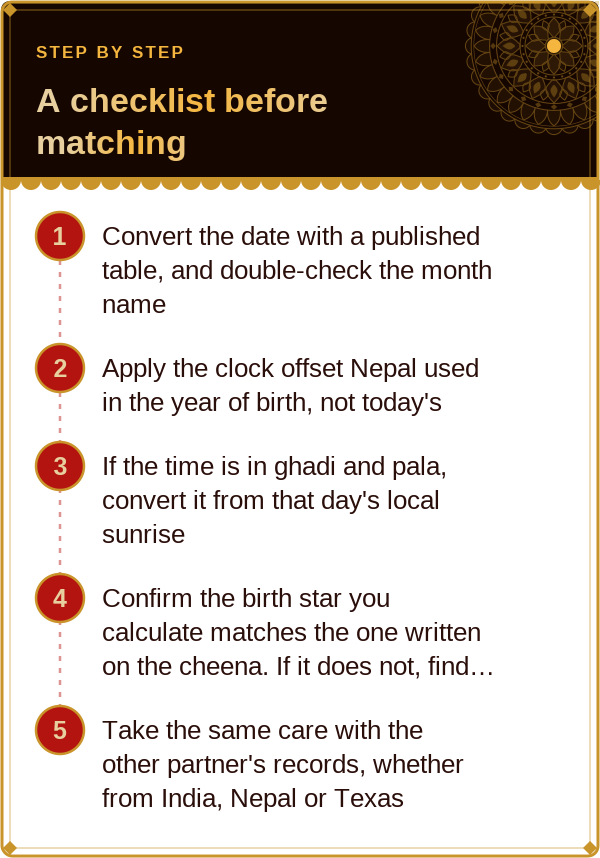
A checklist before matching
- Convert the date with a published table, and double-check the month name.
- Apply the clock offset Nepal used in the year of birth, not today's.
- If the time is in ghadi and pala, convert it from that day's local sunrise.
- Confirm the birth star you calculate matches the one written on the cheena. If it does not, find out why before matching.
- Take the same care with the other partner's records, whether from India, Nepal or Texas.
The question of whether a chart made abroad still applies after moving is covered in whether a kundli made in India is still valid in Texas. The short answer is yes: a chart belongs to the time and place of birth.
Bringing a cheena to a session
For kundli matching in Fort Worth, send a clear photo of the relevant part of the cheena along with any other records. Astrologer and Psychic Vijayram converts both sets of data, shows the conversion so the family can check it, and then runs the comparison by phone, WhatsApp or video. What conversion and comparison cannot do is decide whether two people should marry. They only make sure that whatever the family discusses rests on accurate numbers.
Common questions
What is a cheena in a Nepali horoscope?
A cheena, also spelled chino, is the traditional Nepali birth horoscope, usually prepared by a family priest after a birth. It records the Bikram Sambat date, the birth time, the birth star and the planetary positions.
How many years ahead is Bikram Sambat?
Usually 57 years ahead of the Gregorian calendar, or 56 between January and the Nepali new year in mid-April. An exact day conversion needs a published table, because month lengths vary from year to year.
Can a cheena be matched with an Indian kundli?
Yes. Once both are converted to the same calendar and drawn the same way, guna milan works identically. Most disagreements come from conversion errors, not from differences between the traditions.
Our cheena gives the time in ghadi. Can that be used?
Yes. A ghadi is 24 minutes and a pala is 24 seconds, counted from local sunrise at the birthplace on that date. The astrologer works out that sunrise and converts the count to clock time.
Related service
Keep reading
Porutham and Guna Milan: South and North Indian Matching Side by Side
Porutham vs guna milan in plain terms: how the South Indian ten-porutham list and North Indian ashtakoota matching differ, and why their verdicts can clash.
Read article →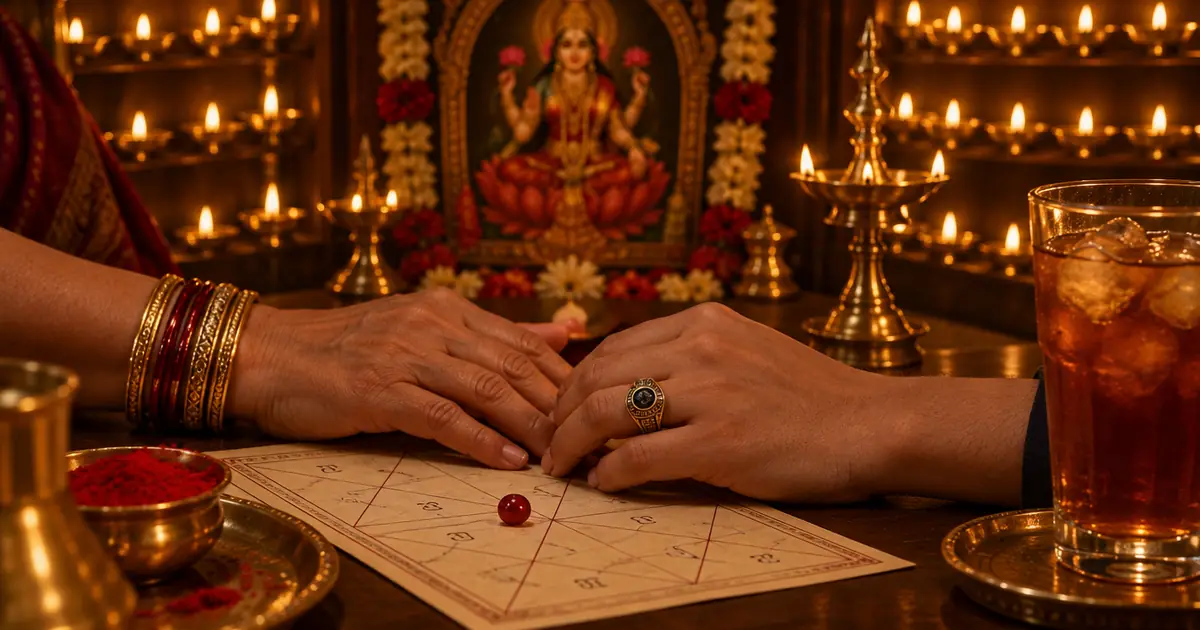
Manglik Worries in Second-Generation Texas Families
Manglik dosha in the USA for Texas families: why parents worry, why their children doubt it, what the cancellations say, and keeping the choice with the couple.
Read article →
A Couples' Chart Review Before Diwali: Setting Intentions for the Year
A couples horoscope review at Diwali: read both charts for the year ahead, mark family dates and agree on one shared intention. A Fort Worth guide.
Read article →Quick answers
Do gunas matter if we are already engaged?
If you are already engaged, guna scores still offer useful talking points, used as guidance rather than a veto. How kundli matching helps Fort Worth couples.
Read answer →Can we marry if our kundlis do not match?
Yes, you can marry if your kundlis do not match. How kundli matching is done, whether it is necessary for a love marriage, and what Fort Worth couples weigh.
Read answer →Talk to Astrologer and Psychic Vijayram
Tell us what you are facing. If a reading is unlikely to help, you will be told that plainly.