
Chart Matching in Nepali Families Around Euless
Nepali kundli matching compares the two partners' Moon signs and birth stars with the same eight-part guna milan that North Indian families use, usually starting from each person's cheena. Around Euless, families often add their own priest's judgment, the Nepali calendar and practical questions about family life. The score starts the conversation; it does not make the decision.
Key takeaways
- In many Nepali families, matching begins with the elders: a parent, an aunt, or the family's trusted pandit.
- The core is the same eight-koota system used across North India: varna, vashya, tara, yoni, graha maitri, gana, bhakoot and nadi, adding up to 36 points.
- A proper comparison does not stop at 36 points.
- Many mid-cities families have seen a promising proposal stall on a low number.
- Matching is a beginning, not the end of the chart's usefulness.
In parts of Euless, in the mid-cities a few miles east of Fort Worth, Nepali households are a settled part of the neighborhood. Many families arrived as refugees from Bhutan, others came from Nepal for work or study, and the city's own profile notes how culturally prominent the Nepali community is there and in neighboring Irving. When a son or daughter reaches marrying age, Nepali kundli matching tends to come up early, often before the young people have said much at all.
Who starts the conversation
In many Nepali families, matching begins with the elders: a parent, an aunt, or the family's trusted pandit. The cheena, the horoscope scroll prepared after a birth, comes out of a drawer or a suitcase that may have traveled from Kathmandu, or from a camp in eastern Nepal, to an apartment off Highway 10. Sometimes it is faded, partly missing, or dated in the Bikram Sambat calendar, which needs converting before anything else. The post on converting Bikram Sambat birth dates before matching covers that step in detail.
The young people involved often grew up in Hurst-Euless-Bedford schools and now work in Fort Worth, Irving or at DFW Airport. They usually want a say, and they are entitled to one. A matching that happens over their heads tends to create resentment, whatever the score.
Where it follows the North Indian method
The core is the same eight-koota system used across North India: varna, vashya, tara, yoni, graha maitri, gana, bhakoot and nadi, adding up to 36 points. Each person's Moon sits in one of the 27 nakshatras, and the two are compared category by category. A Nepali pandit in Euless and a Punjabi pandit in Arlington, given the same correct birth details, will normally reach the same total. The common rule of thumb that 18 points is the minimum to consider a match is shared too.
Both traditions pay close attention to nadi and bhakoot, which carry the most points. The middle categories get less attention than they deserve, and the post on gana, yoni and graha maitri explains what they measure.
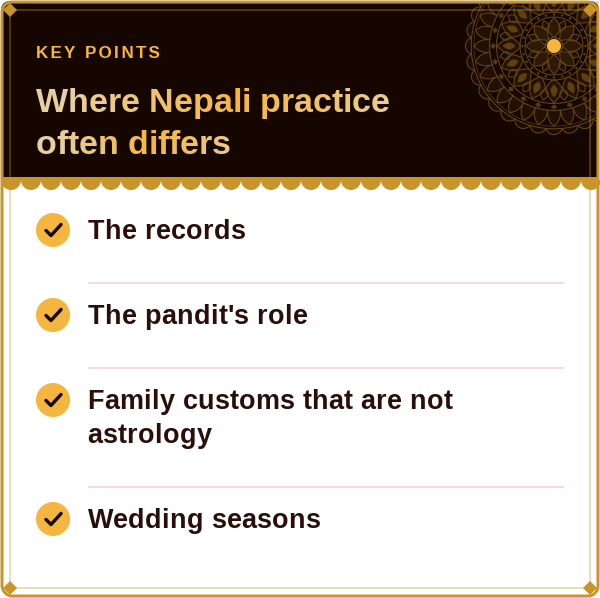
Where Nepali practice often differs
- The records. Dates are often in Bikram Sambat, and older cheenas sometimes give the birth time in ghadi and pala counted from sunrise instead of clock time. Errors in conversion are the commonest reason two pandits disagree.
- The pandit's role. Many families give real weight to their own priest's overall judgment, not only to the printed number.
- Family customs that are not astrology. Gotra and clan considerations come from family and community custom. A chart says nothing about them, and it is worth keeping the two conversations separate.
- Wedding seasons. Families often think in Nepali months when planning the eventual wedding, and some months are traditionally busier for weddings than others.
Couple match astrology beyond the score
A proper comparison does not stop at 36 points. It reads both full charts: the seventh house and its lord, the placement of Mars, the condition of Venus, and the planetary periods each person will be running in the first years of marriage. That is the difference between an app's couple match astrology and a reading. The full comparison is offered as kundli matching for Fort Worth families, and it often raises practical questions that matter more than any planet: which language the children will speak at home, who will care for aging parents, whether the couple will stay near Euless or move for work, and how a partner coming from Nepal will manage visas and a new job market.
When the score comes back low
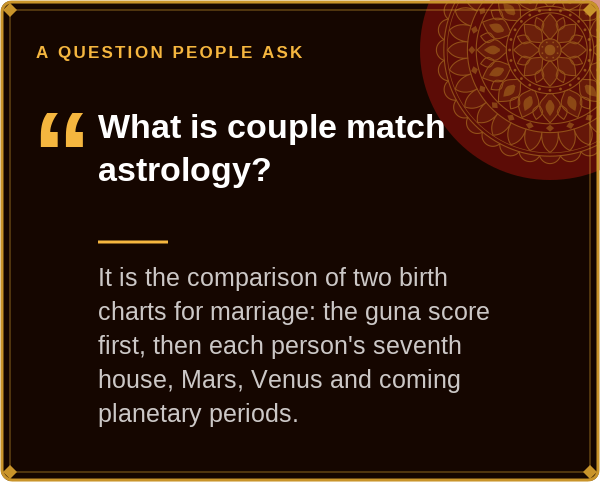
Many mid-cities families have seen a promising proposal stall on a low number. Before anyone decides, three checks are worth making:
- Confirm that both birth dates and times were converted correctly. A one-day error changes the birth star.
- Check whether the classical exceptions cancel the dosha that cost the points.
- Read the two full charts, then talk as a family, with the couple at the table.
The short answer on marrying when kundlis do not match explains why a low score is a reason to look closer, not a ban.
After the wedding
Matching is a beginning, not the end of the chart's usefulness. Some couples come back each year, often around Dashain or an anniversary, for a yearly chart review for married couples that looks at both partners' periods together. Astrologer and Psychic Vijayram works by phone, WhatsApp or video, so parents in Euless, the couple in Fort Worth and an uncle in Jhapa can all be on the same call.
What no comparison can do is tell you whether two people will treat each other with kindness and respect. That shows in how they behave, how they handle disagreement and how their families welcome them, and it deserves as much attention as any score.
Common questions
Is Nepali kundli matching different from Indian matching?
The scoring system is essentially the same eight-koota guna milan. The differences lie mostly in the records, such as Bikram Sambat dates and older time formats, and in how much weight a family gives its own priest's overall view.
Can a match be done from a cheena alone?
Usually, if it gives the date, place and time or at least the birth star. The date must be converted from Bikram Sambat first, and a faded or partial cheena may need checking against other family records.
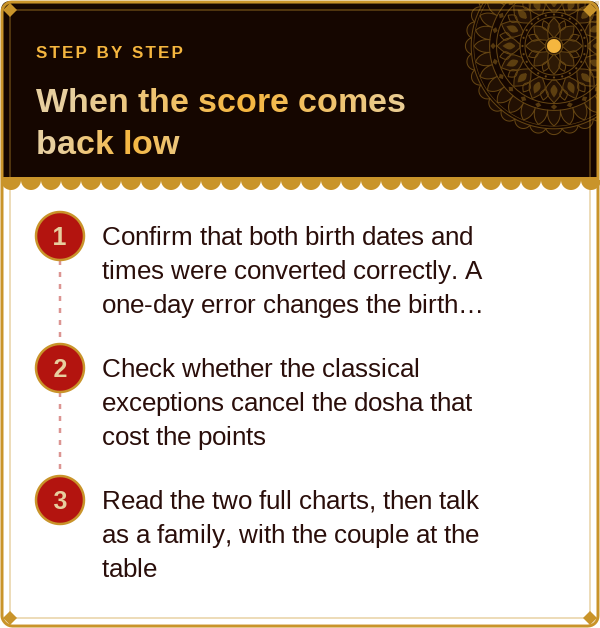
What is couple match astrology?
It is the comparison of two birth charts for marriage: the guna score first, then each person's seventh house, Mars, Venus and coming planetary periods. It describes tendencies worth talking about, not a verdict on the couple.
Can relatives in Nepal join the session?
Yes. Kathmandu is 10 hours 45 minutes ahead of Fort Worth during daylight saving time and 11 hours 45 minutes ahead in winter, so a morning video call in Texas reaches relatives there in their evening.
Related service
Keep reading
The Texas Marriage License and Your Muhurta
The Texas marriage license waiting period is 72 hours and the license lasts 90 days. How to line up the paperwork with your chosen wedding muhurta.
Read article →
Hosting a Roka at Home in Tarrant County: Guests, Gifts, Timing
Choosing an engagement muhurta in Fort Worth for a home roka or sagai: who attends, simple customs and gifts, and a good day and time in Central Time.
Read article →
Gana, Yoni and Graha Maitri: The Middle Kootas Families Overlook
Guna milan's 36 points include three middle kootas families skim past: gana, yoni and graha maitri. What each one measures and how to read a low score.
Read article →Quick answers
Do gunas matter if we are already engaged?
If you are already engaged, guna scores still offer useful talking points, used as guidance rather than a veto. How kundli matching helps Fort Worth couples.
Read answer →Can we marry if our kundlis do not match?
Yes, you can marry if your kundlis do not match. How kundli matching is done, whether it is necessary for a love marriage, and what Fort Worth couples weigh.
Read answer →Talk to Astrologer and Psychic Vijayram
Tell us what you are facing. If a reading is unlikely to help, you will be told that plainly.