
Hosting a Roka at Home in Tarrant County: Guests, Gifts, Timing
An engagement muhurta in Fort Worth is a favorable day and time, worked out in Central Time, for a roka or sagai. It weighs the weekday, lunar day and nakshatra, avoids periods many families skip, and then fits the hours when both families, including relatives joining by video from India, can actually be present.
Key takeaways
- Roka literally means "stop": the families agree that the search for other matches is over.
- Details vary by family, but a home roka often includes:
- Many families also skip certain stretches of the year entirely:
- India runs on Indian Standard Time , 10 hours 30 minutes ahead of Fort Worth during daylight saving time and 11 hours 30 minutes ahead in winter.
- Only one moment, usually the tilak or the rings, needs to land inside the chosen window.
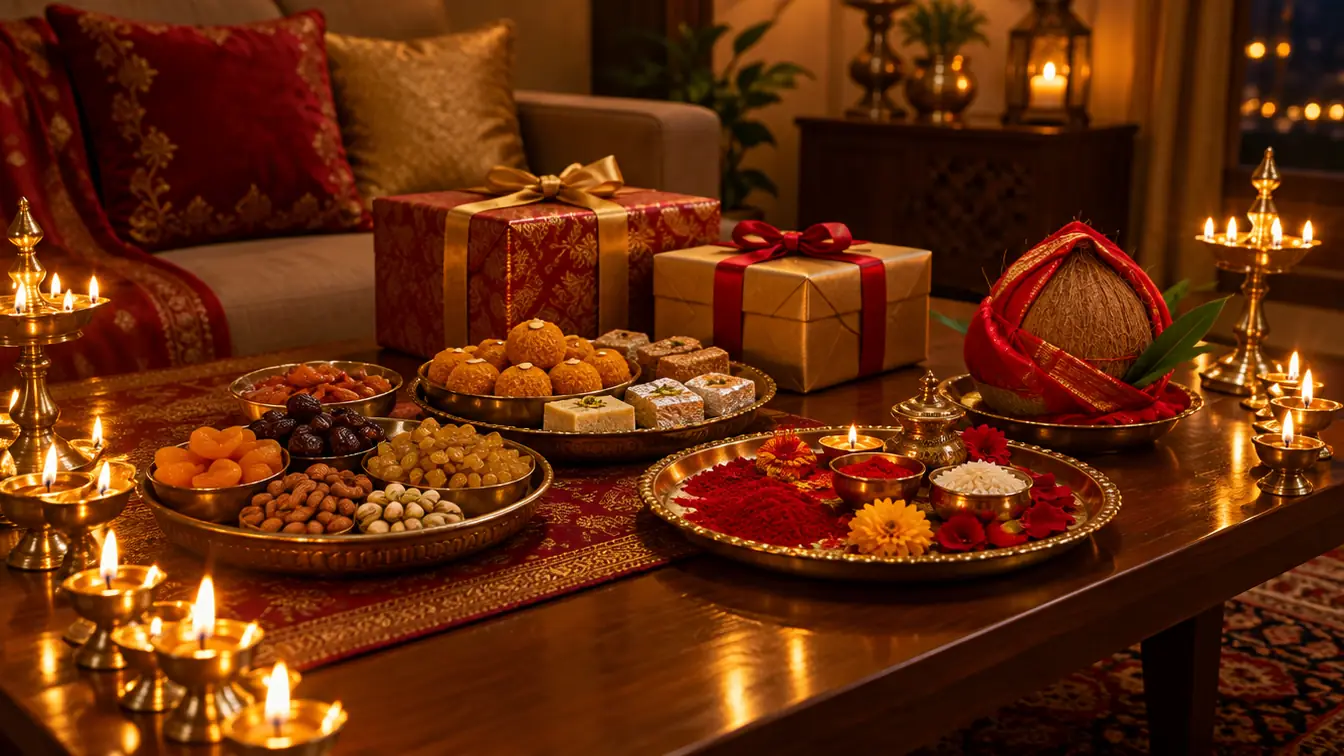
A roka is the moment a match becomes official. In many Punjabi and North Indian families it happens at home: a living room in north Fort Worth, a backyard in Benbrook, a few close relatives, a tray of dry fruit and a great deal of hugging. Because it is small, people sometimes skip the planning, and then discover on the day that half the family in India is asleep. A little thought about guests, gifts and the engagement muhurta keeps the occasion relaxed.
Roka, sagai, ring ceremony: what is the difference?
Roka literally means "stop": the families agree that the search for other matches is over. It is usually informal and intimate. The sagai or mangni is the formal engagement, often with a ring exchange, and it may follow weeks or months later. Other communities have their own versions, such as nischayathartham in Tamil families or gol dhana in Gujarati ones, and the wider customs of Hindu marriage vary from region to region. Many Tarrant County families now combine the roka and the ring ceremony into one afternoon so relatives only travel once.
Who usually attends
- Parents and siblings of both partners, and grandparents if they are in town
- A handful of close aunts, uncles and cousins
- Sometimes a priest, though many families lead the prayer themselves
- Relatives in India, the Gulf or other states joining on a phone or laptop propped on the mantel
Keeping it small is part of the custom. The big celebration comes later.
Simple customs and gifts
Details vary by family, but a home roka often includes:
- A short prayer to Ganesh or the family deity
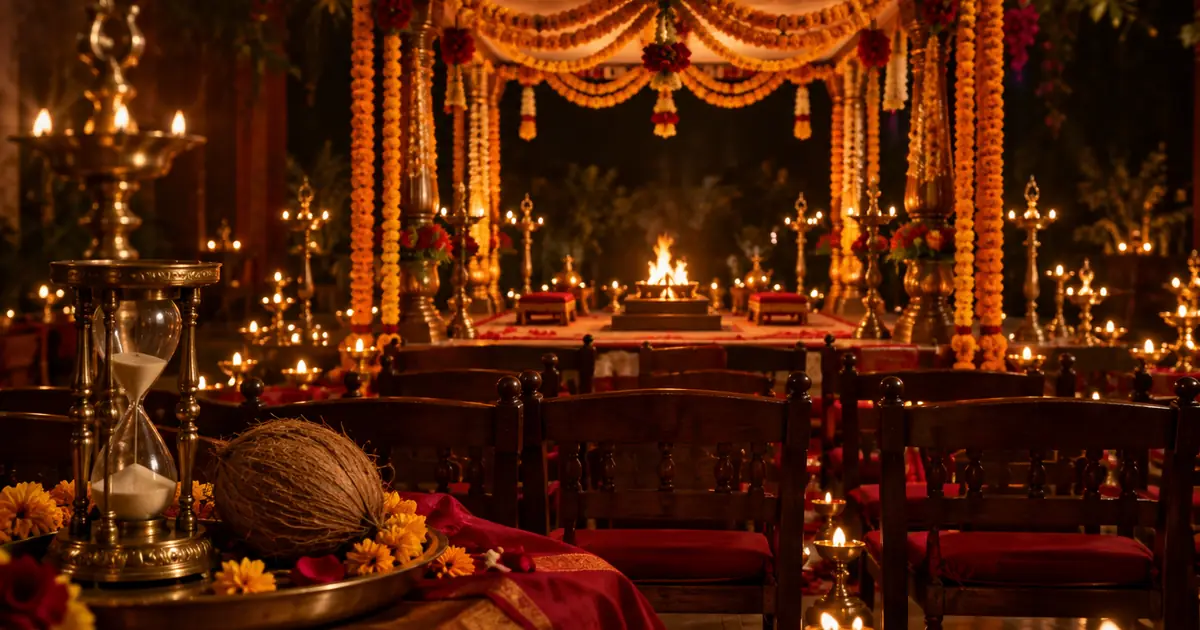
- Tilak on the groom's forehead from the bride's family, with sweets, a coconut and gifts
- A red chunni placed over the bride's head by the groom's family, with clothes or jewelry
- Envelopes of shagun, traditionally an amount ending in one
- Rings, if the families combine roka and sagai
- A meal, photographs and a lot of tea
Keep gifts modest and mutual. When gift expectations turn into a quiet negotiation between families, the couple feels it, and the roka stops being a happy day.
What an engagement muhurta weighs
A sagai muhurat is lighter than a wedding muhurta, but it uses the same building blocks described in the overview of muhurta: a supportive weekday, lunar day and nakshatra, and a time window that avoids the day's less favorable periods. Many families also skip certain stretches of the year entirely:
- Pitru Paksha, the two weeks set aside for ancestors in early autumn
- Kharmas, when the Sun is in Sagittarius or Pisces, roughly mid-December to mid-January and mid-March to mid-April
- Chaturmas, which some families observe as a pause for new beginnings
Within a good day, the window avoids Rahu kaal, which moves every day with local sunrise. The post on why Rahu kaal in Fort Worth differs from India explains why a time copied from an India calendar will be wrong here.
Getting the time right in Central Time
India runs on Indian Standard Time, 10 hours 30 minutes ahead of Fort Worth during daylight saving time and 11 hours 30 minutes ahead in winter. A roka at six in the evening in Fort Worth is 4:30 the next morning in Delhi during summer time. A late-morning roka in Texas reaches India in the evening, which is kinder to grandparents watching on video. When the astrologer offers windows, ask for them in Central Time and check the India time alongside.
A simple running order
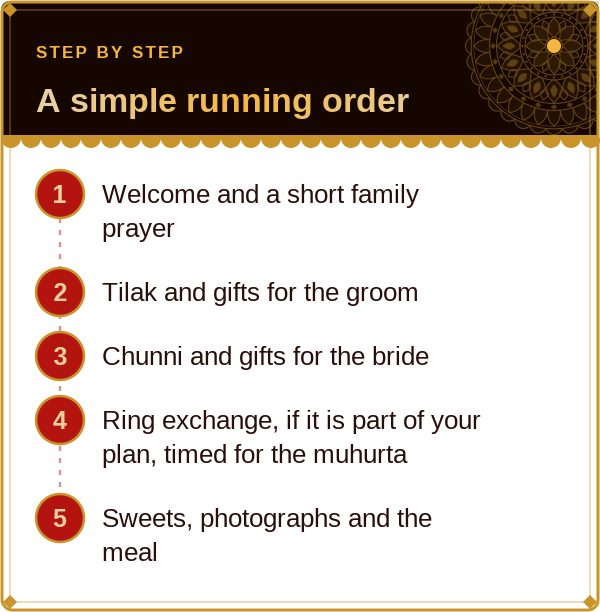
- Welcome and a short family prayer
- Tilak and gifts for the groom
- Chunni and gifts for the bride
- Ring exchange, if it is part of your plan, timed for the muhurta
- Sweets, photographs and the meal
Only one moment, usually the tilak or the rings, needs to land inside the chosen window. Everything else can move at the family's pace.
What comes next
Once the roka is done, the next question from every aunt is the wedding date. Astrologer and Psychic Vijayram can work out both by phone or video as part of wedding muhurta selection for Fort Worth couples, and if matching has not happened yet, it is kinder to do kundli matching before the roka than after it. Once you have a date, the post on the Texas marriage license and your muhurta covers the legal side.
A good engagement date does not make a match right or wrong. It is a respectful way to begin, and the relationship itself is built afterwards, by the two people at the center of it.
Common questions
How far ahead should we choose a sagai muhurat?
A few weeks is usually enough for a home roka. Give the astrologer both families' constraints and a range of dates, and leave time to tell relatives in India so they can plan to join the call.
Can the roka and the ring ceremony happen on the same day?
Yes. Many families now combine them to save travel. The muhurta is then chosen for the key moment, such as the tilak or the ring exchange, and the rest of the gathering follows at an easy pace.
Do we need a priest for a roka at home?
Not necessarily. Many families lead a short prayer themselves. If you would like a priest, ask early, because weekend dates in wedding season fill quickly.
Can an engagement be held during Pitru Paksha?
Most families avoid it, because those two weeks are set aside for honoring ancestors. If the date truly cannot move, talk it over with your elders and priest, since customs differ between families.
Which weekdays are favored for a roka ceremony date?
Many families favor Monday, Wednesday, Thursday and Friday for engagements and avoid Tuesday and Saturday, though customs differ by region. The weekday is only one factor; the lunar day, the nakshatra and both families' schedules all go into the final choice.
Related service
Keep reading
Gana, Yoni and Graha Maitri: The Middle Kootas Families Overlook
Guna milan's 36 points include three middle kootas families skim past: gana, yoni and graha maitri. What each one measures and how to read a low score.
Read article →
Nadi Dosha and Family Health Worries: Tradition Versus Medicine
Nadi dosha explained for worried families: what tradition links it to, the exceptions the texts list, and why health questions belong with doctors first.
Read article →
Bhakoot and Moon-Sign Distance: The 6-8 and 2-12 Pairings Explained
Bhakoot dosha meaning in plain terms: the 6-8, 2-12 and 5-9 Moon-sign distances behind it, the usual cancellations, and why a low score starts a talk.
Read article →Quick answers
Why are some Hindu wedding muhurtas late at night?
Some Hindu wedding muhurtas fall late at night because the rising sign and nakshatra decide the time. How Fort Worth venues and families plan around it.
Read answer →Do gunas matter if we are already engaged?
If you are already engaged, guna scores still offer useful talking points, used as guidance rather than a veto. How kundli matching helps Fort Worth couples.
Read answer →Talk to Astrologer and Psychic Vijayram
Tell us what you are facing. If a reading is unlikely to help, you will be told that plainly.