
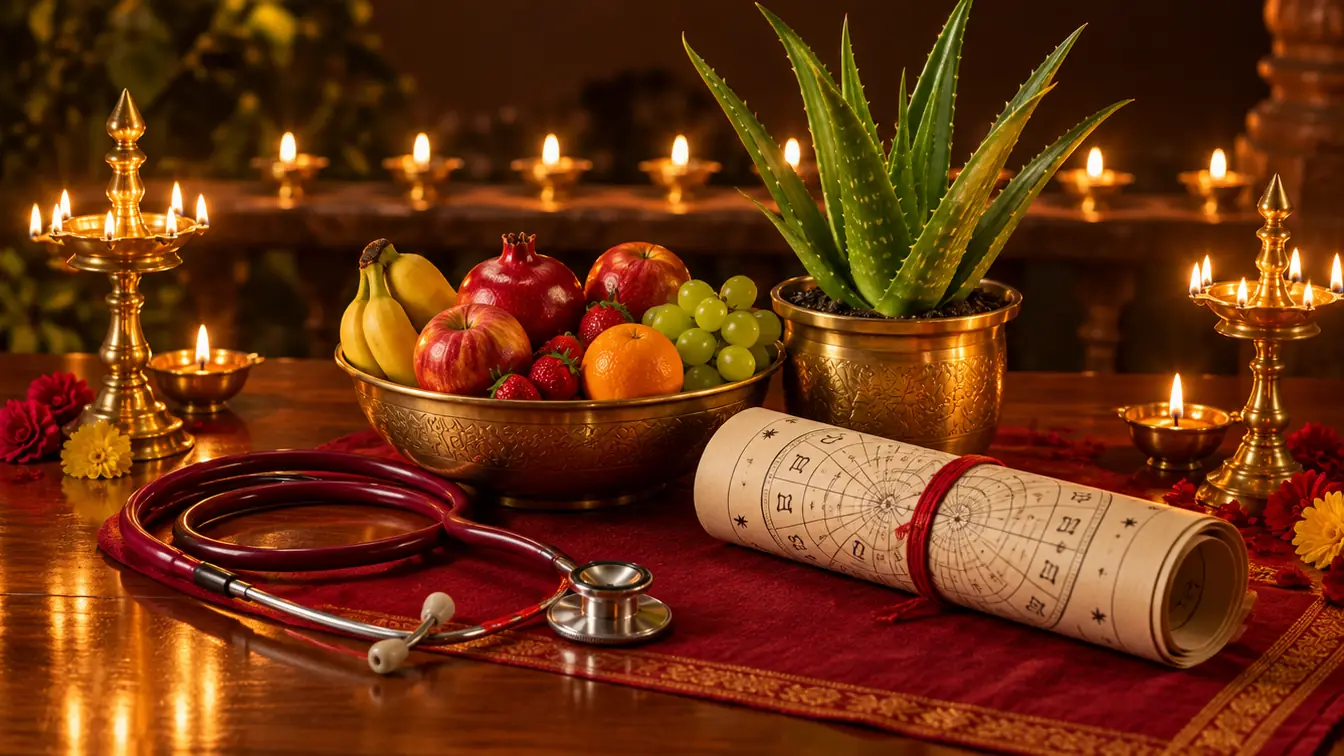
Nadi Dosha and Family Health Worries: Tradition Versus Medicine
Nadi dosha occurs when both partners' birth stars fall in the same nadi, one of three groups in guna milan, which costs all 8 nadi points. Tradition links it with health and children, but it is not a medical finding. Real health or genetic worries belong with a doctor or genetic counselor, and classical exceptions often cancel the dosha anyway.
Key takeaways
- No astrological result should delay medical care, and no remedy is a reason to stop any treatment.
- The stars cycle through the three nadis in a fixed zigzag order around the zodiac.
- Authorities differ in detail, but these are the cancellations most often quoted:
- The old reasoning borrowed from Ayurveda: two people of the same constitution were thought to complement each other poorly, and the worry extended to children.
- Nadi worries often arrive together with questions about Mars.
If a guna milan printout says "nadi dosha" and an older relative's face falls, here is the first thing to know. With nadi dosha explained honestly, it is a traditional category, not a diagnosis. It says nothing measurable about anyone's blood, genes or fertility. If your family has real health questions, about an inherited condition, a relative with a genetic disorder or a history of pregnancy loss, the people to ask are a doctor and a genetic counselor. With that settled, the tradition is worth understanding on its own terms.
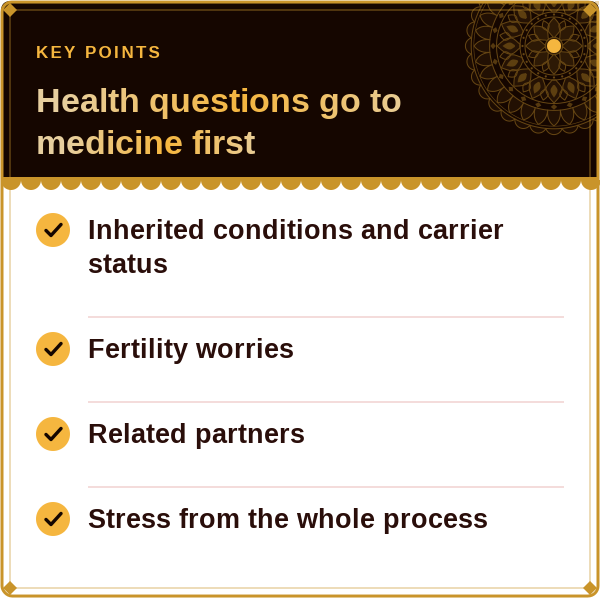
Health questions go to medicine first
- Inherited conditions and carrier status. A genetic counselor reviews family history and can arrange tests. MedlinePlus explains what genetic counseling involves and when it helps. For families of South Asian descent, a doctor may discuss carrier screening for blood disorders such as thalassemia, depending on family history.
- Fertility worries. An OB-GYN or fertility specialist is the right starting point, for either partner.
- Related partners. If the couple are cousins or from a small community where families intermarry, a genetic counselor can explain the actual risks.
- Stress from the whole process. Family pressure around matching can weigh heavily. A counselor can help, and in a crisis you can contact the Suicide and Crisis Lifeline.
No astrological result should delay medical care, and no remedy is a reason to stop any treatment.
What nadi means in the tradition
Each of the 27 nakshatras is assigned to one of three nadis, named Adi, Madhya and Antya, and loosely linked with the three constitutions of Ayurveda. The stars cycle through the three nadis in a fixed zigzag order around the zodiac. When both partners' birth stars share a nadi, the koota scores zero out of eight. When they differ, it scores the full eight. There is no in-between.
Because nine stars belong to each nadi, roughly one couple in three shares a nadi by chance alone. A dosha that common was never meant to be a sentence on a third of all marriages, which is one reason the texts list so many exceptions.
The exceptions the tradition lists
Authorities differ in detail, but these are the cancellations most often quoted:
- Both Moons in the same sign but in different nakshatras.
- The same nakshatra, but with the Moons in different signs. This can happen with stars that straddle two signs, such as Krittika, Punarvasu, Chitra or Vishakha.
- The same nakshatra in different padas, the quarter-divisions of a star, accepted by some authorities.
- The two Moon-sign lords being the same planet, or natural friends, in some traditions.
Ask whoever does your matching which exceptions they apply and why. A clear answer is a good sign.
Why the tradition tied it to health
The old reasoning borrowed from Ayurveda: two people of the same constitution were thought to complement each other poorly, and the worry extended to children. That is a cultural idea from a world without genetics, not a finding about DNA. It is also unrelated to blood group, which many people confuse with nadi. Respect the tradition as a tradition, and let medicine answer medical questions.
Mars questions families ask in the same breath
Nadi worries often arrive together with questions about Mars. Briefly, drawing on the traditional rules summarized under Manglik:
How is kuja dosha formed?
Kuja dosha, also called mangal dosha or being manglik, is formed when Mars sits in the 1st, 2nd, 4th, 7th, 8th or 12th house of the birth chart, counted from the ascendant and often also from the Moon and Venus. The short answer on checking manglik dosha from the Moon or the ascendant explains why the reference point matters.
Is mangal dosha real?
Mangal dosha is real as a traditional rule, not as a proven effect on marriage. With six of twelve houses counted, about half of all charts qualify from the ascendant alone, which tells you how broad the rule is.
Is kuja dosha dangerous?
No. It is not a danger to anyone's life or health. The old folklore about harm to a spouse is not something a responsible reader repeats as fact; a modern reading treats Mars as temperament: drive, directness and impatience.
Is kuja dosha permanent?
The placement in a birth chart never moves, but tradition holds that its weight eases with maturity, popularly after about age 28, and many cancellations apply from birth.
How is mangal dosha canceled?
The most quoted cancellations are both partners being manglik, Mars in its own sign or exaltation, and Jupiter's aspect on Mars. The full lists are longer and vary between schools; the post on two manglik partners covers the mutual case.
Talking about it as a family
- Keep the medical conversation and the astrological one separate, and finish the medical one first if there is a real concern.
- Ask for the exceptions in writing, with the reasoning.
- Be wary of anyone who sells an expensive "nadi dosha removal" with warnings about children. Any prayer is optional and should be explained before it is suggested.
A manglik dosha consultation with Astrologer and Psychic Vijayram works through Mars, nadi and bhakoot cancellations together, by phone or video, and the wider comparison is part of kundli matching in Fort Worth. One limit is absolute: a chart cannot tell you anything about the health of future children. Only medical testing and care can.
Common questions
Can a couple with nadi dosha marry?
Yes. Many do, often because a classical exception applies, and many simply decide the tradition does not outweigh everything else they know about each other. It is a family decision, not a prohibition.
Is nadi dosha linked to blood group?
No. Nadi is worked out from the birth star. Blood group and genetic carrier status come from lab tests, and a doctor or genetic counselor is the person to interpret them.
Should we do a puja for nadi dosha?
Only if it is meaningful to you. Some families choose a prayer or an act of charity for reassurance. It is optional, it should never be sold through fear, and it never replaces medical advice.
Related service
Keep reading
Bhakoot and Moon-Sign Distance: The 6-8 and 2-12 Pairings Explained
Bhakoot dosha meaning in plain terms: the 6-8, 2-12 and 5-9 Moon-sign distances behind it, the usual cancellations, and why a low score starts a talk.
Read article →
Two Manglik Partners: Why Mutual Mangal Dosha Changes the Picture
When both partners are manglik, tradition treats the two Mars placements as balancing out. Other cancellations, online checks, and calm family talk.
Read article →
Introduced by Family or Met on Your Own? Reading Both Paths in Texas
Love marriage astrology for Tarrant County's second generation: what the fifth and seventh houses suggest about meeting a partner, and why your choice leads.
Read article →Quick answers
Is Manglik dosha checked from the Moon or the ascendant?
Manglik dosha is checked from the ascendant, the Moon and often Venus, which is why two reports can disagree. What Manglik means for Fort Worth couples.
Read answer →Do gunas matter if we are already engaged?
If you are already engaged, guna scores still offer useful talking points, used as guidance rather than a veto. How kundli matching helps Fort Worth couples.
Read answer →Talk to Astrologer and Psychic Vijayram
Tell us what you are facing. If a reading is unlikely to help, you will be told that plainly.