
Venue Contract or Muhurta First? Planning a Fort Worth Wedding
A wedding muhurat is the auspicious window chosen for the central Hindu marriage rite, such as the pheras, using the Hindu calendar and both partners' charts. For a Fort Worth wedding, ask for a short list of muhurta windows before signing a venue contract. If the venue date is already fixed, the best window that day can still be found.
Key takeaways
- A wedding muhurat is a period of time judged favorable for marriage by the Hindu calendar and the couple's birth charts.
- Plenty of couples sign first, because a venue had one Saturday left or a deposit was needed quickly.
- Weather is a real factor in North Texas.
- You can find wedding muhurat lists online in seconds, but most are calculated for India, often for Delhi or another single city, in Indian Standard Time.
- No, a muhurta is a Hindu tradition and is not part of an Islamic nikah.
What is wedding muhurat, and why does it matter before you sign a venue contract? In a Hindu wedding, the muhurat (or muhurta) is the auspicious window chosen for the central rite, usually the pheras or saptapadi. Popular wedding venues around Fort Worth and the wider Metroplex can book up far in advance, so the order in which you decide things can save a lot of stress. This post compares the two routes couples take and what to do if your date is already fixed.
What is a wedding muhurat?
A wedding muhurat is a period of time judged favorable for marriage by the Hindu calendar and the couple's birth charts. The concept of muhurta covers many life events, and weddings are the best known. The window is chosen by looking at the tithi (lunar day), weekday, nakshatra and the sign rising at the ceremony location, then checked against both partners' charts. Customs and calendars vary between regions and communities, as the overview of Hindu marriage shows, so the family's own practice shapes the choice. The full method is on the wedding muhurta selection page.
Route A: muhurta first, venue second
This is the ideal order if you have time.
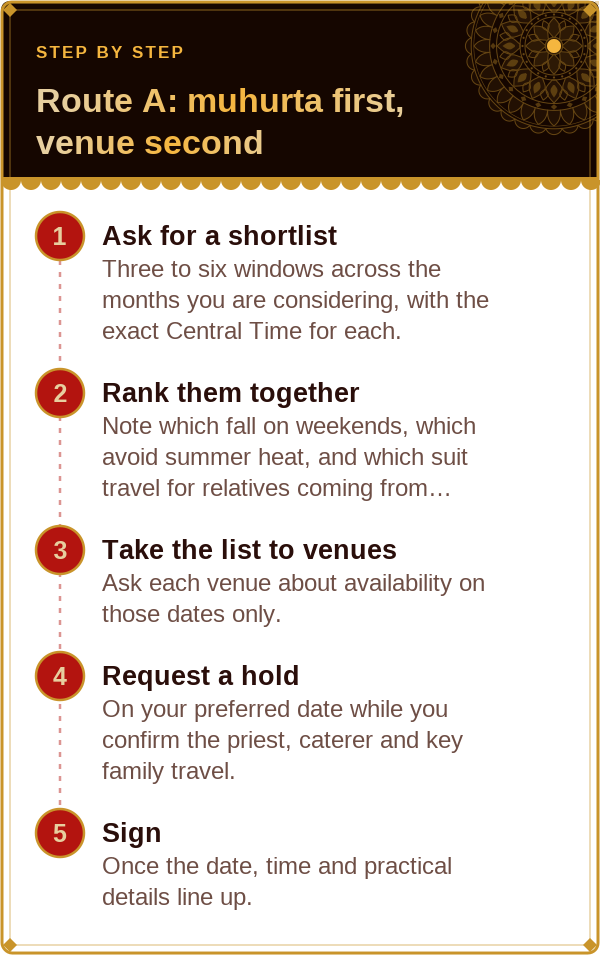
- Ask for a shortlist. Three to six windows across the months you are considering, with the exact Central Time for each.
- Rank them together. Note which fall on weekends, which avoid summer heat, and which suit travel for relatives coming from India or other states.
- Take the list to venues. Ask each venue about availability on those dates only. It turns a vague search into a focused one.
- Request a hold on your preferred date while you confirm the priest, caterer and key family travel.
- Sign once the date, time and practical details line up.
The trade-off: your favorite venue may not have your favorite muhurta free. Having several windows makes that much easier to absorb.
Route B: the venue date is already fixed
Plenty of couples sign first, because a venue had one Saturday left or a deposit was needed quickly. That is fine. A muhurta can still be found:
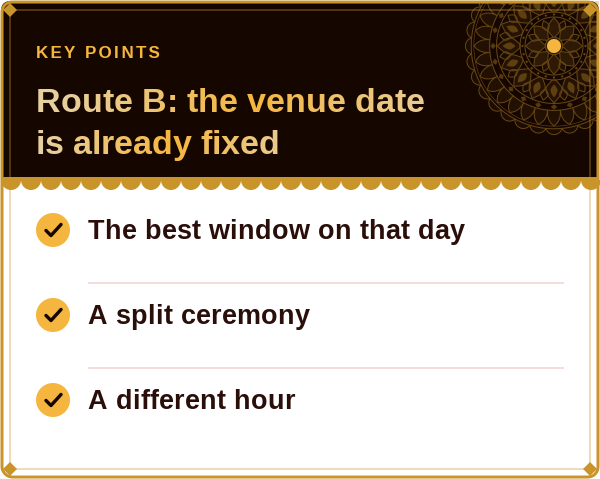
- The best window on that day. Most days have at least one period that works reasonably well. The ceremony time is then set around it.
- A split ceremony. If the day is weak by tradition, some families hold a small rite at home or a temple on a stronger date, then celebrate at the venue on the booked day.
- A different hour. Moving the pheras earlier or later in the day can make a real difference, which is why some muhurtas land at unusual hours. The answer on why some wedding muhurtas fall late at night explains this.
Nobody should feel they have "ruined" the wedding by signing first. Tradition offers more flexibility than people expect.
Questions to ask a venue before signing
- Can the ceremony start at a time other than the standard slot, including early morning or late evening?
- What is the policy on a small contained fire for the havan or agni? Some venues allow it, some do not.
- Is a baraat with dhol, and possibly a horse, permitted on the grounds, and is there a noise curfew?
- How much setup time is allowed for the mandap?
- What is the indoor backup if an outdoor ceremony meets heat, hail or storms?
- How long will the venue hold a date while you confirm?
Weather is a real factor in North Texas. The post on spring or fall wedding seasons in North Texas compares the traditional months with local conditions.
How to find a wedding muhurat online, and its limits
You can find wedding muhurat lists online in seconds, but most are calculated for India, often for Delhi or another single city, in Indian Standard Time. Sunrise, the rising sign and some timing rules shift with location, so a window that works in Delhi may not work in Fort Worth. Generic lists also ignore your charts. A wedding muhurat online service that asks for both birth details and the ceremony city is doing the job properly. Astrologer and Psychic Vijayram prepares the shortlist by phone, WhatsApp or video and sends it in writing for your priest and planner.
Is a wedding muhurat checked in Muslim weddings?
No, a muhurta is a Hindu tradition and is not part of an Islamic nikah. Muslim families choose a date by convenience and their own customs, guided by their imam where needed. In interfaith weddings, couples often hold a Hindu ceremony timed by muhurta and a nikah scheduled separately; the post on intercultural couples and horoscope matching looks at how families combine traditions respectfully.
Keep the legal timeline separate
The Texas marriage license has its own waiting period and expiry, which must be checked with the county clerk. Plan those dates alongside the muhurta, not after it. The post on the Texas marriage license and your muhurta explains how couples line them up.
What a wedding muhurat cannot do
A muhurta is a faith-based way of beginning a marriage with intention. It cannot promise a happy marriage, good weather or a smooth day, and it should never override safety, the law or the couple's own wishes.
Common questions
How far ahead should we ask for muhurta dates?
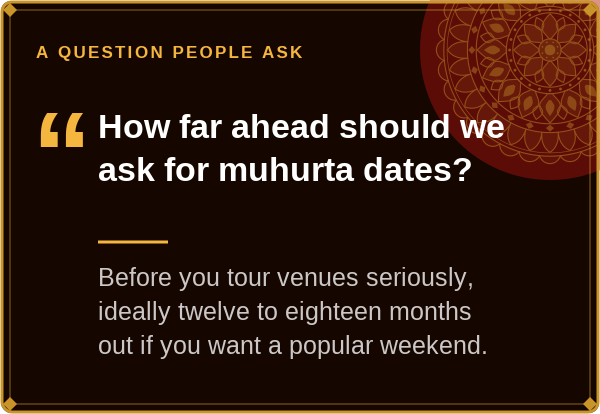
Before you tour venues seriously, ideally twelve to eighteen months out if you want a popular weekend. That gives you a shortlist to compare with venue calendars instead of fitting the muhurta around a contract afterward.
What if the strongest muhurta falls on a weekday?
Many families hold the core rite on the weekday with close relatives, then celebrate with a larger reception on the weekend. Others choose the best weekend window instead. Both are reasonable; it is your decision.
Can the muhurta be at a different time from the reception?
Yes. The muhurta only governs the central rite. The reception, dinner and dancing can be at whatever time suits the venue and guests.
Is a muhurta legally required for a marriage in Texas?
No. Texas law cares about the marriage license and the officiant, not the time of day. The muhurta is a religious and family tradition, and the legal steps should be planned separately.
Related service
Keep reading

Spring or Fall? Auspicious Wedding Seasons in North Texas
The best wedding months in Fort Worth for a muhurta: how traditional Hindu wedding seasons line up with North Texas springs, falls and 100-degree summers.
Read article →
Kundli Matching for Southlake, Keller and Irving Families
Kundli matching in DFW: how Southlake, Keller and Irving families use guna milan today, as one conversation among several rather than a verdict on a match.
Read article →
Karwa Chauth on a Work Day: Fasting and Moonrise in Fort Worth
Karwa Chauth moonrise in Fort Worth, for a fast on a work day: planning sargi, the evening puja, cloudy skies and the health limits that come first.
Read article →Quick answers
Why are some Hindu wedding muhurtas late at night?
Some Hindu wedding muhurtas fall late at night because the rising sign and nakshatra decide the time. How Fort Worth venues and families plan around it.
Read answer →Do gunas matter if we are already engaged?
If you are already engaged, guna scores still offer useful talking points, used as guidance rather than a veto. How kundli matching helps Fort Worth couples.
Read answer →Talk to Astrologer and Psychic Vijayram
Tell us what you are facing. If a reading is unlikely to help, you will be told that plainly.