

Hanuman Chalisa on Tuesdays and Saturdays: A Fort Worth Home Routine
Hanuman Chalisa protection is traditionally sought by reciting the forty-verse hymn, especially on Tuesdays and Saturdays, days linked with Hanuman and with easing Saturn's weight. A recitation takes about ten minutes. Families treat it as devotion and courage-building rather than a promise that nothing bad will happen, and it fits easily before work or school.
Key takeaways
- The Chalisa is a devotional hymn to Hanuman, written by the poet-saint Tulsidas in the 16th century in Awadhi, a language of northern India.
- Tuesday (Mangalvar) is widely kept as Hanuman's day, especially in North India.
- A few verses are especially associated with protection.
- As a protection mantra in the Hindu tradition, the Chalisa sits alongside others, such as the protective hymns described in kavach and raksha prayers .
- Reciting the Hanuman Chalisa is devotion.
On a Tuesday morning in a Fort Worth home, a parent stands at a small shrine with a cup of tea going cold on the counter, reciting forty short verses while the kids find their shoes. On Saturday, the same family sits together a little longer, maybe with sweets afterward. Across Tarrant County, many Hindu households keep some version of this routine. Hanuman Chalisa protection is one of the most common reasons given for it, but if you ask the people who recite it, they often talk more about courage, steadiness and a sense of being looked after.
What the Hanuman Chalisa is
The Chalisa is a devotional hymn to Hanuman, written by the poet-saint Tulsidas in the 16th century in Awadhi, a language of northern India. As the account of the Hanuman Chalisa explains, its name comes from chalis, forty, the number of four-line verses between its opening and closing couplets. It praises Hanuman's strength, wisdom and devotion to Rama, and retells episodes from the Ramayana in brief.
Hanuman himself is among the most loved figures in Hinduism: the monkey-god who leapt the ocean to find Sita, carried a mountain of healing herbs, and served Rama with complete loyalty. The overview of Hanuman gives the wider tradition.
Why Tuesdays and Saturdays?
Tuesday (Mangalvar) is widely kept as Hanuman's day, especially in North India. Many devotees visit a Hanuman temple, fast, or offer red flowers and sindoor on Tuesdays. Tuesday is also linked with Mars, and Hanuman's strength and energy are often associated with Mars's positive qualities.
Saturday (Shanivar) is Saturn's day. A popular story tells that Hanuman freed Shani, the deity of Saturn, from captivity, and in gratitude Shani promised not to trouble Hanuman's devotees. So families going through a hard Saturn period, such as Sade Sati, often recite the Chalisa on Saturdays. The posts on Saturn in the Vedic birth chart and Sade Sati explain why those periods carry such weight in the tradition.
The protection lines
A few verses are especially associated with protection. One of the best known says that ghosts and evil spirits do not come near when the name of Mahavir, the great hero, is spoken. Another says Hanuman frees from trouble those who hold him in mind, word and deed. Another speaks of illness and pain being removed by constant recitation. These are devotional poetry, loved for centuries. They are not medical or literal promises, and they never replace a doctor, the police or common sense.
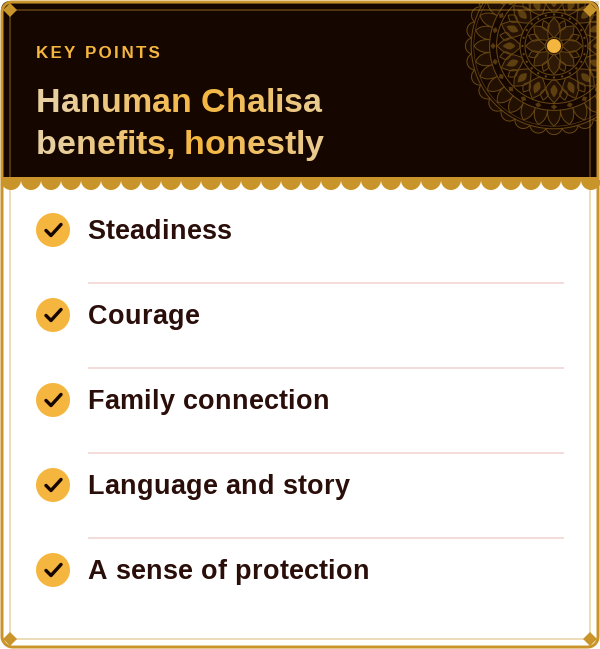
Hanuman Chalisa benefits, honestly
- Steadiness. A fixed ten minutes, twice a week or daily, gives the mind a calm anchor.
- Courage. Reciting verses about strength and loyalty reminds many people of their own.
- Family connection. Children who learn it with parents and grandparents carry a shared practice for life.
- Language and story. The verses open a door into the Ramayana.
- A sense of protection. Many devotees feel looked after, and that feeling helps them face hard days.
As a protection mantra in the Hindu tradition, the Chalisa sits alongside others, such as the protective hymns described in kavach and raksha prayers.
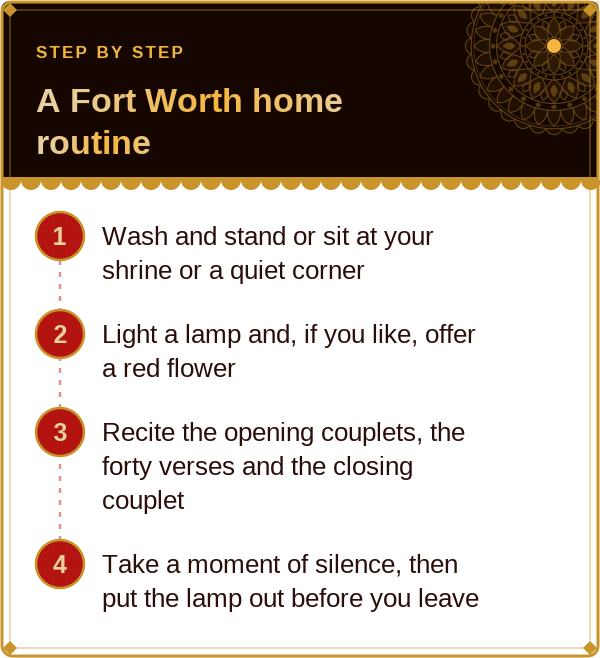
A Fort Worth home routine
Tuesday: ten minutes before the day starts
- Wash and stand or sit at your shrine or a quiet corner.
- Light a lamp and, if you like, offer a red flower.
- Recite the opening couplets, the forty verses and the closing couplet.
- Take a moment of silence, then put the lamp out before you leave.
If mornings are a rush between school drop-off and the commute, recite it the evening before, or split it: the first twenty verses at breakfast, the rest at night.
Saturday: a slower family version
- Gather the family at a relaxed time, morning or evening.
- Recite together, with children joining the lines they know.
- Read the meaning of one verse in English and talk about it for a minute.
- Share a simple offering afterward: jaggery and roasted chana, or any sweet.
On the go
Some people listen on the TEXRail or a bus, which is fine. Do not let it pull your attention while driving on I-35W or Loop 820; save active recitation for when you can focus.
For a compact daily practice that fits a busy schedule, see a ten-minute mantra practice for busy days, and for setting up a shrine in limited space, a prayer corner in a small apartment.
Where this fits in protective prayer sessions
People who come to Astrologer and Psychic Vijayram worried about ill-wishing or a run of misfortune are often guided toward a simple routine like this one, after ordinary causes have been looked at. It is described on the protective prayer page, and a personal routine can also be built in a mantra and meditation session, by phone, WhatsApp or video, in Central Time.
What the Chalisa cannot do
Reciting the Hanuman Chalisa is devotion. It cannot guarantee that nothing bad will happen, and it does not replace medical care, safety precautions or practical help. Its value is the steadiness and faith it brings to the person who recites it.
Common questions
How long does it take to recite the Hanuman Chalisa?
Most people take eight to twelve minutes at a steady pace. Beginners may take longer while learning the words, and that is fine. Reciting slowly with attention matters more than speed.
Can I listen to the Hanuman Chalisa instead of reciting it?
Yes. Many people listen to a recording, especially while learning, and join in where they can. Listening attentively is a form of devotion. Just avoid letting it play as background noise while your mind is elsewhere.
Do I have to recite it seven or eleven times?
No. Some devotees recite it several times on special days or as a vow, but once, with attention, is the common daily practice. Do not let a target number turn devotion into pressure.
Can children recite the Hanuman Chalisa?
Yes, and many families teach it early. A good approach is to learn a few lines a week, explain what they mean in English, and keep it gentle. Children often enjoy the stories of Hanuman behind the verses.
Related service

Keep reading

Kavach and Raksha: Protective Prayers in the Tradition
Kavach mantra meaning explained: what a kavach hymn is, how the Devi Kavacham, Rama Raksha and the raksha sutra are used day to day, and what protection means.
Read article →
Kohl, Kajal and Lead: Keeping Newborn Nazar Customs Safe
Nazar on baby customs, from the black dot to kajal, and why the FDA warns about lead in some kohl products. Safer ways to keep it, pediatrician first.
Read article →
A Weekly Upkeep Routine for a Small Shop After Its Blessing
An office cleansing ritual you can keep weekly after a shop blessing: a lamp, a clean threshold, a short prayer, and fire-code sense for Fort Worth leases.
Read article →Quick answers
Can protection prayers be said for me remotely?
Yes, protection prayers can be said for you remotely, by phone or video, as a faith practice. Safety steps come first, and the fee is stated before booking.
Read answer →Is nazar the same thing as mal de ojo?
Nazar and mal de ojo are close cousins: both name the evil eye of envy or admiration. How the South Asian and Latin American beliefs differ in Fort Worth.
Read answer →Talk to Astrologer and Psychic Vijayram
Tell us what you are facing. If a reading is unlikely to help, you will be told that plainly.