

Kohl, Kajal and Lead: Keeping Newborn Nazar Customs Safe
Families put a small black dot or a line of kajal on a baby to turn away nazar, the evil eye. The FDA warns that kohl, kajal and surma products can contain lead, which harms children. You can keep the custom with nothing on the skin: a prayer, a charm out of reach, or circled salt. Ask your pediatrician first.
Key takeaways
- Across India, Pakistan, Nepal and Bangladesh, the belief is that too much praise, even well-meant, can draw a harmful glance: nazar , drishti or buri nazar .
- Some are sold online or imported with packaging that lists no lead at all.
- None of these put anything on the skin, and several are just as traditional as the dot.
- Pediatric safety advice warns against necklaces, bracelets, anklets and strings on infants because of choking and strangulation risks.
- Relatives sometimes blame nazar when a baby who was calm at the party is fussy by evening.
Health first: if your baby has been having kohl, kajal or surma applied, mention it to your pediatrician at the next visit and ask whether a blood lead test makes sense. If a baby is unusually sleepy, will not feed, has a fever or seems unwell in any way, call the pediatrician or the nurse line now, and call emergency services in an emergency. No custom replaces that call.
Worry about nazar on baby is one of the oldest instincts in South Asian families. A newborn arrives, relatives admire the round cheeks, and someone's grandmother quietly reaches for the kajal. The gesture comes from love. This post explains what the customs mean, why US health authorities have warned about some of the products, and how Fort Worth families keep the tradition in ways that are gentle on a baby's skin and body.
What the black dot and kajal customs mean
Across India, Pakistan, Nepal and Bangladesh, the belief is that too much praise, even well-meant, can draw a harmful glance: nazar, drishti or buri nazar. A small flaw is thought to deflect it. So a dot of black, the kala tika, goes behind the ear, on the sole of the foot or at the edge of the hairline, and some families line a baby's eyes with kajal in the belief that it also strengthens the eyes. The history of the nazar amulet shows how far the same idea travels, from blue glass eyes in Turkey to red threads in Latin America.
Underneath the custom is an ordinary parental fear: something so small and precious could be harmed. That fear deserves respect, not mockery. It also deserves products that do not add a real risk.
Why the FDA warns about kohl, kajal and surma
The U.S. Food and Drug Administration warns that kohl, kajal, surma and similar eye cosmetics have been found to contain high levels of lead, and that these products are not approved for cosmetic use in the United States. Some are sold online or imported with packaging that lists no lead at all. Homemade kajal, made from lamp soot, carries its own uncertainty.
Lead matters more for babies than for adults. Small bodies absorb it more easily, and babies rub their eyes and put their hands in their mouths constantly, so anything on the face ends up swallowed. MedlinePlus explains that lead exposure in young children can affect development and often shows no obvious signs at first, which is why testing, not guessing, is how you find out.
A label reading "herbal" or "natural" does not settle the question. If you are unsure what is in a product, keep it off your baby.
Safer ways to keep the custom
None of these put anything on the skin, and several are just as traditional as the dot.
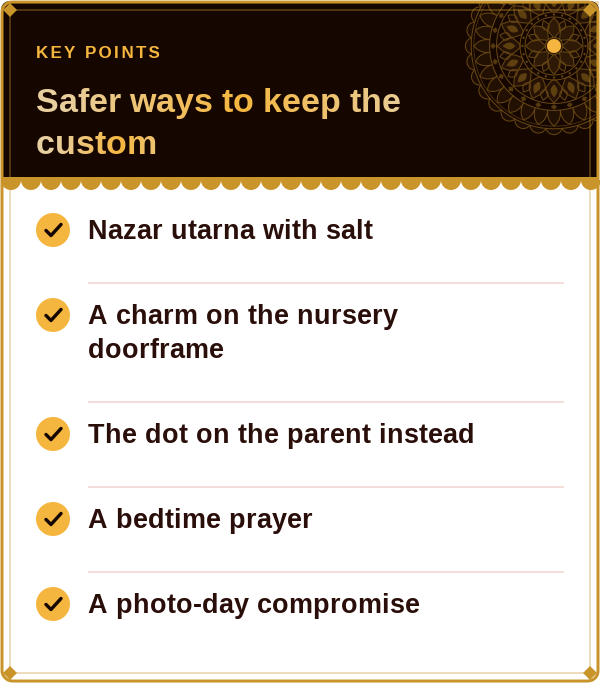
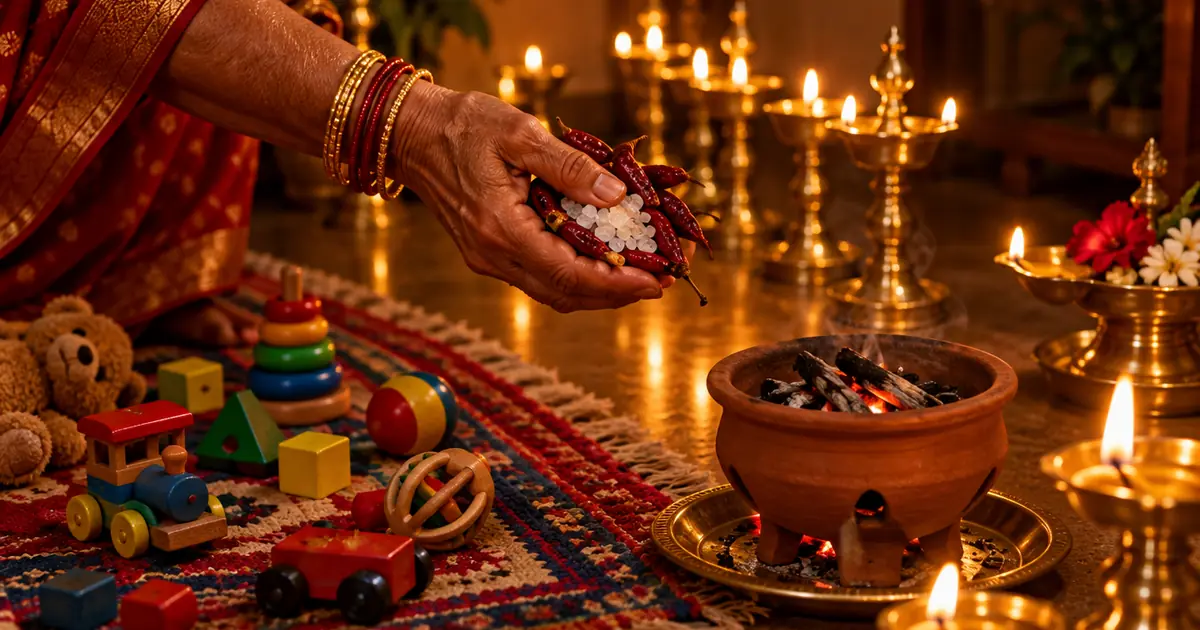
- Nazar utarna with salt. A grandparent circles a pinch of rock salt around the sleeping baby without touching, says a short prayer, then dissolves the salt in running water. Keep salt well away from small hands and from pets.
- A charm on the nursery doorframe. A blue eye bead, a small image of Ganesha or Hanuman, or a lemon-and-chili string, hung where adults pass and nowhere near the crib.
- The dot on the parent instead. Some families place the tika on the mother's or grandmother's own wrist while she holds the baby. The symbolism carries over; the risk does not.
- A bedtime prayer. A verse of the Hanuman Chalisa, a Gayatri recitation or simply "may no harm come to you," said over the baby each night. Prayer leaves no residue.
- A photo-day compromise. If the family wants a visible dot for pictures at a namkaran ceremony, ask the pediatrician which product is safe, use the tiniest amount behind the ear, and wipe it off afterward.
What not to put on or near a baby
Pediatric safety advice warns against necklaces, bracelets, anklets and strings on infants because of choking and strangulation risks. That includes black thread bracelets, teething strands and nazar beads on a cord. These customs suit an older child or an adult; for a baby, keep them on the doorframe. Our post on black thread bracelets and when to remove them covers the thread customs for older family members.
Nothing belongs on a car seat or in a crib either: no hanging charms, ribbons or loose cloth. A safe sleep space is a plain one.
When a baby cries a lot, check ordinary causes first
Relatives sometimes blame nazar when a baby who was calm at the party is fussy by evening. Overstimulation, hunger, a wet diaper, gas, a growth spurt or the start of a cold are far more common explanations. A long day of visitors in a warm house is tiring for anyone, never mind someone a few weeks old. Our post on nazar worries and everyday causes walks through the same thinking for adults.
If crying is constant or high-pitched, or comes with fever, vomiting, a rash or poor feeding, that is a question for the pediatrician, not a spiritual one.
How a reader can help, and what a reading cannot do
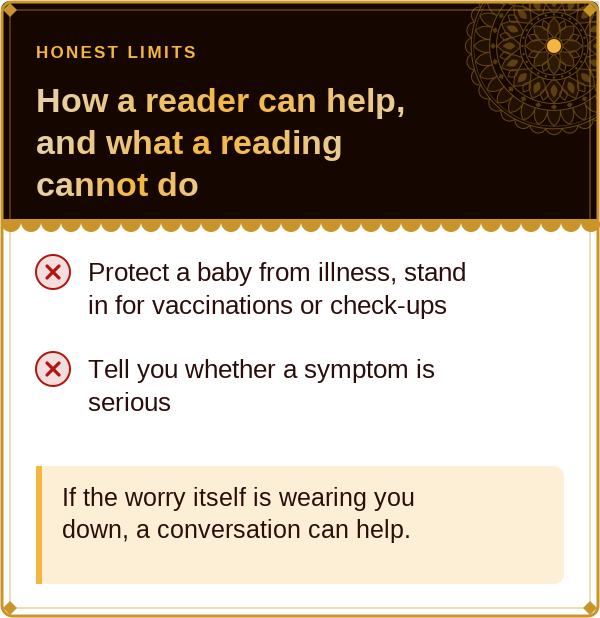
If the worry itself is wearing you down, a conversation can help. Astrologer and Psychic Vijayram can talk through your family's customs, suggest a short protective prayer suited to your tradition and explain the evil eye removal prayers offered by phone, WhatsApp or video. Nothing in that session involves putting products on your child. A prayer cannot protect a baby from illness, stand in for vaccinations or check-ups, or tell you whether a symptom is serious. Those answers belong to your pediatrician.
Common questions
What is a horoscope for a baby, and is it needed for nazar customs?
A baby's horoscope, or janam kundli, is a chart of the sky at the moment of birth, used for naming and family milestones. Nazar customs need no chart at all. If you would like one prepared, see newborn kundli and naming for Fort Worth families.
Is kajal from an Indian grocery store safe for babies?
You cannot tell from the shelf. The FDA warns that many kohl and kajal products contain lead and are not approved for cosmetic use in the US. Keep them off your baby and ask your pediatrician what, if anything, is safe.
My mother-in-law insists on the black dot. What can I say?
Offer a swap rather than a refusal: the dot on your own wrist while you hold the baby, salt circled and dissolved, or a charm on the doorframe. Many elders relax once they see the custom honored rather than dropped.
Should I ask about a lead test for my baby?
Yes, if kohl, surma or imported powders have been used. Lead often causes no early symptoms, so a simple blood test is how a pediatrician checks.
Is nazar the same as mal de ojo?
They are close cousins. Many Hispanic families in Fort Worth protect babies from mal de ojo with a red bracelet or an ojo de venado charm. The same safety rule applies: no strings or bracelets on infants. More in how nazar and mal de ojo compare.
Related service
Keep reading

A Weekly Upkeep Routine for a Small Shop After Its Blessing
An office cleansing ritual you can keep weekly after a shop blessing: a lamp, a clean threshold, a short prayer, and fire-code sense for Fort Worth leases.
Read article →
Rahu, Ketu and Feeling Under a Cloud
Rahu Ketu negative effects explained calmly: how astrologers read restless or foggy periods in a Vedic chart, without calling them a curse or selling fear.
Read article →
After a Cleansing: Keeping the Home Calm
What to do after spiritual cleansing: light, order and a short daily prayer to keep the home calm, with no repeat fees or top-up rituals required.
Read article →Quick answers
Is nazar the same thing as mal de ojo?
Nazar and mal de ojo are close cousins: both name the evil eye of envy or admiration. How the South Asian and Latin American beliefs differ in Fort Worth.
Read answer →How do I know if I need a spiritual cleansing?
How do you know if you need a spiritual cleansing? Rule out health, sleep and stress first; then a cleansing can be a calm faith practice. A Fort Worth guide.
Read answer →Talk to Astrologer and Psychic Vijayram
Tell us what you are facing. If a reading is unlikely to help, you will be told that plainly.