
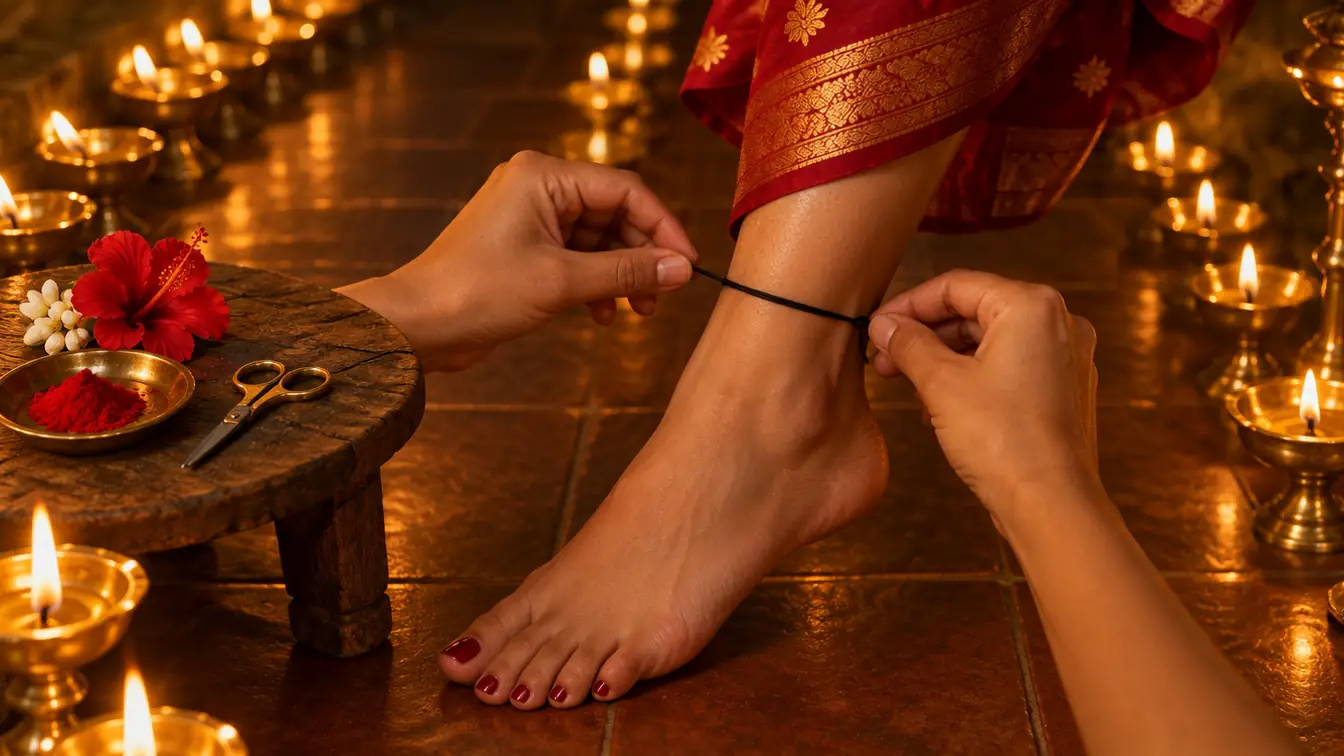
Black Thread Bracelets and Anklets: Meaning and When to Remove
Nimbu mirchi meaning: a lemon and green chillies strung on a thread and hung at a door or shop to absorb envious glances. The black thread, or kala dhaga, does the same job on the body, tied at the wrist, ankle or waist. Both are folk protections, replaced when worn out and removed whenever safety or hygiene calls for it.
Key takeaways
- Nimbu mirchi is a string of one lemon and usually seven green chillies, hung at the entrance of a shop, home or vehicle.
- The kala dhaga, or black thread, is one of the simplest protective customs in South Asian homes.
- Customs differ widely between regions and households, so there is no single correct side.
- The black dot many families put on a baby's cheek or behind the ear is the thread's close cousin: a deliberate flaw meant to stop admirers from staring.
- To dispose of it respectfully, untie or cut it, then place it in running water, bury it in garden soil, or wrap it in paper before putting it in the trash.
Walk past an Indian grocery or restaurant on a Saturday morning and you may spot it hanging above the door: one lemon, a few green chillies, strung on a thread. Look at the wrists and ankles of the people inside and you may see thin black threads. Both are answers to the same old worry, nazar, the evil eye. This post starts with nimbu mirchi meaning, then spends most of its time on the black thread: who wears one, how it is tied, practical points about hygiene, and when to take it off.
Nimbu mirchi meaning, in brief
Nimbu mirchi is a string of one lemon and usually seven green chillies, hung at the entrance of a shop, home or vehicle. The sour lemon and sharp chillies are believed to catch envious glances before they reach the business or family inside. It is traditionally replaced every Saturday, with the old one thrown away outside. Some see it as an offering to Alakshmi, the goddess of misfortune, so she is satisfied at the door and does not enter. It belongs to the same family of protections as the blue glass eye described in the history of the nazar amulet.
What the black thread means
The kala dhaga, or black thread, is one of the simplest protective customs in South Asian homes. Black is believed to absorb negativity and the envious gaze. In astrology, black is associated with Saturn, Shani, and some families tie a new thread on Saturdays for that reason; the post on Saturn in the Vedic birth chart explains Shani's place in the tradition. For most people, though, the meaning is plain: a small, constant reminder that someone wished them protection.
Who wears it, and where
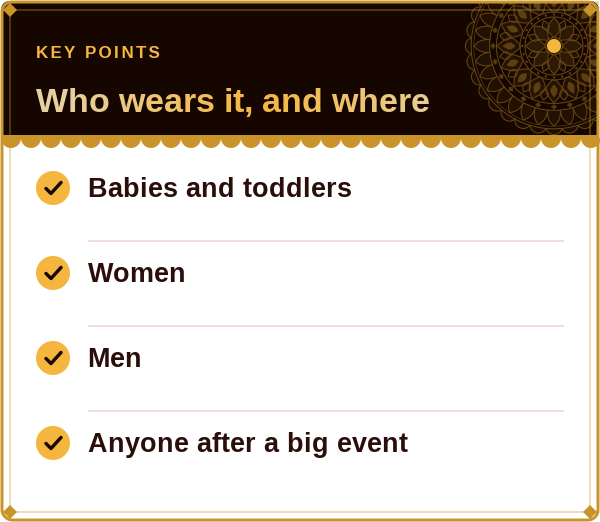
- Babies and toddlers: on the wrist, ankle or waist (a waist thread is sometimes called a kardhani). Never around the neck.
- Women: often on the left ankle, sometimes as a fashion anklet as much as a custom.
- Men: often on the right wrist.
- Anyone after a big event: a wedding, exam, new job or recovery from illness, when families feel extra attention may be on them.
Customs differ widely between regions and households, so there is no single correct side.
How it is tied
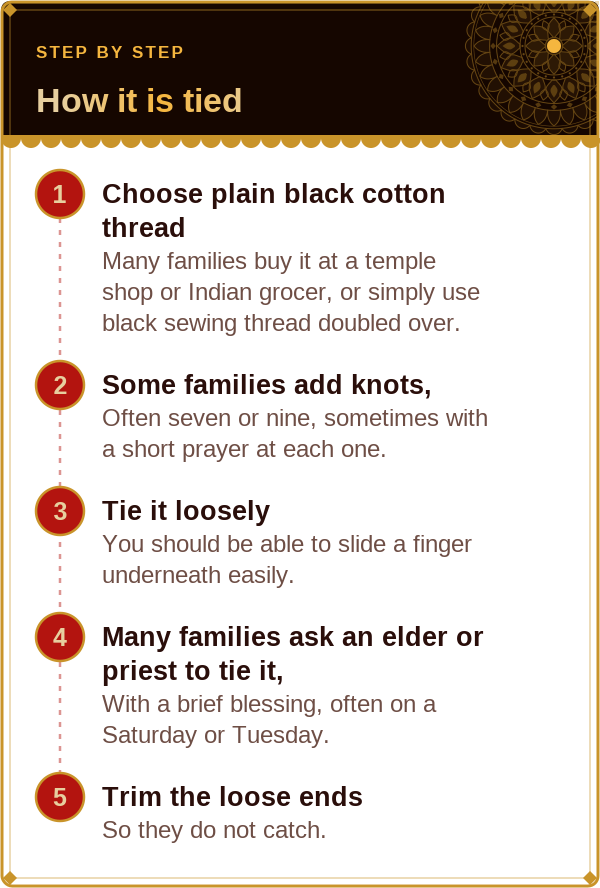
- Choose plain black cotton thread. Many families buy it at a temple shop or Indian grocer, or simply use black sewing thread doubled over.
- Some families add knots, often seven or nine, sometimes with a short prayer at each one.
- Tie it loosely. You should be able to slide a finger underneath easily. For babies, check it every day as they grow.
- Many families ask an elder or priest to tie it, with a brief blessing, often on a Saturday or Tuesday.
- Trim the loose ends so they do not catch.
Hygiene and practical points
- Moisture and skin. Cotton holds water and sweat, which in a Fort Worth summer can mean redness, itching or a rash. Remove it if the skin is irritated.
- Swimming. Chlorine weakens the thread and it frays fast. Some people take it off before swimming.
- Medical visits. Hospitals may ask you to remove threads before surgery or some scans. Remove it without worry; you can tie a new one afterward.
- Sports and work. Anything that could catch on equipment or machinery should come off.
- Babies. Keep threads loose, check skin daily, and remove any thread that is fraying, since loose fibers and small knots can be a choking risk. Ask your pediatrician if you are unsure.
Kajal dot nazar protection, and a safety warning
The black dot many families put on a baby's cheek or behind the ear is the thread's close cousin: a deliberate flaw meant to stop admirers from staring. The product matters. The FDA warns that traditional kohl, kajal and surma can contain lead, which is dangerous especially for children. Many parents now skip it, or use a tiny mark behind the ear with a product they have checked carefully.
When to remove a black thread
- When it breaks or frays. This is not a bad omen; families say the thread has done its work.
- When it gets dirty or smells.
- When the skin underneath is red or irritated.
- Before surgery, certain medical tests, or activities where it could catch.
- When a set period ends, if your family replaces threads at a festival or every few weeks.
- Whenever you simply do not want to wear it anymore. Removing it brings no harm.
To dispose of it respectfully, untie or cut it, then place it in running water, bury it in garden soil, or wrap it in paper before putting it in the trash.
Where these customs fit
Threads, dots and lemons are household customs, done by families themselves. For a broader look at the belief, read what the evil eye is; for babies specifically, protecting children from nazar; and for those blue glass charms, wearing a nazar charm with respect. When a home or person feels weighed down, the negative energy removal service checks everyday causes first and then guides a simple cleansing, and evil eye removal covers the full nazar rite. Astrologer and Psychic Vijayram offers both by phone, WhatsApp or video in Central Time.
What a thread cannot do
A black thread or nimbu mirchi cannot prevent illness, accidents or bad luck. They are faith-based folk customs of care, and they never replace safety precautions or medical attention.
Common questions
Is it bad luck if my black thread breaks?
No. Many families say a thread that breaks has done its job. Simply remove what is left, dispose of it respectfully, and tie a new one if you wish.
Which ankle should the black thread go on?
Customs differ. Many families tie it on the left ankle for women and the right for men; others use either side. Follow your own family's practice, or choose the one that feels comfortable.
Can I wear a black thread in a swimming pool or shower?
You can, but wet cotton holds moisture against the skin and frays faster in chlorine. If you notice redness or itching, remove it, let the skin dry, and tie a fresh one later.
How often should nimbu mirchi be replaced?
Traditionally every Saturday, when shops and homes hang a fresh string and dispose of the old one. In Texas heat the lemon dries or spoils quickly, so many households replace it weekly or use a symbolic version.
Related service

Keep reading

Buying Camphor, Rock Salt and Incense at Tarrant County Grocers
Camphor for puja, rock salt and incense: what to look for at Tarrant County grocers, how each is used in a home cleansing, and fire safety for apartments.
Read article →
Heavy Feelings in a Hot Texas August: Heat, Sleep and Spirit
Negative energy or stress? Before calling it spiritual, Fort Worth readers can check heat exhaustion, sleep, burnout and health, then add prayer as support.
Read article →
Suspecting a Neighbor or Relative? Why We Never Point a Finger
Who did black magic on me? Why this practice refuses to name a neighbor or relative, how blame damages Tarrant County families, and what protective prayer does.
Read article →Quick answers
Is nazar the same thing as mal de ojo?
Nazar and mal de ojo are close cousins: both name the evil eye of envy or admiration. How the South Asian and Latin American beliefs differ in Fort Worth.
Read answer →How do I know if I need a spiritual cleansing?
How do you know if you need a spiritual cleansing? Rule out health, sleep and stress first; then a cleansing can be a calm faith practice. A Fort Worth guide.
Read answer →Talk to Astrologer and Psychic Vijayram
Tell us what you are facing. If a reading is unlikely to help, you will be told that plainly.