
Evil Eye Beads as Souvenirs: Wearing a Nazar Charm With Respect
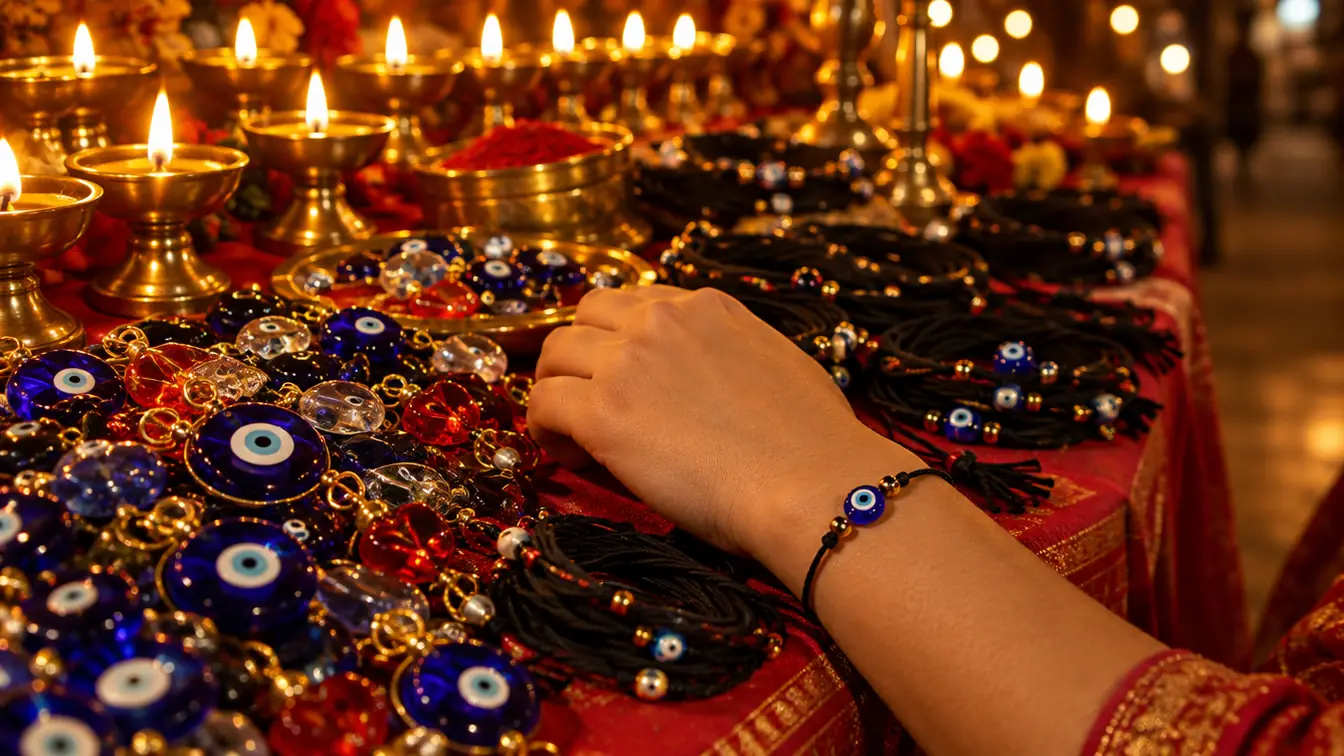
An evil eye bracelet is a protective charm: the blue glass eye, or nazar, is believed to look back at envy and turn it away. It comes from Turkish, Greek, Middle Eastern and South Asian customs. Wearing one as a gift or souvenir is fine when done with respect. It is a symbol of care, not a guarantee of protection.
Key takeaways
- The belief behind all of these charms is old and widespread: a look full of envy, even an admiring one, can cause harm.
- One firm rule: bracelets and strings do not belong on babies, because of choking and strangulation risks.
- Online shops often sell charts saying pink brings love, green brings success and red brings courage.
- Parents hang one in a teenager's first car.
- An evil eye charm cannot stop a coworker's jealousy, protect you from illness or prevent bad luck.
A cousin comes back from Istanbul with a handful of blue glass beads. A friend brings a bracelet from a Greek island. Someone at work hands you a black thread with a tiny eye on it, bought at a market in Jaipur. Now it is on your wrist, and you want to know what it means. This post covers the evil eye bracelet meaning, where the different charms come from, how families actually use them, and what they do and do not promise.
Where the blue eye comes from
The belief behind all of these charms is old and widespread: a look full of envy, even an admiring one, can cause harm. The history of the evil eye belief traces it through the ancient Mediterranean, the Middle East, North Africa and South Asia, and on into Latin America.
The classic blue bead comes from Turkey, where it is called nazar boncuğu. It is made of glass in rings of dark blue, white, light blue and a black center, so it looks like an eye looking back. The idea is that the charm meets the harmful glance first. Greek families call a similar charm the mati, simply "eye." The history of the nazar amulet describes how the same design spread through trade and travel.
South Asian families more often use black: a kala dhaga thread at the wrist or ankle, or a dot of kajal on a child. Mexican and Central American families know mal de ojo and protect children with a red bracelet or an ojo de venado, a seed charm on red thread. Fort Worth is home to families from all of these traditions, so the same charm can carry slightly different meanings in different households. Our post on evil eye traditions in Fort Worth's South Asian and Hispanic homes looks at how they sit side by side.
Bracelet, charm or doorway: how families use them
| Form | Where it goes | Typical use |
|---|---|---|
| Blue-eye bracelet | Wrist, worn daily | Gift for a new job, a move or a big exam |
| Black thread | Wrist or ankle | Everyday protection in many South Asian families |
| Hanging glass eye | Front door, shop entrance, office wall | A new home or business |
| Small charm | Key ring or bag | A souvenir that travels with you |
| Doorframe charm | Nursery door, out of reach | Welcoming a baby |
One firm rule: bracelets and strings do not belong on babies, because of choking and strangulation risks. Our post on keeping newborn nazar customs safe has alternatives. For the thread customs, see black thread bracelets and when to remove them.
Do the colors mean anything?
Online shops often sell charts saying pink brings love, green brings success and red brings courage. Those charts are modern marketing. The traditional bead is blue, and its meaning is protection, full stop. If you love a pink one, wear it, but buy it because you like it, not because a label promised romance.
Nazar bead meaning in a family setting
In families that use them, the bead is rarely about fear. It is a small way of saying "I want good things for you, and I want them to last." A grandmother pins one inside a newborn's room. Parents hang one in a teenager's first car. Friends give one when someone gets a promotion. Seen that way, the charm is closer to a blessing than a shield.
Wearing one with respect
- Know what it is. If someone asks, you can say it is a protective charm from Turkish and Mediterranean tradition, given with good wishes.
- Buy from makers when you can. Hand-blown glass from artisans keeps the craft alive; plastic copies do not.
- Do not use it as a costume. A charm worn for a laugh lands differently with people whose grandparents kept one by the door.
- Give it with a few words. A sentence about its meaning turns a trinket into a real gift.
- Replace it without fear. A lost or cracked bead is not a sign of anything.
If you are browsing for charms in town, the post on metaphysical shops and psychic fairs in Fort Worth explains what you will find and which sales pitches to walk away from.
What a nazar charm does not promise
An evil eye charm cannot stop a coworker's jealousy, protect you from illness or prevent bad luck. It is a symbol, and its value lies in the care behind it. If a run of misfortune has you worried about nazar, read what the evil eye means across Indian languages for the background. If the worry is persistent, Astrologer and Psychic Vijayram offers calm, prayer-based evil eye removal that starts by looking at everyday causes and never names anyone as the source.
Common questions
Which wrist should an evil eye bracelet go on?
There is no single rule. Some families say the left wrist, the receiving side; others prefer the right. Comfort and visibility matter more than the side, so wear it where you will notice it and remember what it stands for.
What does it mean when an evil eye bead breaks?
Folk belief says a cracked bead has done its job by absorbing a harmful glance. In practical terms, glass breaks. Replace it if you like, bury or discard the pieces calmly, and do not read it as an omen.
Can I wear one if I am not from these cultures?
Yes. The charm is widely given as a gesture of goodwill, and families who use it are usually glad to see it worn. Learn what it means, and wear it as a token of care rather than as a joke or a costume.
Should I cleanse a nazar charm?
Some people rinse it in plain water or leave it in sunlight now and then, as a small act of attention. It is optional. Nothing bad happens if you never do.
Related service
Keep reading
Evil Eye Traditions in Fort Worth's South Asian and Hispanic Homes
Evil eye removal traditions in Fort Worth: how South Asian nazar customs and Hispanic mal de ojo practices each understand envy and answer it, side by side.
Read article →
Before the Builder's Walkthrough: Blessing a New-Construction Home
A house blessing for a new home in Fort Worth's new subdivisions: timing it around the walkthrough, closing and first night, and what suits an empty house.
Read article →
Cleansing an Older Fairmount or Ryan Place Bungalow
House cleansing for an old home in Fairmount or Ryan Place: practical checks for century-old bungalows first, then a light traditional cleansing, no ghosts.
Read article →Quick answers
Is nazar the same thing as mal de ojo?
Nazar and mal de ojo are close cousins: both name the evil eye of envy or admiration. How the South Asian and Latin American beliefs differ in Fort Worth.
Read answer →How do I know if I need a spiritual cleansing?
How do you know if you need a spiritual cleansing? Rule out health, sleep and stress first; then a cleansing can be a calm faith practice. A Fort Worth guide.
Read answer →Talk to Astrologer and Psychic Vijayram
Tell us what you are facing. If a reading is unlikely to help, you will be told that plainly.