
Planning a Namkaran Ceremony in Tarrant County: Day, Place and Guests
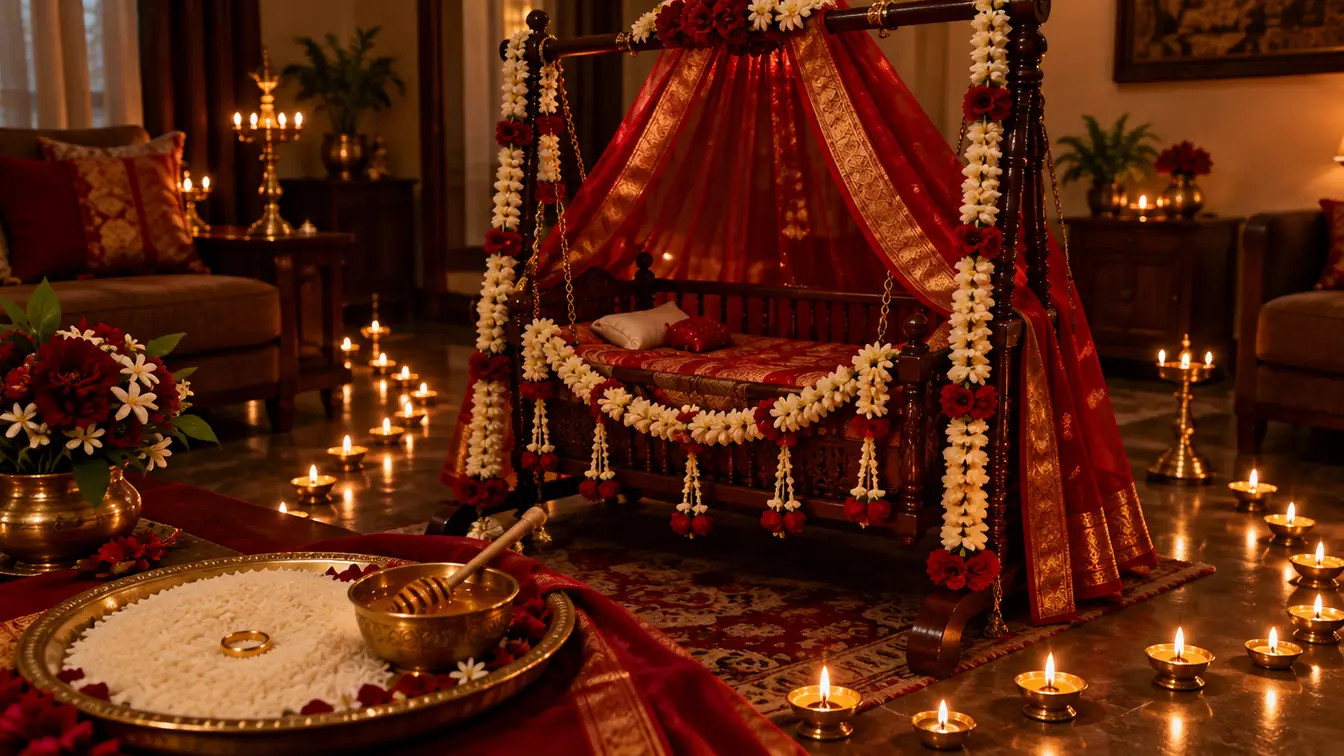
A namkaran ceremony in Fort Worth follows the same tradition as anywhere: the baby's name is given on the tenth to twelfth day after birth, or on a later auspicious date, at home or at a temple, often guided by the syllable of the Moon's nakshatra at birth. Timing is worked out in Central Time.
Key takeaways
- The household ritual texts set the naming soon after birth.
- In the US, parents are normally asked for the baby's name for the birth certificate before leaving the hospital, often long before the tenth day.
- At birth, the Moon sits in one of 27 lunar mansions, or nakshatras, and each is split into four quarters, called padas.
- Most namkarans in Tarrant County happen at home, which is easiest on a newborn and a recovering mother.
- Traditionally the father gives the name, often whispering it into the baby's right ear, and in some families the father's sister has a special role.
The baby is home, the hospital paperwork is done, and the grandparents' flight from India lands on Thursday. For many new parents in Tarrant County, the next question is when and how to hold the naming. A namkaran ceremony in Fort Worth follows the same old tradition as one in Jaipur or Hyderabad, but the setting is different: a birth certificate already filed, a newborn in a Texas winter or summer, relatives scattered across time zones. This post covers the traditional day, holding it at home or at a temple, who attends, and how the nakshatra syllable guides the name.
Which day is traditional?
The household ritual texts set the naming soon after birth. The Paraskara Grihya Sutra's section on the name-giving rite says that on the tenth day the father, having fed Brahmins, gives the child a name, and it even gives rules for the sound of the name: for a boy two or four syllables, for a girl an odd number ending in a long "a" sound. Many families today count the end of the ten-day birth observance and hold the ceremony on the eleventh or twelfth day. Others wait until the mother has recovered, a priest is available or relatives can travel, and choose a later auspicious date in the first months.
Any of these is a sincere choice. Tradition values the act of naming with care more than an exact day.
The paperwork usually comes first
In the US, parents are normally asked for the baby's name for the birth certificate before leaving the hospital, often long before the tenth day. Families handle this in different ways. Some choose the name early and use the namkaran to bless and announce it. Some give a legal name at the hospital and a separate nakshatra name at the ceremony, used in prayers and family rituals. If you have not decided on a name before discharge, ask the hospital's birth registrar about your options; later changes go through Texas Vital Statistics.
How the nakshatra syllable works
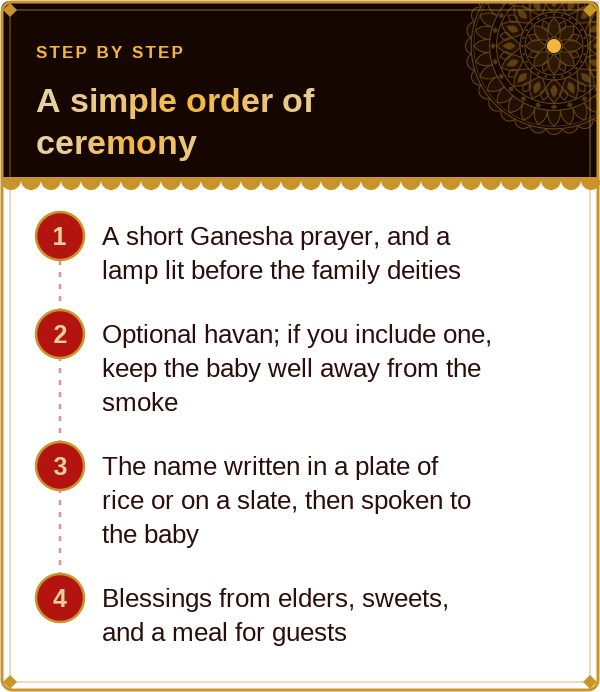
At birth, the Moon sits in one of 27 lunar mansions, or nakshatras, and each is split into four quarters, called padas. Each pada is tied to a starting syllable. A baby born with the Moon in Ashwini, for example, might be given a name starting with Chu, Che, Cho or La, depending on the quarter; one born in Rohini, with O, Va, Vi or Vu. The overview of the nakshatras lists the mansions, and the post on the 27 lunar mansions explains them in plain English.
Because the Moon moves through a pada in roughly six hours, the birth time matters. A birth close to a boundary can change the syllable. Use the time recorded by the hospital; the post on finding your recorded birth time in Fort Worth explains where to look for older records too. A newborn kundli and naming session works out the nakshatra, pada and syllable for you and drafts the baby's first chart.
At home or at the temple?
Most namkarans in Tarrant County happen at home, which is easiest on a newborn and a recovering mother. A priest can come to the house, or guide the family over video, which also lets grandparents in India join live. Some families prefer the temple. The Hindu Temple of Greater Fort Worth on Longvue Avenue serves the west side, and the DFW Hindu Temple in Irving draws families from the mid-cities. Contact the temple directly about ceremonies, priests and booking; schedules and policies are theirs to set. The post on the Fort Worth temple's history has background.

Who attends
Traditionally the father gives the name, often whispering it into the baby's right ear, and in some families the father's sister has a special role. Grandparents bless the child and are often the ones who suggested the name in the first place. Beyond that, keep the guest list short. Newborns are vulnerable to infections, so ask your pediatrician about visitors, ask anyone with a cough or fever to join by video instead, and keep hand-washing easy. A small ceremony followed by a larger celebration later is a common and sensible pattern.
A simple order of ceremony
- A short Ganesha prayer, and a lamp lit before the family deities.
- Optional havan; if you include one, keep the baby well away from the smoke.
- The name written in a plate of rice or on a slate, then spoken to the baby.
- Blessings from elders, sweets, and a meal for guests.
Choosing the muhurta
If you want an auspicious window, it is calculated for Fort Worth in Central Time, usually avoiding the rikta tithis (the fourth, ninth and fourteenth lunar days), the new moon and certain inauspicious periods of the day, and favoring a gentle nakshatra. The muhurta service for auspicious dates does this around your family's real schedule. Families thinking about the sound and number of a name can also look at name numerology for Fort Worth families.
What a name and a syllable cannot do
A name carries love, hope and family memory. It does not set a child's fate, and choosing a syllable outside the tradition does not harm a baby. A good naming is one the parents feel at peace with.
The next milestone, the first taste of solid food, has its own post on choosing an Annaprashan date in Fort Worth. For anything else about the baby's chart, Astrologer and Psychic Vijayram is available by phone, WhatsApp or video.
Common questions
Do we have to use the nakshatra syllable for the baby's name?
No. It is a tradition, not a rule. Many families give a nakshatra name for prayers and rituals and choose a different everyday name for school and paperwork. Some skip the syllable altogether.
Can the namkaran be held months after the birth?
Yes. The classical day is the tenth after birth, but families often wait until the mother has recovered or grandparents arrive, and choose an auspicious date in the first months instead.
Can a priest perform the namkaran over video?
Many priests now guide ceremonies by video, which suits a newborn who should not travel far. Ask the priest or temple what they offer, and keep the baby's routine in mind when choosing the time.
What if we already filed the name on the birth certificate?
That is common in the US. The ceremony can still bless and announce the name already chosen, or add a second, ritual name. Legal changes are a separate process through Texas Vital Statistics.
Related service
Keep reading

Relocating to Fort Worth With Kids in the Middle of a School Year
Moving to Fort Worth astrology for families who transfer mid-school-year: timing for each family member, with enrollment, housing and commute kept first.
Read article →
Why the Clock and Place of Your Call Matter in a Prashna Reading
A prashna reading is cast for the moment and place a question is asked, so a call from Keller and one from Mumbai give different charts. How it works.
Read article →
Hindu Festival Dates for 2027, Worked Out for Tarrant County
Hindu festivals 2027 for Texas families, worked out for Fort Worth in Central Time, month by month, with the nine dates that fall a day before India's.
Read article →Quick answers
Must I stop reading Western horoscopes to see a Vedic astrologer?
No, you do not need to stop reading your Western horoscope to see a Vedic astrologer in Fort Worth. How the two zodiacs differ and why your sign may shift.
Read answer →Do I need my birth certificate for a Vedic reading?
You do not need your birth certificate for a Vedic reading in Fort Worth: date, time and place of birth matter, and a certificate simply confirms the time.
Read answer →Talk to Astrologer and Psychic Vijayram
Tell us what you are facing. If a reading is unlikely to help, you will be told that plainly.