
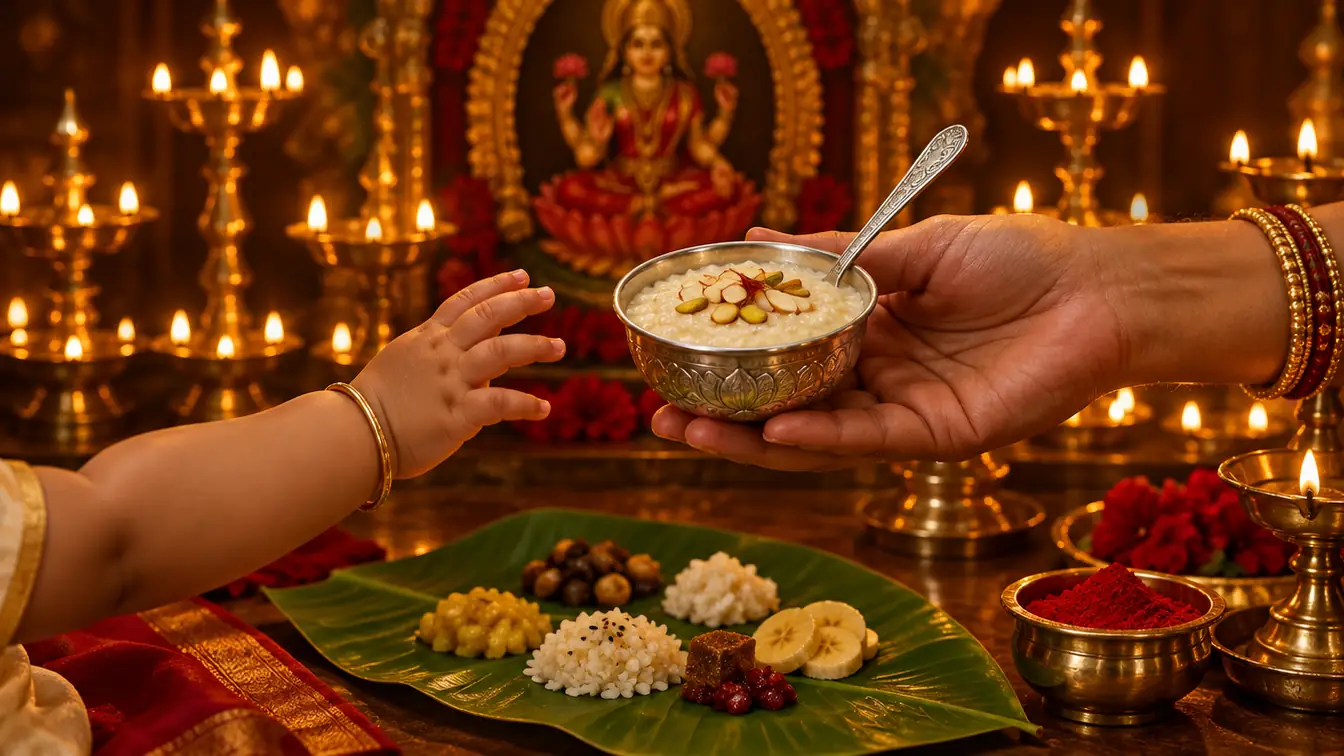
Annaprashan: Choosing a Date for Baby's First Rice in Fort Worth
An annaprashan muhurat is an auspicious window for a baby's first taste of rice. Tradition favors an even month, often the sixth, for boys and an odd month, often the fifth or seventh, for girls. In Fort Worth, check with your pediatrician about starting solids first, then have the window worked out in Central Time.
Key takeaways
- The custom and modern pediatric advice mostly agree, but not on every detail, and the baby's health decides.
- Most traditions favor an even-numbered month for boys, commonly the sixth or eighth, and an odd-numbered month for girls, commonly the fifth or seventh.
- A muhurta is a window picked from the calendar and the sky.
- In many North Indian families the father gives the first taste; in Bengali tradition the maternal uncle often does; in some homes a grandmother leads.
- A home ceremony is simplest for a baby who naps on a schedule.
Somewhere around the middle of a baby's first year, Hindu families mark a moment that is part blessing and part family party: the first taste of solid food. Called annaprashan in much of India, mukhe bhaat in Bengali homes and choroonu in Kerala, it is usually built around rice, ghee and a little sweetness. Many parents in Tarrant County want an annaprashan muhurat, an auspicious window for the ceremony. This post covers the traditional ages, how a window is chosen in Central Time, and why the conversation starts with your pediatrician.
Your pediatrician comes first
The custom and modern pediatric advice mostly agree, but not on every detail, and the baby's health decides. The American Academy of Pediatrics recommends breast milk alone for about the first six months where possible, with other foods introduced once a baby shows readiness, as its guide to starting solid foods explains. Signs of readiness include good head control, sitting with support, interest in food and the ability to move food from a spoon to the back of the mouth.
A few practical points before planning the menu:
- No honey before one year. That rules out giving the baby panchamrit or any sweet made with honey.
- Smooth and cool. Rice kheer or plain rice should be soft, mashed and cooled, with no whole nuts, raisins or hard pieces.
- Allergens. Ask your pediatrician how and when to introduce foods such as dairy, nuts or wheat.
- Babies born early or with medical conditions may need a different timeline; follow the care team's advice.
Traditional ages
Most traditions favor an even-numbered month for boys, commonly the sixth or eighth, and an odd-numbered month for girls, commonly the fifth or seventh. If the fifth month is earlier than your pediatrician advises, families often choose the seventh, or hold the ceremony in the fifth with only a symbolic touch of kheer to the lips and start real solids later. Both honor the tradition. Some families simply hold it for every baby at about six months.
How a muhurta is chosen
A muhurta is a window picked from the calendar and the sky. For annaprashan, guides usually prefer:
- daylight hours, often late morning before the baby's nap;
- a favored weekday, such as Monday, Wednesday, Thursday or Friday;
- a lunar day other than the rikta tithis, the fourth, ninth and fourteenth, and away from the new moon;
- a gentle nakshatra for the Moon, and no clash with the baby's own birth star;
- avoidance of daily inauspicious periods such as Rahu Kaal, which in Fort Worth is calculated from local sunrise.
All of this is calculated for Fort Worth in Central Time, so a window copied from an Indian calendar will be wrong here. The muhurta service for auspicious dates works out options around your real calendar, including when grandparents can join by video from India.
Who feeds the baby
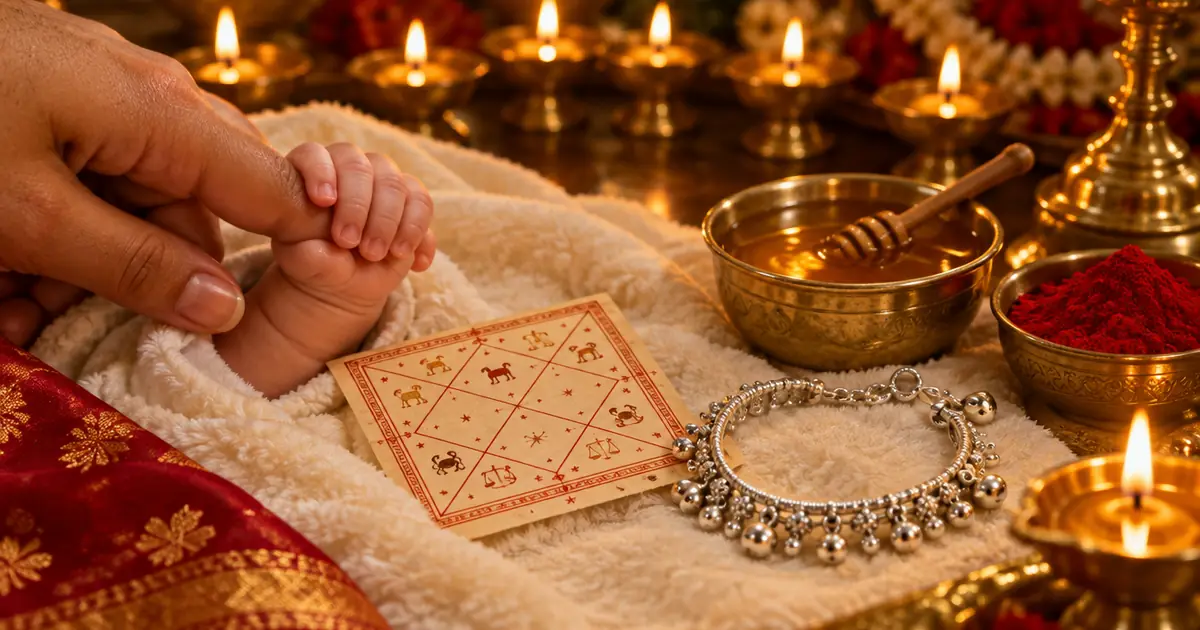
Customs vary. In many North Indian families the father gives the first taste; in Bengali tradition the maternal uncle often does; in some homes a grandmother leads. Usually the baby is dressed in new clothes, seated on a lap facing east, and fed a tiny portion from a clean silver or steel spoon while elders bless the child. Then the adults eat, which is often the bigger event.
At home, at the temple, or somewhere bigger
A home ceremony is simplest for a baby who naps on a schedule. Some families ask a temple to bless the first meal; contact the Hindu Temple of Greater Fort Worth or another temple directly about what they offer. A larger party at a hall can come later in the day. If any of it happens outdoors, remember the season: a July afternoon in Fort Worth is too hot for an infant outside, and spring storms can arrive quickly; see planning outdoor ceremonies around North Texas weather. In winter, keep the guest list short and ask anyone unwell to watch by video.
The object-choosing game
Many families end with a light ritual: a few objects such as a book, a pen, a coin, soil or jewelry are set before the baby, and everyone watches which one is grabbed first. It is fun and it makes a good photograph. It is not a forecast of the child's future, and nobody should take the result seriously. Use items too big to fit in a mouth, and keep them out of reach afterward.
What a muhurta cannot do
An auspicious window honors the moment. It cannot protect a baby's health, decide how well the child will eat or shape the future. Feeding, growth and allergies belong with the pediatrician. Families who want a gentle protective custom alongside the meal can read about nazar customs and care for children, all optional.
The first year's milestones
Annaprashan usually comes a few months after the naming, covered in planning a namkaran ceremony in Tarrant County. If you would like the baby's first chart drawn, with its nakshatra and the syllable for a name, the newborn kundli and naming session with Astrologer and Psychic Vijayram runs by phone, WhatsApp or video.
Common questions
Is the fifth month too early for annaprashan?
It can be. Pediatric guidance generally points to around six months for starting solids, depending on the baby's readiness. If tradition suggests the fifth month, ask your pediatrician; a symbolic touch of kheer to the lips is a common compromise.
Can panchamrit be given at the ceremony?
Not to the baby if it contains honey. Honey is not safe for infants under one year. Keep panchamrit for the adults and offer the baby a smooth, cooled rice kheer or plain mashed rice instead.
Which weekdays are good for annaprashan?
Many muhurta guides favor Monday, Wednesday, Thursday and Friday, in daylight, avoiding the rikta tithis and the new moon. A reader weighs these against your family's schedule rather than insisting on one perfect day.
What is the object-choosing custom?
Some families place a few items, such as a book, a pen, a coin and some soil, in front of the baby and watch which one is picked. It is a light-hearted game, not a prediction. Use objects too large to swallow.
Related service
Keep reading
Diwali Night in Tarrant County: Pradosh Kaal and Sthir Lagna
Diwali puja time in Fort Worth from local sunset: pradosh kaal, the Taurus sthir lagna, the 2026 window, and why 2027 falls a day earlier than in India.
Read article →
The Navratri Color Calendar: What to Wear Each Day in Tarrant County
Navratri in Fort Worth: how the nine-day color list is fixed from the weekday the festival starts, the 2027 sequence, and simple observance for busy homes.
Read article →
Makar Sankranti During Fort Worth Stock Show Season
Makar Sankranti in Fort Worth falls in Stock Show season. The 2027 date in Central Time, why India may differ, and Lohri, Pongal and kites in a Texas winter.
Read article →Quick answers
Must I stop reading Western horoscopes to see a Vedic astrologer?
No, you do not need to stop reading your Western horoscope to see a Vedic astrologer in Fort Worth. How the two zodiacs differ and why your sign may shift.
Read answer →Do I need my birth certificate for a Vedic reading?
You do not need your birth certificate for a Vedic reading in Fort Worth: date, time and place of birth matter, and a certificate simply confirms the time.
Read answer →Talk to Astrologer and Psychic Vijayram
Tell us what you are facing. If a reading is unlikely to help, you will be told that plainly.