
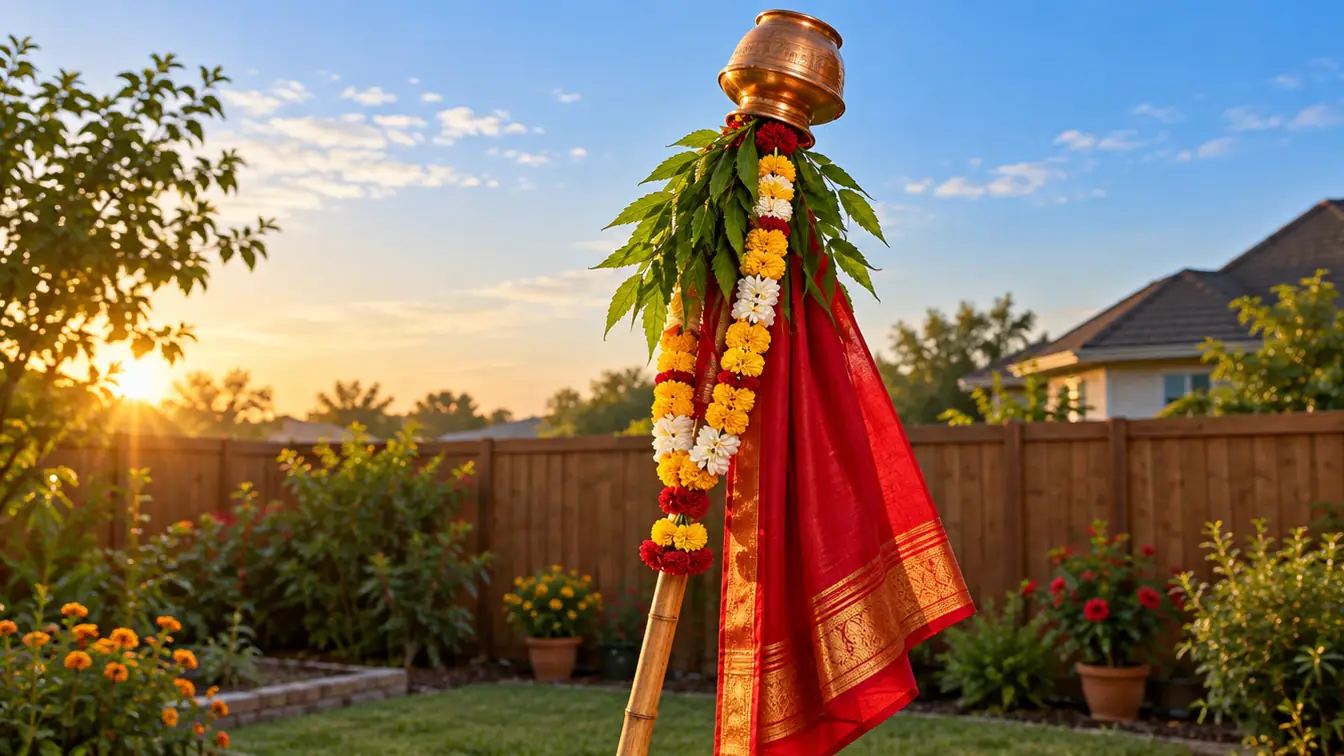
Raising a Gudi in a Tarrant County Backyard: Gudi Padwa at Home
Gudi Padwa in Fort Worth falls on Wednesday 7 April 2027, when the first lunar day of Chaitra is running at local sunrise. Raise the gudi after sunrise, about 7:09 am Central Daylight Time, beside the main door or on a balcony, and take it down before sunset, around 7:53 pm. Ugadi falls on the same day.
Key takeaways
- Gudi Padwa is the Marathi new year, falling on the first lunar day of the bright half of Chaitra in the Hindu lunisolar calendar .
- The new lunar month begins with the new moon at about 6:51 pm on Tuesday 6 April, Central Daylight Time.
- A shorter stick of three or four feet is enough.
- The morning prasad is deliberately bitter: tender neem leaves ground with jaggery, tamarind and a little cumin.
- Few Texas homes face due east, and that is no obstacle.
In Pune or Mumbai, Gudi Padwa morning means gudis rising from balconies up and down every street. In a Fort Worth subdivision it might be the only one on the block, tied to a porch column beside the garage. That is fine. Gudi Padwa in Fort Worth needs only a long stick, a bright cloth, a few leaves and a small pot, and a little thought about Texas wind, homeowners' association rules and the right hours on the clock.
What the gudi is
Gudi Padwa is the Marathi new year, falling on the first lunar day of the bright half of Chaitra in the Hindu lunisolar calendar. The gudi is a victory flag raised at the front of the home. Several stories attach to it: Brahma creating the world on this day, Rama's return to Ayodhya, and the start of the Shalivahana era still used in Indian calendars. Whatever the story your family tells, the gudi says the same thing: a new year has begun, and the household welcomes it.
A traditional gudi has:
- A bamboo stick, or any clean pole about five to six feet long.
- A bright silk or cotton cloth, often yellow, green or saffron with a gold border, tied at the top.
- A sprig of neem leaves and a few mango leaves.
- A garland of flowers, usually marigold, and a garland of sugar crystals called gathi.
- A copper or silver pot, upturned over the top of the stick.

The 2027 date and hours in Fort Worth
The new lunar month begins with the new moon at about 6:51 pm on Tuesday 6 April, Central Daylight Time. By Wednesday's sunrise the first lunar day is running, so Gudi Padwa is Wednesday 7 April 2027. Calculated with the Naval Observatory's sunrise and sunset method for central Fort Worth:
| Moment | Time (CDT) | What to do |
|---|---|---|
| Sunrise | About 7:09 am | Bathe, then raise the gudi soon after |
| Morning | Before you leave for work | A short puja and the neem prasad |
| Sunset | About 7:53 pm | Take the gudi down before this |
It is a Wednesday, so for most households the gudi goes up before the school run and comes down after work, with a slightly longer celebration saved for the weekend.
Raising it in a Tarrant County backyard
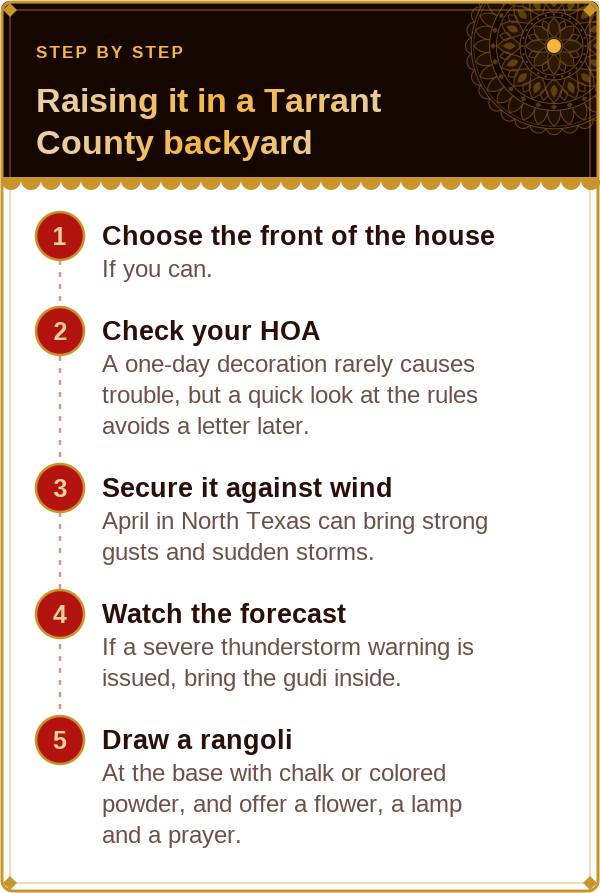
- Choose the front of the house if you can. Tradition puts the gudi beside the main entrance, usually on the right, so passers-by see it. A front porch column, a fence post or a sturdy planter all work.
- Check your HOA. A one-day decoration rarely causes trouble, but a quick look at the rules avoids a letter later.
- Secure it against wind. April in North Texas can bring strong gusts and sudden storms. Tie the pole at two points with cord or zip ties, or stand it in a weighted pot of soil, and lean it slightly outward as is traditional, never toward a walkway.
- Watch the forecast. If a severe thunderstorm warning is issued, bring the gudi inside. A gudi in the living room is better than a flying pole. Our post on a prayer routine for Texas storm season has more on spring weather.
- Draw a rangoli at the base with chalk or colored powder, and offer a flower, a lamp and a prayer.
On an apartment balcony
A shorter stick of three or four feet is enough. Tie it to the inside of the railing so nothing can fall to the balconies below, and skip anything heavy at the top: a small steel or copper cup is plenty. If balconies are restricted, a gudi in a front window keeps the custom. Our post on a prayer corner in a small Fort Worth apartment covers other small-space ideas.
Neem, jaggery and a bitter-sweet year
The morning prasad is deliberately bitter: tender neem leaves ground with jaggery, tamarind and a little cumin. Telugu and Kannada families make Ugadi pachadi, which combines six tastes, sweet, bitter, sour, salty, hot and tangy, for the mix of experiences a year brings. Indian grocers around the Metroplex often stock fresh or dried neem near the festival.
Many families also listen to the new year's almanac being read, a custom called panchanga shravanam. Treat it as a reflective tradition rather than a forecast for your own life.
The entrance and the new year
In vastu, the main entrance is treated as the mouth of the house, and new-year mornings are a natural time to clean the threshold, hang a fresh toran of mango leaves and clear the clutter that collects by the door. Few Texas homes face due east, and that is no obstacle. A vastu consultation for a Fort Worth home can suggest simple, inexpensive ways to make the entrance welcoming in whatever direction it faces. The same morning opens the spring Navratri; our Navratri color calendar covers the autumn festival in detail.
What a gudi cannot do
A gudi greets the new year; it does not decide how the year will go. If you would like the year's festival dates or a new-year chart review prepared for your family, Astrologer and Psychic Vijayram works by phone, WhatsApp or video, in Central Time.
Common questions
Which side of the door does the gudi go on?
Traditionally on the right side of the main entrance, high enough to be seen from the street. If that spot is impractical, a window or balcony on the front of the home works. Visibility and care matter more than an exact position.
Can I raise a gudi in an apartment?
Yes. Use a shorter stick, tie it firmly to the balcony railing on the inside so nothing can fall, and check your lease or ask the office if you are unsure. A gudi in a front window is a fine alternative where balconies are off-limits.
Is Ugadi on the same day?
Yes. In 2027, Ugadi for Telugu and Kannada families, Gudi Padwa for Marathi families and the start of Chaitra Navratri all fall on Wednesday 7 April in Fort Worth. Many Tarrant County neighbors will be celebrating the same morning in different ways.
What happens to the gudi afterward?
Take it down before sunset with a short prayer. The sugar-crystal garland is shared as prasad, the neem and mango leaves can go into the compost, and the cloth and kalash are washed and kept for next year.
Related service

Keep reading

Four Prahar Pujas on Maha Shivaratri, Timed for Fort Worth
Maha Shivaratri prahar times for Fort Worth on 6 March 2027: four night pujas from sunset to sunrise in Central Time, the nishita window, and fasting safely.
Read article →
Clay Murtis and Bucket Visarjan: Ganesh Chaturthi in Tarrant County
Ganesh Chaturthi in Fort Worth on 3 September 2027: choosing an unbaked clay murti, a simple puja in a small home, and immersion in a bucket at home.
Read article →
Akshaya Tritiya Gold Buying in Tarrant County: Custom and Budget
Akshaya Tritiya in Fort Worth falls on Saturday 8 May 2027. Why families buy gold or start ventures that day, how to stay within budget, and why giving counts.
Read article →Quick answers
Must I stop reading Western horoscopes to see a Vedic astrologer?
No, you do not need to stop reading your Western horoscope to see a Vedic astrologer in Fort Worth. How the two zodiacs differ and why your sign may shift.
Read answer →Do I need my birth certificate for a Vedic reading?
You do not need your birth certificate for a Vedic reading in Fort Worth: date, time and place of birth matter, and a certificate simply confirms the time.
Read answer →Talk to Astrologer and Psychic Vijayram
Tell us what you are facing. If a reading is unlikely to help, you will be told that plainly.