
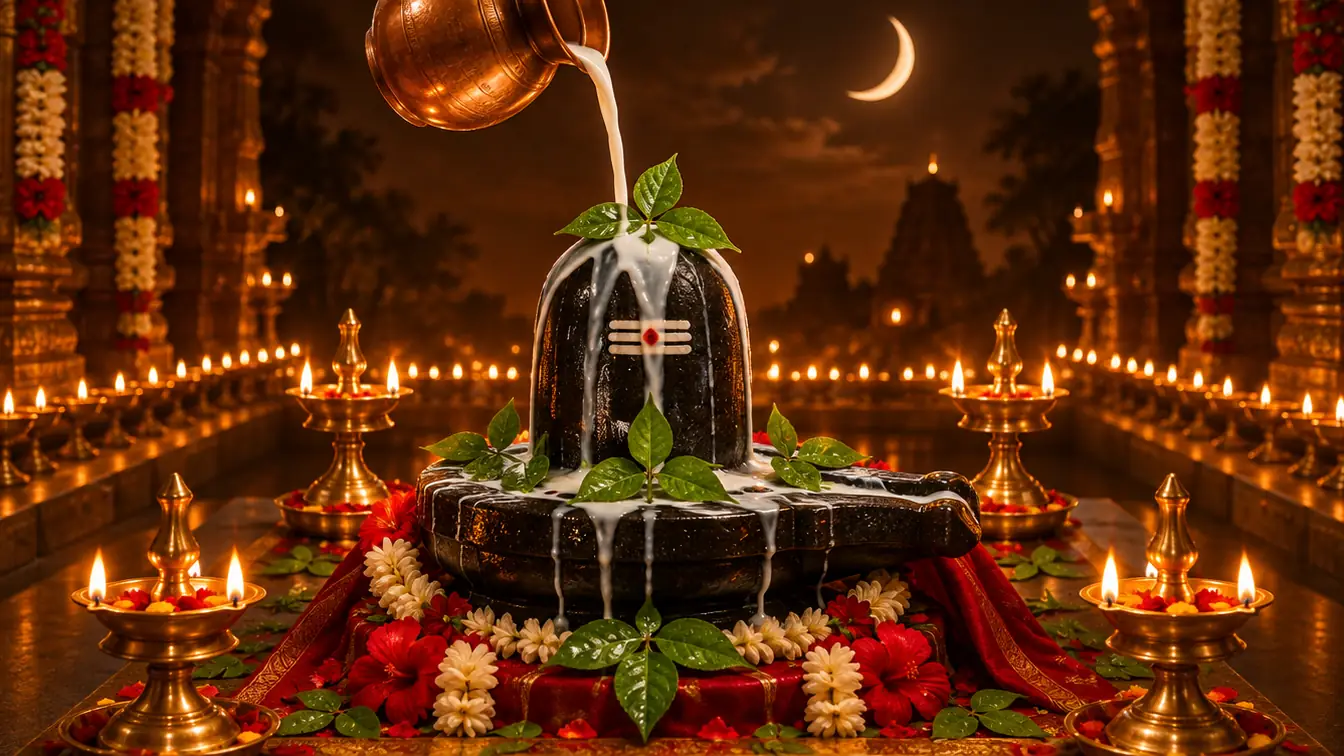
Four Prahar Pujas on Maha Shivaratri, Timed for Fort Worth
The Maha Shivaratri prahar times for Fort Worth in 2027, on the night of Saturday 6 March, are roughly 6:30 to 9:35 pm, 9:35 pm to 12:40 am, 12:40 to 3:45 am, and 3:45 to 6:49 am Central Standard Time. The nishita window, the holiest part of the night, runs from about 12:15 to 1:04 am.
Key takeaways
- Fasting is part of Shivaratri for many people, but health comes first, and the tradition agrees.
- The night is measured from Fort Worth's own sunset to the next sunrise, using the Naval Observatory's sunrise and sunset method .
- Shivaratri falls on the fourteenth lunar day of the dark half of the month (Magha in the southern and western reckoning, Phalguna in the northern one).
- In vastu, the northeast corner of the home is called Ishana, which is also one of the names of Shiva, and it is the traditional place for worship.
- Many temples hold special Shivaratri pujas through the night, and some schedule prahar pujas at set hours.
Maha Shivaratri is a night festival. Its worship is divided into four watches, or prahars, running from sunset to sunrise, and the times on the clock depend entirely on where you are. In 2027 the festival falls on the night of Saturday 6 March in Fort Worth, which makes it easier for working families to keep. Below are the Maha Shivaratri prahar times for Fort Worth, how they are worked out, and how to fast without putting your health at risk.
Before you plan a fast
Fasting is part of Shivaratri for many people, but health comes first, and the tradition agrees. Please speak to your doctor before fasting if you:
- have diabetes, low blood pressure, a heart or kidney condition, or a history of an eating disorder;
- are pregnant or breastfeeding;
- take medication that has to be taken with food or at set times;
- are older, or recovering from an illness or surgery.
Never stop or skip a prescribed medication to keep a fast. A fruit-and-milk fast, a single simple meal, or simply giving up one food is fully traditional. MedlinePlus, from the National Library of Medicine, has reliable health information on most conditions if you want to read up before talking to your doctor. If you feel faint, confused or unwell during a fast, eat, drink and seek medical help; in an emergency call emergency services.
One more practical point: after an all-night vigil, do not drive until you have slept. Drowsy driving on I-20 or Loop 820 on Sunday morning is a real danger.
The four prahars in Fort Worth, 2027
The night is measured from Fort Worth's own sunset to the next sunrise, using the Naval Observatory's sunrise and sunset method. On 6 March sunset comes at about 6:30 pm and sunrise on Sunday 7 March at about 6:49 am, both Central Standard Time (the clocks do not change until 14 March). That night of about twelve hours and nineteen minutes, divided by four, gives prahars just over three hours long:
| Prahar | Approximate time (CST) | Traditional abhishekam |
|---|---|---|
| First | 6:30 to 9:35 pm | Milk |
| Second | 9:35 pm to 12:40 am | Curd (yogurt) |
| Third | 12:40 to 3:45 am | Ghee |
| Fourth | 3:45 to 6:49 am | Honey |
The offerings listed follow a common custom; families and temples vary, and water alone is always acceptable. The nishita kaal, the eighth of the night's fifteen divisions and the most sacred stretch, runs from about 12:15 to 1:04 am on Sunday, straddling the second and third prahars.
Why the date and times move each year
Shivaratri falls on the fourteenth lunar day of the dark half of the month (Magha in the southern and western reckoning, Phalguna in the northern one). Because the lunar day must be running at local midnight, Fort Worth can occasionally differ from India by a night. Prahar lengths change too: a Shivaratri in mid-February has a longer night and longer prahars than one in early March. These times are calculated for 2027 only; for another year they have to be worked out afresh.
A home plan for a working family
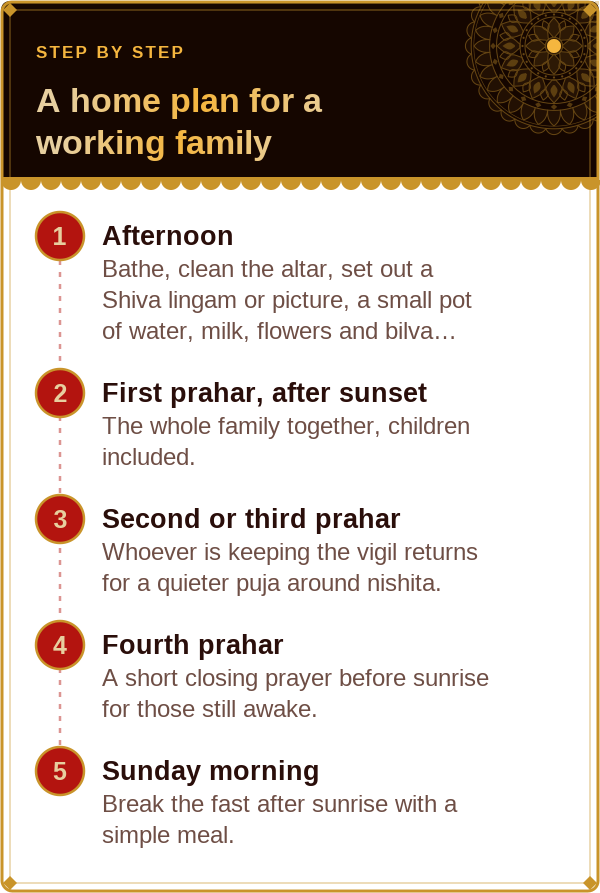
- Afternoon: bathe, clean the altar, set out a Shiva lingam or picture, a small pot of water, milk, flowers and bilva leaves if you have them.
- First prahar, after sunset: the whole family together, children included. Pour water or milk over the lingam while chanting "Om Namah Shivaya", offer flowers, and do aarti.
- Second or third prahar: whoever is keeping the vigil returns for a quieter puja around nishita. Some recite the Mahamrityunjaya mantra; our personal mantra guidance can help you choose a practice you can sustain.
- Fourth prahar: a short closing prayer before sunrise for those still awake.
- Sunday morning: break the fast after sunrise with a simple meal. Our post on fasting and its safe limits has gentle ways to end a fast.
Where to set up the altar
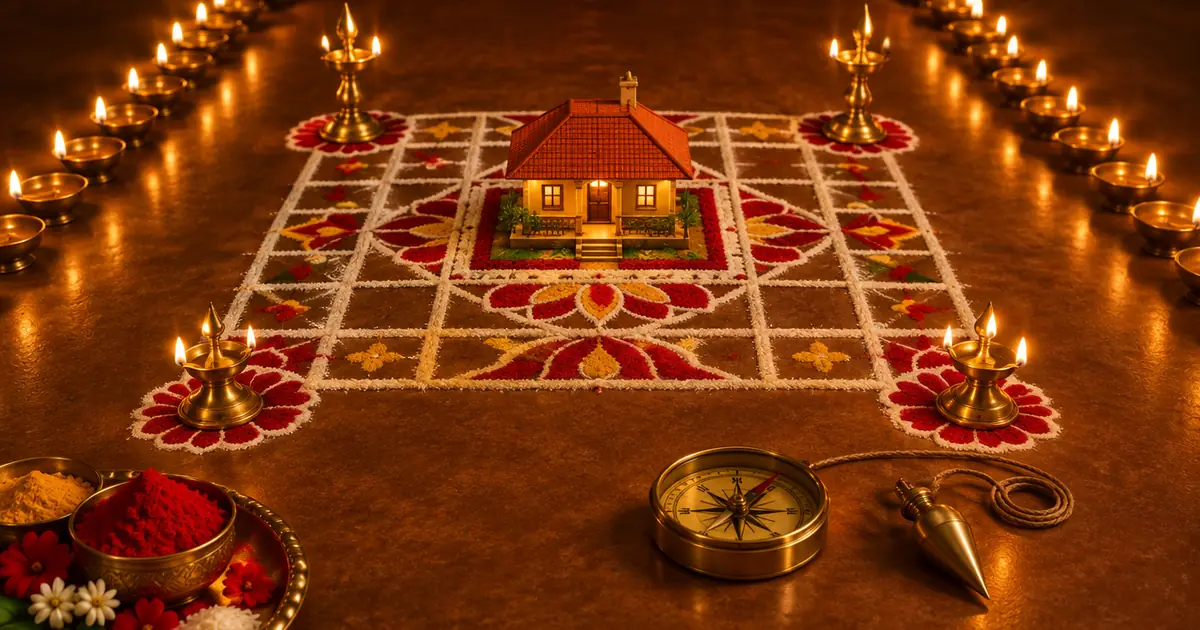
In vastu, the northeast corner of the home is called Ishana, which is also one of the names of Shiva, and it is the traditional place for worship. In many Tarrant County floor plans the northeast is a garage or a closet, and that is fine: any clean, quiet spot works, and the northeast corner of a single room will do. A vastu consultation for your Fort Worth home can suggest a practical place for a permanent prayer shelf, and our post on a prayer corner in a small apartment covers tight spaces.
Temple or home
Many temples hold special Shivaratri pujas through the night, and some schedule prahar pujas at set hours. Check your temple's own announcements, since its times may follow its own almanac and differ by a few minutes from these.
What the night cannot do: fasting and vigil are devotion, not a remedy for illness or a way to earn a particular result. If you would like this year's or next year's prahar times worked out for your household, Astrologer and Psychic Vijayram can prepare them by phone, WhatsApp or video.
Common questions
Why is Shivaratri on Saturday 6 March in 2027?
Shivaratri is kept on the night when the fourteenth lunar day of the waning Moon is running at nishita, the middle of the night. In Fort Worth that lunar day runs from just after midnight on Saturday until about 2:16 am on Sunday, so it covers Saturday night's nishita in full.
Do I have to stay awake all night?
No. A full vigil is a devotion some people choose, not a requirement. Many families keep the first prahar together and one more later, then rest. A sincere puja in one prahar is a real observance.
Can I drink water during the Shivaratri fast?
Yes. Most traditions allow water, and many allow fruit and milk. A waterless fast is an optional extra discipline that is not suitable for anyone with a health condition, anyone pregnant, older people or anyone taking regular medication.
What can I offer if I cannot find bilva leaves?
Indian grocers in the Metroplex sometimes stock fresh or dried bilva around the festival. If not, water, milk, a flower or simply the mantra are fully acceptable. The tradition values devotion over any single item.
Related service
Keep reading
Clay Murtis and Bucket Visarjan: Ganesh Chaturthi in Tarrant County
Ganesh Chaturthi in Fort Worth on 3 September 2027: choosing an unbaked clay murti, a simple puja in a small home, and immersion in a bucket at home.
Read article →
Akshaya Tritiya Gold Buying in Tarrant County: Custom and Budget
Akshaya Tritiya in Fort Worth falls on Saturday 8 May 2027. Why families buy gold or start ventures that day, how to stay within budget, and why giving counts.
Read article →
Janmashtami Midnight Timing in Central Time
Janmashtami in Fort Worth in 2027: why Krishna's midnight falls near 1:30 am on a Central Daylight clock, which night counts, and how temples set their times.
Read article →Quick answers
Must I stop reading Western horoscopes to see a Vedic astrologer?
No, you do not need to stop reading your Western horoscope to see a Vedic astrologer in Fort Worth. How the two zodiacs differ and why your sign may shift.
Read answer →Do I need my birth certificate for a Vedic reading?
You do not need your birth certificate for a Vedic reading in Fort Worth: date, time and place of birth matter, and a certificate simply confirms the time.
Read answer →Talk to Astrologer and Psychic Vijayram
Tell us what you are facing. If a reading is unlikely to help, you will be told that plainly.